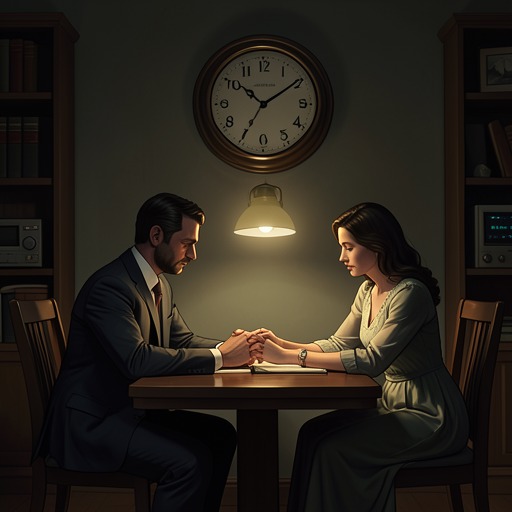
Henry and Clare win the Illinois lottery
The Time Traveler's WifeHenry and Clare win the Illinois Lottery when Henry uses foreknowledge of the next day’s newspaper to secure an eight-million-dollar prize. The episode makes his ability to cross time materially useful, but it does not let the money arrive as an uncomplicated fantasy: Clare sees the win as cheating, while Henry treats the ticket as a choice she can accept, destroy, or give away. Its decisive change is not simply financial. The windfall offers Clare the larger studio she wants, and the couple move from moral discomfort into a spontaneous celebration together.
The ticket and the winning numbers
The scene begins with the couple at home, watching a waterbed commercial on Channel 9. Henry has carried the television into the living room, where it sits on the coffee table; after he adjusts an extension cord and the set’s knobs, the Illinois Lottery logo appears. He hands Clare a small white ticket and tells her to hold it. The televised drawing produces the numbers 43, 2, 26, 51, 10, and 11, matching the ticket. The officials congratulate the winners: Henry and Clare have won eight million dollars.
Henry clicks off the television and calls it a neat trick. His understatement makes the extraordinary result seem almost casual, but Clare does not respond with uncomplicated joy. She immediately objects that the win is not real in the morally meaningful sense: the ticket is genuine, but Henry knew the outcome in advance. The distinction between a valid ticket and an unfair advantage becomes the scene’s central tension.
Foreknowledge as advantage—and burden
Henry explains that he obtained the winning numbers by looking them up in the next day’s Tribune. His knowledge of the future lets him turn a lottery, ordinarily defined by uncertainty, into a predictable source of money. For someone who has generally tried to live like a normal person, choosing to exploit that knowledge is a departure. The prize is therefore both a practical resource and evidence of how profoundly his condition can alter ordinary rules when he decides to use it.
Clare’s objection is not that the State of Illinois will refuse the ticket. Henry insists that it is legitimate as a piece of paper and that the state will issue a real check. Her concern is that they have won by knowing what chance is supposed to conceal. Henry answers with sarcasm, pointing out that ordinary ticket buyers also accept the lottery’s unfairness toward those who lose; but his teasing does not settle the question for her. Their disagreement remains a real difference in judgment, not a technical dispute over whether the ticket can be cashed.
Henry demonstrates that he is willing to let Clare’s discomfort determine what happens next. He disappears into the kitchen and returns with matches, then lights one and holds the ticket toward the flame. Clare cries out, and he blows it out before the ticket is destroyed. One corner is singed. The near-destruction turns an abstract ethical hesitation into a tangible decision: the money is available, but Henry will not force Clare to take it.
A choice tied to Clare’s work
Henry tells Clare that the couple could win the lottery repeatedly if they wanted to, and that they can simply forget this ticket if she objects. He leaves the ticket in her hands, saying she can cash it or give it to the first homeless person she meets. Clare protests that he cannot leave her with such a huge responsibility. The choice is generous but weighty: Henry has made the opportunity, while Clare must decide what it means for them to accept it.
The motive becomes clear when Clare recognizes what the money could provide. Henry has set aside his dedication to living normally so she can have a studio large enough to roller-skate across. The prize is not introduced as abstract wealth; it is connected to the space Clare wants for her art. That purpose changes how she understands his act. Her initial sense that the win is wrong gives way to the recognition that Henry is trying to give her room to work, and she feels that she has been ungrateful.
The scene leaves the ethical tension visible rather than resolving it through a claim that foreknowledge makes the money deserved. Clare’s acceptance follows from understanding Henry’s intention and the practical good the money can do, not from forgetting how he obtained the numbers. The ticket remains a choice between keeping the advantage and refusing it, and Henry allows Clare to make that choice.
From hesitation to shared celebration
After the uncomfortable silence that follows, the conversation turns to what is on television; Henry answers that there is snow. He then laughs, pulls Clare up from the couch, and proposes that they spend their ill-gotten gains. His joking description acknowledges the moral unease even as he moves the couple toward celebration. He suggests buying Gomez and Charisse a car for their wedding, extending the imagined benefit beyond their own household. Clare counters that the pair gave them wine glasses, and the exchange brings the moment back to their social ties and the give-and-take of friendship.
They go down the stairs and out onto Belle Plaine Avenue on a spring night. Henry takes Clare’s hand; she raises their joined hands, and he twirls her. They dance along the street without music, accompanied by passing cars and their laughter. Cherry blossoms fall like snow beneath the trees. The image echoes the snow on the television moments earlier, but transforms it: the screen’s artificial winter gives way to blossoms falling around the couple as they move together outdoors.
The ending does not erase Clare’s reservations or turn the lottery into a simple reward. Instead, the scene converts a private windfall and an awkward moral choice into a shared act of possibility: a future studio for Clare, a possible wedding gift for friends, and a spontaneous dance. Henry’s temporal advantage has changed their material prospects, but the intimate decision about what to do with it belongs to both of them.