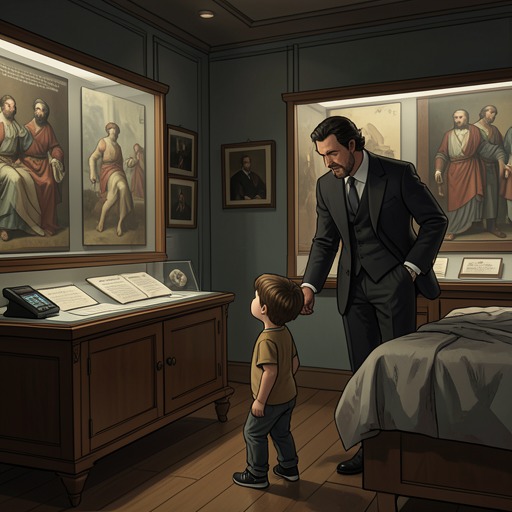
Henry teaches his younger self to pickpocket
The Time Traveler's WifeHenry teaches his younger self to pickpocket during a time-displaced afternoon at the Art Institute of Chicago, turning a lesson in survival into an encounter with the loneliness of being his own guide. The excursion moves from practical theft to self-recognition: the child succeeds at the older Henry’s instruction, then sees their shared face and scar in a hotel mirror and learns that his teacher is himself.
Setting and Premise
On a sunny day in June 1973, Henry, then twenty-seven, stands outside the Art Institute with his nine-year-old self. The child has arrived from the following Wednesday; the older Henry has come from 1990. Their mismatched temporal positions make the outing possible: Henry can take his younger self through an afternoon whose lessons he already knows, while the child experiences them as new.
The museum is not simply a place to admire art. Henry frames the visit as training in how to survive, and the contrast between the institution’s celebrated collection and the practical business of stealing gives the scene its peculiar character. The younger boy wants to look at the art and asks to see St. George; the older one insists that he needs to learn to steal. They cross Michigan Avenue past the bronze lions and enter together, though Henry instructs the child to act as if they do not know each other.
The Lesson in Practice
Henry sets out specific rules before they begin: the child should keep close enough to observe, avoid drawing attention to their connection, and quickly pocket anything the older Henry passes him. The instruction is procedural as well as moral in its bluntness. The child asks whether he could simply beg instead, but Henry counters that begging is tedious and can lead to being taken away by the police. He presents pickpocketing as a skill required by their unusual circumstances, not as a game devised for the museum.
In the crowded Impressionist rooms, Henry demonstrates how a theft can be concealed inside an apparently ordinary encounter. He bumps into a distracted mother, catches her as she pitches forward, apologizes, and removes her wallet while she is focused on her child. He later has the boy inspect the wallet, which contains twenty-two dollars and change, and directs him to return it to a guard as something supposedly found on the floor. The episode makes the lesson concrete: distraction, an offered explanation, and a quick hand work together, while the stolen money is not the point of this particular demonstration.
Henry next lifts a wallet from a man lecturing his companion about Vincent van Gogh, then passes it to the child. He continues with additional methods, including taking a wallet from a suit’s inside breast pocket, shielding a hand in a purse, distracting someone, and approaching a backpack. As Henry’s demonstrations accumulate, the boy becomes less tense and begins to enjoy watching. But when the older Henry finally tells him to try, the child freezes; observation has not yet made the action easy.
The First Successful Theft
The older Henry lets the boy choose where to make his attempt. They go to the line for the museum’s garden restaurant, where a tall man in a brown suit stands ahead of them. The wallet is not readily visible. Instead of reaching for it unseen, the child approaches with one of the wallets Henry has already stolen, holds it out, and softly asks whether it belongs to the man, claiming it was on the floor.
The man checks his own pocket, finds his wallet still there, and begins explaining that the child ought to take the found wallet to security because it contains quite a bit of cash. While the man is leaning toward him, the boy reaches beneath the jacket and steals the man’s wallet. The older Henry follows behind and takes it from the child, who has succeeded by using the harmless appearance of returning property as a distraction. The two leave the museum, make their way to the Artists Cafe, and treat themselves to milkshakes and French fries. Afterwards they put the wallets in a mailbox without the cash, closing the lesson with an act that separates the money they keep from the wallets they return.
The child’s verdict is brief but important: looking at himself in the bathroom mirror, he says he did it. Henry praises him. The triumph is real, but it does not settle what the outing has exposed. The boy has learned how to perform the older Henry’s skill; he has not yet learned why their companionship can never be ordinary or permanent.
Recognition in the Mirror
In the ornate bathroom at the Palmer House, the older Henry and the child look at themselves side by side. The older man is taller, more muscular, and shaves; the boy is slender and ungainly. But their dark hair, eyes, and ears match. Henry pulls his hair back to show the scar from the accident, and the child instinctively repeats the gesture, touching the corresponding scar on his own forehead. The physical resemblance makes visible what the older Henry has been withholding: the mentor is not an emissary from a wider society but the child’s own future self.
The recognition arrives as a moment of wonder for the younger Henry and as memory for the older one. He remembers having imagined that time travelers belonged to a vast fellowship, and that his teacher had been sent to prepare him for inclusion. The realization that there may be no others turns a hoped-for community into isolation. The older Henry says he has never met any other time travelers; a tear gathers in the boy’s eye, and the older self holds him for a long time. Their doubled body offers companionship, but it cannot provide the larger company the child had imagined.
Departure and Significance
Later, they order hot chocolate through room service and watch Johnny Carson. The boy falls asleep with the light on. When the older Henry looks over, the child has vanished back to his old room in his father’s apartment, where he lands sleepily beside his bed. The separation occurs without a farewell between the two versions of Henry. The older one turns off the television and bedside lamp, hears the street noises of 1973 through the open window, and lies alone on the hard hotel bed, desolate and still unable to understand.
The episode makes the time traveler’s identity both the answer to the child’s question and a source of grief. Henry can teach himself to navigate danger by passing knowledge backward through his own life, but that circular instruction cannot create a community beyond himself. The mirror turns a successful initiation into a recognition scene: the boy gains a skill and discovers the person who will teach it to him, while the older Henry watches the old wonder and loneliness recur from the other side. The lesson’s title-like promise of survival therefore remains double-edged: the child has learned how to get by, but he has also glimpsed the isolation built into his future.