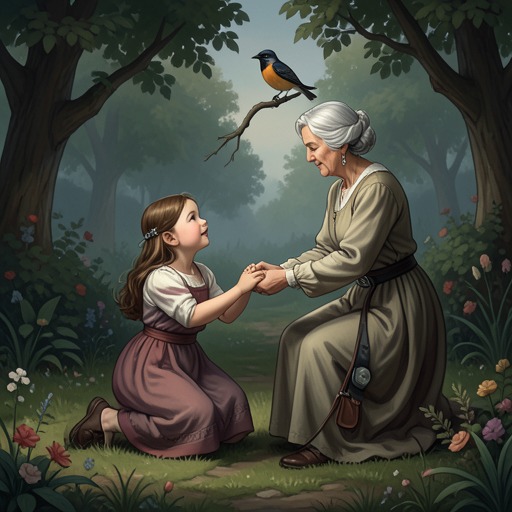
Henry tells Clare her mother will die of ovarian cancer
The Time Traveler's WifeHenry tells Clare that her mother will die of ovarian cancer after a careless slip makes Clare suspect that Lucille is already dead. The scene in the Reading Room transforms Henry’s time-travel knowledge from a private burden into a painful disclosure: he cannot spare Clare the truth without lying to her, and telling it means giving a fifteen-year-old a loss that lies ahead in her own chronology.
Setting and the Accidental Disclosure
On Monday, February 2, 1987, Clare is fifteen and Henry is thirty-eight. Clare returns from school to find him waiting in the Reading Room, the small basement space she has arranged beside the furnace room. She has made the room a plausible place to spend time, left the back door unlocked for him, and brought him food. Henry has been staying there in a makeshift nest of pillows and blankets, reading old magazines under her desk lamp. The improvised refuge reflects the circumstances of their relationship: Clare’s household is not told why she spends so much time in the basement, while Henry depends on her practical care during his visits.
During a conversation about Lucille, Henry refers to her in the past tense. Clare catches the change immediately and asks why he said “was.” Her question exposes more than a verbal mistake. Henry knows something about her mother’s future that Clare does not, and his grammar has made that hidden knowledge visible. In the scene, their different ages and experiences do not give them equal standing: Henry has the information, but Clare recognizes that he has withheld it.
Fear, Evasion, and Disclosure
Henry understands the scale of his mistake. He wishes he could return to his own present, consult Clare there, and learn what to say to her younger self. Instead, he must respond without that guidance. He knows Clare is especially alert to small lies and sees that refusing to answer will leave her panicked, while denying what she suspects will not persuade her. Telling the truth, meanwhile, risks distressing her and altering how she understands her relationship with her mother.
Clare presses him to explain. Henry tells her that knowing things ahead can damage a life, but she refuses the half-disclosure: he cannot raise the subject and then leave her to guess. When he continues to withhold an answer, Clare becomes certain that Lucille has killed herself—the outcome she has feared most. Her conclusion is not what Henry knows to be true, but it brings the hidden future into the conversation as an immediate terror.
Henry first denies that Lucille has killed herself, yet Clare cannot tell whether he is being truthful. Faced with the distress his silence has intensified, he gives her the actual diagnosis: ovarian cancer. Clare responds with relief that her mother has not died by suicide and then cries. The relief does not cancel the grief contained in the news; it comes from learning that her worst fear is false, even as Henry confirms that another serious loss awaits.
Foreknowledge and Care
The episode makes Henry’s knowledge an ethical problem rather than a simple advantage. He cannot change the information he carries into Clare’s earlier life, and his attempt to avoid harming her through silence instead encourages her to imagine the death she fears. His first obligation in the moment is not to explain the mechanics of what he knows, but to decide whether withholding the truth is kinder than disclosing it. The exchange offers no painless choice: foreknowledge can wound before the event itself, while concealment can isolate the person it is meant to protect.
Clare’s insistence that Henry cannot half-tell her what he knows establishes a central tension in their bond. She does not accept reassurance that contradicts the clue she has heard; she wants him to take responsibility for what his words have revealed. Henry’s eventual answer is quiet and limited to the fact she has pressed him to disclose. The scene therefore presents honesty not as a way to remove suffering, but as a response to the damage that evasion has already caused.
Consequences and Wider Context
The later account of Henry and Clare’s attempt to have a child echoes the scene’s concern with what can and cannot be known in advance. In spring 1996, after about two years of marriage, they decide to see whether they can have a baby. Clare recalls that Henry is pessimistic about their chances, but she avoids asking whether he has seen a future without a child or whether his time-travel condition might be hereditary. She is drawn instead to the imagined baby and to the possibility of becoming a mother. As in the earlier conversation about Lucille, knowledge of a feared future shapes what Clare is willing to ask, even when no answer is given.
That later account belongs to a different decision and does not resolve the 1987 disclosure. It does, however, place the Reading Room scene within the couple’s recurring struggle over foreknowledge: Henry’s access to events outside Clare’s present affects what each can say, and Clare must decide how much she wants to know. In the earlier scene, she demands an answer because the truth has already entered their conversation. The disclosure matters both as a revelation about Lucille’s future and as an instance of the intimate costs of living with knowledge that arrives out of sequence.