Henry’s vasectomy
The Time Traveler's WifeHenry’s vasectomy is an attempt to end the cycle of hope, pregnancy, and loss that has shaped Henry and Clare’s efforts to have a child. Henry arranges the procedure in secret, convinced that it is a necessary way to protect Clare from further pain; their eventual agreement to stop trying brings a moment of relief, but the outcome reverses their expectation when Clare becomes pregnant again.
Background and the decision
About two years into their marriage, Henry and Clare decide to see whether they can have a baby. Clare is consumed by the possibility of parenthood, imagining the child in intimate, ordinary terms, while avoiding questions about Henry’s pessimism and the possibility that his time-travel condition could be inherited or affect a child. Her hopes are shadowed by what she does not want to know. The narrative later places this longing beside repeated pregnancy losses, making the decision about a vasectomy the consequence of accumulated grief rather than a detached medical choice.
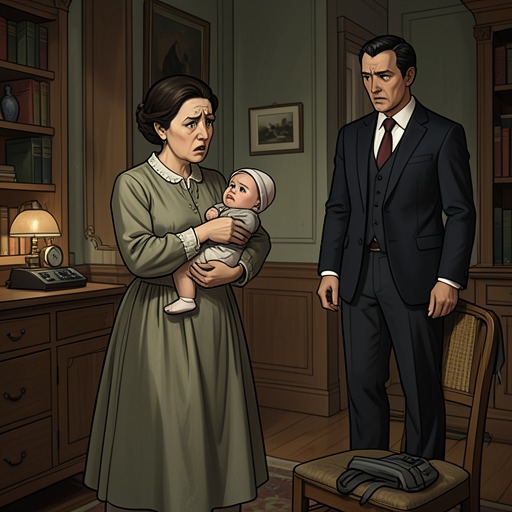
By June 2000, Henry has decided to undergo the procedure without telling Clare. He waits for an appointment with Dr. Robert Gonsalez on Sheridan Road, near Diversey, and describes the choice to himself as necessary: he believes it will spare Clare further anguish after their attempts to have a baby. His private reasoning is inseparable from an imagined memory of Clare’s distress and from his conviction that he has no choice. He hopes that one day she will understand, but his plan to keep it secret means she has not been included in the decision as he makes it.
The interrupted appointment
The procedure does not take place as planned during this visit. When the doctor’s office calls Henry, he is abruptly displaced in time and arrives alone in the Meadow, in late autumn, wearing clothes from the mid-1980s. He finds the clothes box and changes into its contents, then wonders whether to wait for Clare, who is about fifteen or sixteen in this period. He turns toward the orchard instead. Clare runs after him, bringing the present-day medical decision into contact with one of their earlier encounters.
The displacement makes the attempt at control especially precarious. Henry has come to the appointment believing he can make a decisive intervention in their future, but his condition takes him away at the threshold of the procedure. The action is postponed rather than resolved: Henry must return to the question after he has again crossed time, while the strain of repeated attempts to conceive remains between the couple.
Clare learns what Henry intended
Later, Henry and Clare discuss the appointment. Clare has inferred what he was going to do from a note he left about the doctor’s visit. She tells him he may go ahead with the vasectomy if he has to, and says she cannot continue trying for a baby. Her response is not an accusation or a celebration of Henry’s choice. It is a relinquishment shared between them: they agree to stop, and Henry thanks her.
That exchange changes the meaning of the secret plan. Henry had imagined the procedure as something he must do for Clare, without her knowledge; now Clare knows and gives her consent to ending their attempts. The decision remains painful, but it is no longer only Henry’s private act of protection. The scene’s subdued agreement gives the couple a brief way out of the cycle of trying and fearing another loss.
The reversal and its consequences
For the first time in many months, Henry and Clare resume making love without worrying about the consequences. Four weeks later, Henry has had the vasectomy, and Clare discovers that she is pregnant for the sixth time. The pregnancy arrives after they have agreed to stop trying and after Henry has acted on that agreement. The narrative’s chronology of displacement adds another complication: Henry later recognizes that the conception occurred during an earlier encounter in 1996, when the couple were desperately trying for a child, even though Clare learns of the pregnancy weeks after that night in her own present.
The pregnancy is not presented as proof that their earlier losses are resolved or that Henry’s fears were unfounded. It renews uncertainty instead. Clare describes pregnancy as life under water, isolated with the baby in a slow, distant world. The child’s birth also becomes a fraught medical scene: when Clare is in labor, Dr. Montague notes that the baby’s heartbeat is very fast and that the girl is frightened. These later events show how the couple’s desire for a child remains bound to risk and fear, rather than being settled by the vasectomy or the pregnancy that follows it.
Significance
Henry’s vasectomy is a turning point in the couple’s effort to balance their desire for a child against the suffering of repeated loss and the uncertainty surrounding Henry’s inherited condition. His first impulse is to manage that uncertainty alone, framing secrecy as care. Clare’s discovery and consent expose the emotional cost of this approach: protection cannot remove the need to face the decision together.
The episode also makes the novel’s unstable chronology part of the reproductive dilemma. Henry’s attempt to prevent a future pregnancy is interrupted by time displacement, and the couple’s agreement to stop trying is followed by a pregnancy connected to a past encounter. The procedure therefore marks neither a clean ending nor a reliable boundary. It records an exhausted choice, a moment of mutual surrender, and the return of hope in a form that neither can control.