Newberry Library
The Time Traveler's WifeThe Newberry Library is the workplace around which Henry DeTamble’s professional life is organized and a recurring setting where his involuntary time travel interrupts ordinary routines. Its Special Collections reading room brings Henry and Clare Abshire face to face in 1991, although Clare already knows him from childhood and he does not yet recognize her. Elsewhere in the building, the stacks, staff rooms, and the forbidding Cage turn his recurring disappearances into practical problems witnessed by colleagues. The library is at once a place of scholarship, a workplace that Henry struggles to keep, and the physical framework against which his unstable relationship with time becomes legible.
Setting and Work
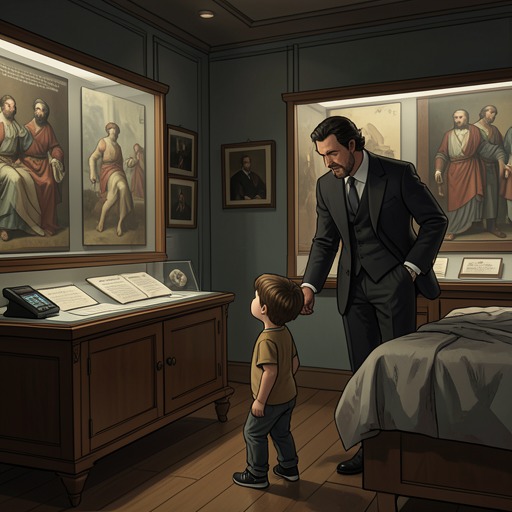
On a clear October morning in 1991, Clare visits the library for the first time to research Kelmscott Press papermaking for an art history paper. After receiving a Reader’s Card, she goes to Special Collections, where the heavy tables, books, tall windows, and autumn light make the room feel to her like a box of beautiful books. Unable to navigate the catalog, she returns to the desk for help. The staff member directs her to Mr. DeTamble, and Clare turns to find Henry.
Henry’s working day occupies a less picturesque side of the institution. He catalogs a donated collection of marbled papers in a small, windowless, humidity-controlled room on the fourth floor. He finds the task dull and, after a night spent drinking and arguing with Ingrid Carmichel, is tired and hung over. His route from the workroom takes him past the Reading Room, where the staff member’s suggestion brings him into Clare’s path. The encounter joins the library’s ordinary circulation of readers and staff to a meeting whose significance is invisible to Henry at first.
The library’s professional life also gives Henry an identity he is determined to preserve. He describes a normal job as part of having a normal life, even though time travel repeatedly puts that employment at risk. He catalogs and reshelves books, tells visitors about the collections, and gives presentations on books and calligraphy. On one occasion, he and a colleague are due to give a calligraphy presentation to a trustee and her lettering club while Henry is trying to get dressed after another displacement. The juxtaposition makes the library’s orderly public work depend on private improvisation.
Clare and Henry’s Reunion
At their first adult encounter in the Special Collections reading room, Henry is startled by Clare’s recognition. He suspects that he may have said or promised something to her in the past, but he cannot place her. Clare identifies herself as someone who knew him when she was a little girl, then invites him to dinner. Henry accepts, stunned by the intensity of her greeting and the gulf between what she remembers and what he knows at that moment.
The scene gives the library more than a role as a backdrop: it is where the couple’s unequal knowledge becomes a visible feature of their relationship. Clare approaches Henry carrying a history that he has not yet experienced from his own point of view. For her, the encounter is a return; for him, it is an unsettling introduction. Their meeting occurs amid the ordinary business of seeking books and assistance, so the emotional reversal emerges through a small workplace exchange rather than a planned reunion.
The building continues to connect Henry’s work and personal life. In conversation with Clare and her friends, he tells stories about the library and its unusual readers. When Charisse asks whether it really holds a book made of human skin, Henry identifies a particular volume, The Chronicles of Nawat Wuzeer Hydembed, reportedly found in the palace of the King of Delhi in 1857, and invites her to see it. The collection thus supplies both the material of Henry’s expertise and a point of social contact beyond his daily duties.
Displacement in the Workplace
Time travel turns familiar work spaces into unstable locations. Henry can disappear while reshelving books and return in the stacks, where his clothing and book cart await him in a neighboring aisle. After one such episode, he dresses, finishes shelving, and cautiously opens the security door, unsure whether the alarms may have been activated. Instead, the Reading Room appears to have continued as usual: staff instruct a new patron, a colleague passes, sunlight enters through the windows, and the clock shows that less than fifteen minutes have elapsed.
The contrast between Henry’s subjective absence and the library’s apparently uninterrupted routine is central to his experience there. On another occasion, he returns to the Newberry after being lost for days in rural Indiana in 1973. Tired, hungry, and without his clothes, he finds himself in a fourth-floor staff men’s room. Colleagues have encountered the missing clothing and, unable to find him, leave it in his office. Their response converts an inexplicable disappearance into a practical workplace accommodation without resolving its cause.
The library’s ordinary timetable is also described through repeated routines. Henry works Tuesday through Saturday, rises at 7:30, makes coffee, runs, showers, and catches the elevated train after breakfast. Clare’s account of the household morning places the library at the far end of this familiar sequence: Henry leaves for work while she returns to bed. The schedule makes his employment seem dependable, even as the episodes in the stacks repeatedly expose how little control he has over whether he can remain at his post.
The Cage and the Cost of Secrecy
A stark stairwell in the Newberry is associated with Henry’s fear of the Cage, the metal enclosure encountered in the library’s back-of-house circulation. It stands apart from the main staircase, with its marble steps and carved balustrades: the other stairwell has no windows, fluorescent lights, cinderblock walls, concrete steps marked with yellow safety strips, and metal doors. Henry identifies the Cage as the source of his unease. The institutional architecture that organizes movement through the building thus contains a space that, for him, is inseparable from vulnerability and confinement.
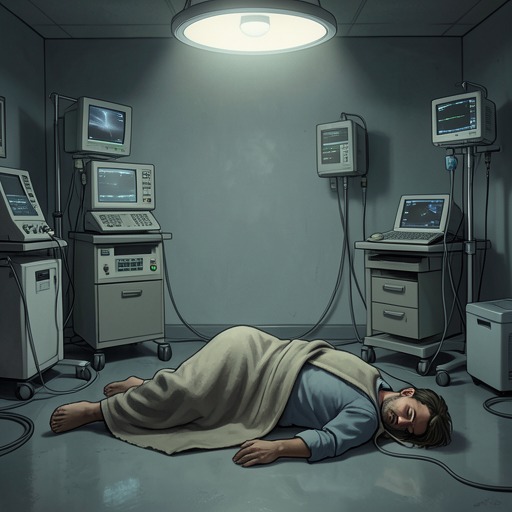
That fear becomes concrete when Henry comes to on a cold floor after-hours, injured and disoriented, inside the Cage. A security guard discovers him when the library opens. Henry is naked, trapped, and unable to offer an explanation that would make the situation intelligible within ordinary workplace procedures. Colleagues and security staff eventually come down to the enclosure; after the guards leave, Henry is alone with Roberto, a colleague he respects and to whom he has repeatedly lied. The Cage forces the secret he has managed through evasion into direct confrontation.
When Henry finally explains himself to his coworkers, he describes his condition as a disease with practical and genetic aspects that he cannot control. His account covers his relationship with Clare, his work with Dr. David Kendrick, causal loops, and the fear and stealing that accompany his attempts to manage displacement. He ends by insisting that a normal job is part of a normal life. The Newberry is therefore not only the setting where his secret threatens to expose him; it is also the community and livelihood he is trying to retain while telling the truth.
Narrative and Institutional Significance
The Newberry’s scenes are shaped by the novel’s shifting dates and narrators. In the 1991 reunion, Clare and Henry recount the same encounter from different positions of knowledge: she arrives remembering their childhood connection, while he has no conscious account of it. The library’s stable rooms help orient the reader, but the people moving through them do not share a single temporal perspective. A return to the same institution can therefore mark a first meeting for one person and a continuation for another.
Its recurring spaces give the time-travel premise a practical scale. A cataloging room, a book cart, clothing left in an office, a security door, and a clock measuring a brief absence show how a condition that exceeds ordinary chronology collides with schedules, collections, and workplace expectations. The library’s preservation of books contrasts with Henry’s inability to remain reliably present: the institution can keep its materials in place, but it cannot keep him there.
The Newberry also links specialized knowledge to lived experience. Henry’s work among rare books lets him explain collections to readers and visitors, while the same stacks become places into which he vanishes and from which he returns without warning. The institution does not cure or explain his condition, but it frames the consequences of his effort to work, speak with colleagues, and maintain a recognizable daily life. Its importance rests in that tension: a stable workplace becomes the repeated stage on which Henry’s instability has to be managed.