Reading Room
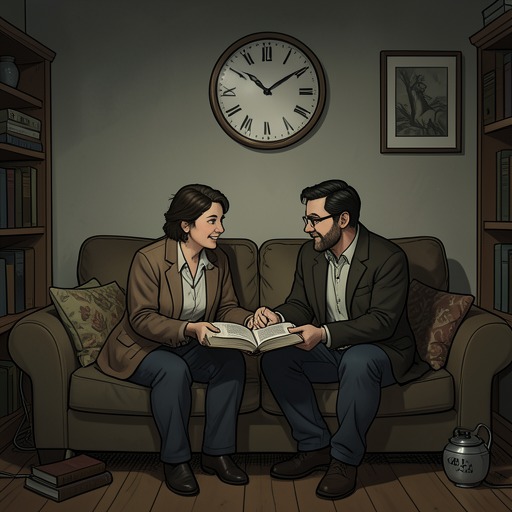
The Time Traveler's WifeThe Reading Room is a basement room in Clare’s family home that serves as a concealed refuge for Henry during his visits to the past. It is both a practical hiding place and a domestic space made intimate by Clare’s care: old books and magazines supply reading, while food, borrowed clothes, and a makeshift bed help Henry remain there unnoticed. The room’s ordinary purpose as storage contrasts with the extraordinary demands placed on it, making its limits part of the story of shelter and waiting.
Setting and Domestic Cover
The Reading Room occupies part of a large basement divided into several rooms. A storage room holds the household’s “useless old books and magazines,” and the furnace is on the other side of a wall; elsewhere in the basement are bicycles. These practical landmarks define a space with little glamour but several possible hiding places. Its name is affectionate and faintly ironic: the room is called a reading room because unwanted printed matter has accumulated there, not because it was designed as a library.
Clare makes Henry’s presence less conspicuous by letting her household believe that she likes spending time in the basement to read. That explanation is plausible because she really does spend time there, but it also gives her a discreet way to conceal a purpose the household does not know. The room’s privacy therefore depends not on a formal lock or a separate dwelling, but on a cover story woven into Clare’s familiar routine.
Henry’s Refuge
When Clare returns from school, Henry is waiting in the room she has prepared next to the furnace room, on the side opposite the bicycles. He has wedged a chair beneath the doorknob, turning an ordinary piece of furniture into a barrier. Clare knocks four times before he lets her in. Inside, Henry has arranged pillows, chair cushions, and blankets into a nest and is reading old magazines by the light of her desk lamp. He wears her father’s old jeans and a plaid flannel shirt, and looks tired and unshaven.
Clare has left the back door unlocked so Henry can enter before she gets home. When she finds him, she brings a tray of food and offers to bring books. These details establish the refuge as something they make together: Henry improvises a place to rest and a way to protect the door, while Clare supplies access, clothing, food, and the possibility of better reading material. The small gestures are consequential because the basement is not his home; it is a room in which he can stay only through Clare’s planning and assistance.
Reading, Scarcity, and Memory
The room’s stock of books and magazines is both its defining feature and a measure of its limitations. During a blizzard, Henry is confined in the basement for three days while schools and workplaces are closed. Clare recalls that the household has little food because Etta was meant to go grocery shopping when the storm arrived. Henry survives on sardines and ramen noodles and reads old Reader’s Digests. The episode gives the room a sharply practical dimension: it offers concealment, but cannot guarantee comfort or supplies when weather cuts off ordinary routines.
In another moment in the room, Henry holds up a 1968 publication and describes it as useful to time travelers who need facts readily available; the surrounding material also identifies old Mad magazines from the 1960s. Such reading matter is not a curated collection, but it gives Henry something to occupy himself with while hidden. The basement’s discarded print becomes an improvised resource, linking his unusual circumstances to the commonplace objects already stored in Clare’s household.
Narrative Significance
The Reading Room turns a basement storage space into a recurring shelter whose safety is partial and carefully maintained. Its furnace-side location, the chair under the doorknob, the four knocks, and the unlocked back door make concealment concrete, while the food tray and borrowed clothes show the care required to sustain it. Yet the blizzard episode marks the boundary of that care: Henry can be sheltered there, but the room’s provisions are finite and its occupants remain subject to conditions beyond their control.
The room also gives the story a domestic scale for Henry’s dislocation. Rather than a purpose-built refuge, he receives a nest assembled from household cushions and blankets, and reading material that was considered useless until it became relevant to his needs. Clare’s cover story makes this private arrangement possible without changing the room’s public identity. The result is a place at once ordinary and exceptional: a basement readers’ room whose significance comes from the fragile refuge Henry and Clare create within it.