Successful experiment with time-traveling mice
The Time Traveler's WifeThe successful experiment with time-traveling mice is a pivotal scientific demonstration: Dr. Kendrick reproduces Henry DeTamble’s involuntary time displacement in an animal, making the condition experimentally observable without explaining why it occurs. In the Newberry Library’s meeting room, a tiny white mouse vanishes under a flashing penlight. The feat offers a cautious prospect of treatment, but its immediate significance lies in what it changes: time travel is no longer only Henry’s baffling personal experience; it has become a phenomenon that research can produce and investigate.
Demonstration at the Newberry
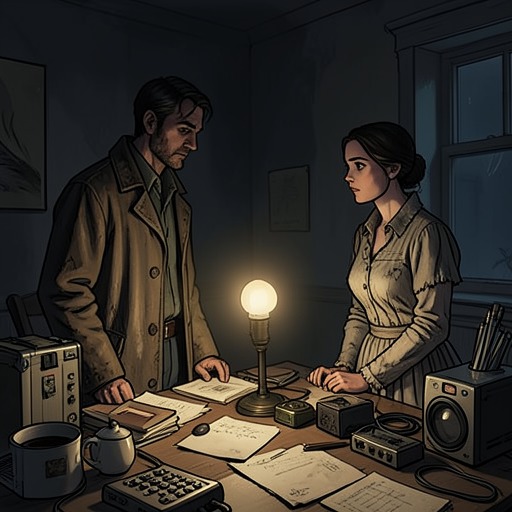
On January 14, 2000, Clare accompanies Henry to meet Kendrick. In a windowless conference room, Kendrick dims the lights and uncovers a cage on a cart. Clare sees bedding, food bowls, a water bottle, an exercise wheel, and a cardboard toilet-paper core before Kendrick reaches in and lifts out a small white mouse. He flashes a penlight rapidly over it; the mouse tenses, then disappears. The demonstration is brief and startlingly concrete: an animal vanishes in front of Henry and Clare, rather than the effect being described as a theory or reported from a distance.
The scene also makes research a shared encounter. Clare watches the disappearance and reacts with amazement; Henry is close enough to crowd around the mouse and, later, to hold it in his cupped hands. The mouse is not merely a laboratory result in the conversation that follows. Its small body and ordinary cage provide an intimate, visible counterpart to a condition that has shaped Henry’s life through sudden, unpredictable departures from the present.
How the experiment was made
Kendrick explains that access to the mouse genome, sequenced by Celera, helped his team locate the four genes they were targeting. The researchers cloned Henry’s genes, used enzymes to remove damaged portions of DNA, and introduced those pieces into mouse embryos at the four-cell-division stage. The successful result therefore connects Henry’s condition to a genetic research program, though the account does not claim that the genetic intervention reveals the condition’s full cause.
Kendrick makes that limit explicit: the team can make the time displacement happen, but still does not know why or how it happens. The experiment establishes a capacity to reproduce the phenomenon, not a complete explanation of it. He describes gene therapy and drugs as the next directions for investigation, keeping the distinction between producing an effect and understanding or treating it clear.
The mouse as a living model
After the demonstration, Kendrick passes the mouse to Henry, who notices its tracking tattoo. The mark identifies it because the animals repeatedly escape and frustrate the Animal Lab technicians. Henry jokes that escape is their Darwinian advantage; when he strokes the mouse, it defecates in his palm. Kendrick calls it intolerant of stress and returns it to the cage, where it flees into the toilet-paper core. These small details make the experimental animal both a monitored subject and an unruly living creature, not an abstract diagram of a gene.
The mouse’s escape also gives Henry’s joke a personal edge: the researchers are trying to study a condition whose defining action is sudden departure. Yet the parallel does not erase the difference between them. The mouse is tracked with a tattoo and observed in a cage; Henry’s own episodes have left him naked, without possessions, and at times in police custody. The model makes the condition experimentally accessible, but the scene keeps its consequences for a person in view.
Consequences and unresolved stakes
The experiment changes the practical horizon for Henry and Clare. When they return home, Clare calls Dr. Montague to discuss immunosuppressants and internal bleeding, and Montague asks her to come in the following week while she researches the possibilities. Clare tells Henry that trying is worthwhile. Henry answers by recalling that many laboratory mouse mothers died before researchers worked out how to make the procedure succeed. Their exchange frames treatment as a genuine possibility, but one burdened by risk and uncertainty rather than guaranteed by the demonstration.
That uncertainty matters because the research is connected to the possibility that Alba could inherit Henry’s time-displacement condition. The mouse experiment supplies a way to investigate a biological basis and contemplate intervention, but it does not promise prevention or cure. Its importance is therefore double: it gives the family a scientific route toward action, while making clear that the route begins with a phenomenon Kendrick can induce but cannot yet explain. The mouse vanishes in an instant; the questions it leaves behind remain.