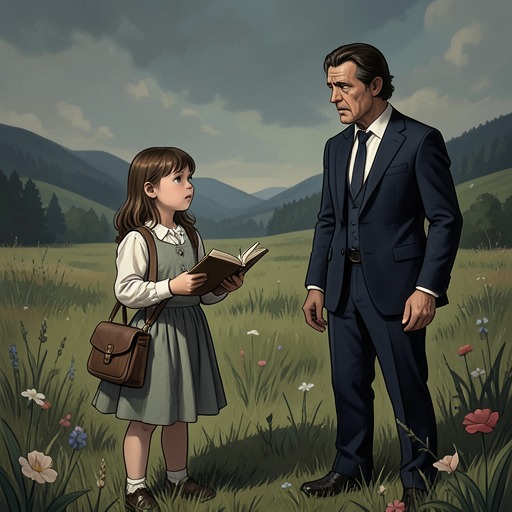
The Ouija board spells out that Henry will be Clare’s husband
The Time Traveler's WifeThe Ouija board episode is an early disclosure of the future at the heart of Clare and Henry’s relationship: at a fifth-grade sleepover, a battered game spells out the name of the man who will become Clare’s husband. The revelation comes not as a solemn prophecy but as a sequence of questions among school friends, leaving the eleven-year-old embarrassed, puzzled, and unsettled by a future she cannot yet comprehend.
Setting and Circumstances
On Saturday, May 14, 1983, Clare is almost twelve and attending a birthday sleepover for Mary Christina Heppworth with girls from St. Basil’s. After dinner, the group watches a video and gathers in Mary Christina’s pink bedroom. They have brought sleeping bags, but pile them against a wall while sitting on the bed and floor. Nancy has peppermint schnapps, and the girls play Truth or Dare before losing interest: they have known one another since kindergarten and already know much of one another’s business.
Mary Christina proposes the Ouija board as the next game. Its box is battered, and the plastic pointer has lost its clear window. The ordinary, slightly worn object is treated as exciting because the girls consider the game cool, but the scene also gives it a small store of mystery. Clare remembers Henry once telling her about a séance in which the medium suffered a medical emergency. That recollection does not settle whether the board is genuine; it frames Clare’s uncertainty as the game moves from familiar teasing toward a question whose answer concerns her own future.
The Board’s Answers
The group understands that players must ask their questions aloud. Mary Christina and Helen try first, asking whether a boy likes Mary Christina and whether any boys like Helen. Their turn establishes the game’s social atmosphere: the questions are about crushes, the other girls watch, and the answers prompt giggling and commentary. When the board is handed to Clare and Ruth, Clare says she does not know what to ask, though she privately has many questions, including whether her mother will be all right and whether Henry is a real person.
Ruth proposes asking which boys like Clare. Clare says no, but puts her fingers on the pointer. She and Ruth try to touch it lightly and avoid pushing. It begins to move, first in circles, then to H, and then more quickly through E, N, R, and Y. The name is recognizable to Clare, but it is not yet a clear explanation: the other girls do not know who Henry is, and Clare herself says she does not know much about him.
The group changes players, and Nancy asks who Henry is while Laura joins her. At first the board does not move. Then it spells H, U, S, B, A, N, D. The other girls look toward Clare, making the answer public within the room even though its meaning remains beyond her. She protests that she is only eleven and unmarried. When Laura wonders who Henry is, Clare can only say that perhaps he is someone she has not met yet. The board’s startling answer is thus not a complete account of the future: it supplies a name and a relationship, but no explanation of how either will come to pass.
Clare’s Response and the Future Marriage
Clare’s response moves between denial and recognition. She initially treats Henry’s name as something she cannot explain, and after the board identifies him as her husband she repeats the word to herself in disbelief. The other girls are unsettled too, but the revelation attaches itself particularly to Clare: the group’s laughter and curiosity turn into attention directed at her, while she has no knowledge with which to answer their questions.
The scene establishes a sharp difference between what the reader is told and what Clare can know at this age. The board announces a future marriage before Clare understands Henry’s identity or has experienced the relationship as an adult. Its answer is specific enough to foreshadow their eventual marriage, yet radically incomplete from her point of view. In this way, a children’s party game becomes an early point in the novel’s larger pattern of uneven knowledge: the future can appear in advance, while its people and consequences remain unknown to the person receiving the message.
Narrative Significance
The episode is narrated by Clare as a memory of her childhood, so the scene joins immediate bewilderment to a future the novel’s readers can recognize. The timing matters: Clare is nearly twelve, and the marriage prediction arrives amid questions about crushes and schoolmates, not through an authoritative explanation. That mismatch makes the answer both startling and difficult to interpret. The group can identify the letters, but cannot place Henry in Clare’s life.
The Ouija board’s message also anticipates the novel’s dislocated chronology. Across the story, Clare and Henry do not encounter their shared life from the same temporal position; information and experience arrive unevenly. Here, the future marriage is named well before Clare can understand it, turning the board’s letters into a compact instance of foreknowledge without comprehension. The scene does not explain the mechanism behind the prediction. Instead, it leaves Clare with the question of who Henry is—and the reader with an early sign that their relationship will be known in fragments before it can be lived in sequence.