Time travelers arrive without their clothes
The Time Traveler's WifeThe rule that time travelers arrive without their clothes makes Henry DeTamble’s involuntary journeys physically precarious rather than merely uncanny. Each displacement leaves him without clothing, money, identification, or belongings, forcing him to find cover and improvise in whatever time and place receives him. The repeated naked arrival gives the novel’s temporal disorder a concrete bodily cost: Henry can cross decades, but cannot bring even the simplest protection with him.
The Rule in Practice
Henry describes himself outside ordinary time as a changed, desperate version of himself: a thief and vagrant who runs, hides, and startles strangers. The transformation is not just a matter of appearance. Without possessions, he must acquire clothing and conceal himself before he can navigate an unfamiliar setting. His journeys may deposit him among crowds or leave him alone in a field, house, car, beach, or school; the circumstances vary, but naked arrival recurs as the condition he must solve first.
The rule also compounds the danger of encounters with authorities. In Chicago, Henry has repeatedly disappeared while in police custody, leaving the police unable to establish who he is or where he lives. He refuses to speak to them, and his outstanding warrants include breaking and entering, shoplifting, resisting arrest, trespassing, indecent exposure, and robbery. He has been arrested seven times, but has vanished before the police could fingerprint or photograph him. His nakedness makes stealth difficult, while the abruptness of his departures prevents an arrest from becoming a stable account of his identity.
Clothing as Improvised Continuity
Henry’s visit to Lighthouse Beach with his ten-year-old daughter, Alba DeTamble, shows the rule shaping a shared journey. Both have arrived through time travel; Henry wears jeans and a white T-shirt stolen from a North Evanston mansion, while Alba wears a pink nightgown taken from an old woman’s clothesline and tied up at the knees because it is too long. They swim, build a sand castle, and buy hot dogs and fries from a vendor, but have neither a blanket nor towels. Their borrowed clothes let them spend an afternoon together in public, though passersby still find the pair an unusual sight.
On the beach, Henry tells Alba how he first met her mother, Clare Abshire: he arrived naked in a meadow, and Clare gave him a beach towel to wear. The story turns the practical problem of arrival into part of the family’s origin story. A towel is not simply an emergency covering; it is the first object Clare gives Henry, and the detail connects the rule to their relationship and to Alba’s own understanding of how her parents met.
Exposure and Its Consequences
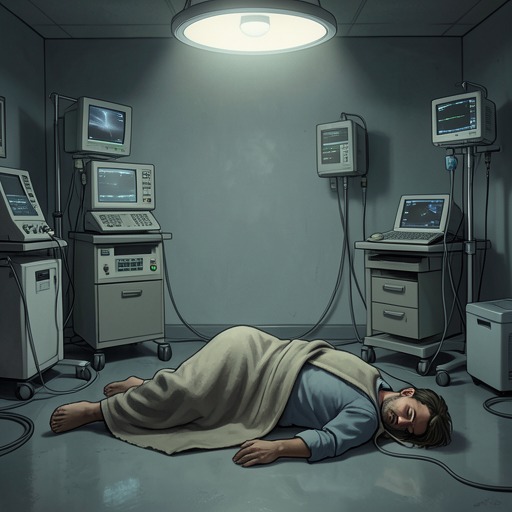
The rule remains in force even when Henry’s destination is familiar. At the Newberry Library, he comes to in darkness on the cold concrete floor of the Cage, a four-story steel structure in the stairwell. He has a swollen area behind his left ear and realizes that he is trapped there after hours. The passage foregrounds his fear of being revealed to his coworkers, and he spends hours pacing, then sitting compactly on the floor, waiting for the library to open. The scene makes the Cage’s steel bars and locked-in setting a stark contrast to the mobility of time travel: Henry has been displaced into his own workplace, yet cannot simply leave or summon what he needs.
After his feet are amputated, Henry’s dependence on others becomes more immediate. When Kimy finds him in bed in the afternoon, he tells her he cannot get up because he has no feet. She brings his wheelchair, but it cannot pass through the bathroom doorway. The moment concerns the consequences of his injuries rather than a new instance of naked arrival; alongside the recurring need to find clothing, it shows how bodily vulnerability persists after a journey ends and how ordinary spaces can obstruct care.
Family, Care, and the Limits of the Rule
Henry and Clare’s domestic life offers a counterpoint to the isolation of his arrivals. Because the kitchen counters and cabinets are too high for Henry in his wheelchair, he teaches Clare to cook from the kitchen table, pushing a cutting board and knife toward her as she dices an onion. They make sauces, lasagna, desserts, eggs, salmon, and pizza; later, Clare cooks dinner by herself, and Henry and Alba encourage her. This episode does not alter the time-travel rule, but it shows the couple adapting their shared life to bodily limits that travel and injury leave behind.
The rule cannot be suspended for affection or familiarity. At Lighthouse Beach, Alba asks why Henry never visits her mother in the future. He answers that he would be there if he could. As Alba stands and brushes sand from her nightgown, she disappears, leaving Henry holding the damp garment and staring at her footprints in the fading light. Her clothing briefly remains where she was, an intimate material trace of a visit that time has abruptly ended. Across Henry’s journeys, the inability to carry anything makes such objects especially resonant: what can be held belongs to the present moment, while the traveler himself may vanish without warning.
Narrative Significance
Naked arrival gives time travel a recurring, practical grammar. Displacement strips Henry of the objects that ordinarily establish safety and social identity, so each episode begins with exposure and the work of becoming inconspicuous. The rule also produces a repeated contrast between extraordinary movement through time and mundane dependence on available clothes, shelter, doors, and other people’s help.
Its consequences change with circumstance. In the police car, nakedness helps make Henry conspicuous and vulnerable to arrest; at Lighthouse Beach, stolen and borrowed clothes enable a father and daughter to share an ordinary afternoon; in the meadow story, Clare’s towel becomes an enduring detail of their first meeting. The rule thus binds the novel’s temporal mechanics to its intimate relationships, making each journey a fresh separation from possessions and a renewed reliance on whoever happens to be there.