Time, let me vanish
The Time Traveler's Wife“Time, let me vanish” is Clare’s appeal to time as she sits down to draw after Henry’s death. The words join an impossible wish—to erase the difference between now and then—to the work of making an image: drawing cannot restore Henry’s presence, but it gives memory a form in which absence and reunion can briefly meet.
The phrase in context
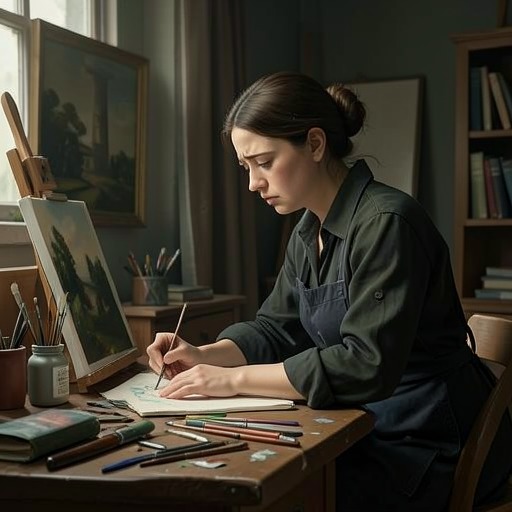
Clare comes to her drawing table because, on waking, she felt an urge to return to art, which she imagines as an assignation with an old lover. Yet the impulse does not immediately become inspiration. She waits for something to come, lays out a sheet of indigo-dyed paper, weighs pieces of white pastel in her palm, and pours coffee. The careful sequence makes the return to art a hesitant act rather than a sudden cure for grief.
The room remains anchored in ordinary time: wind rattles branches, a car splashes through alley slush, and the coffeemaker hisses. Against these sounds, Clare looks toward the back of the house and imagines Henry there in possible everyday scenes—at his desk, playing Scrabble with Alba, reading comics, or making soup. Her wish to “try to feel time revert” arises from these familiar possibilities. The phrase “Time, let me vanish” gives that wish its starkest expression: not simply to remember Henry, but to escape the present that marks him as absent.
Memory, absence, and reunion
Clare recognizes that memory is what holds her in this moment. The phrase follows that recognition, making vanishing a paradoxical desire: she wants to disappear from the time that separates her from Henry, yet it is memory that keeps their connection available. The next thought imagines what such an escape might accomplish: “Then what we separate by our very presence can come together.” The movement from separation to reunion is expressed as a possibility of altered perception, not as a literal change in events.
The appeal also turns the drawing into an answer shaped by its limits. Clare cannot make time run backward, but she can approach Henry through the image forming on the page. The phrase does not claim that grief has ended or that art can undo death. Instead, it marks the distance between the life she remembers and the life she inhabits, while giving that distance a creative purpose.
From invocation to image
After the appeal, Clare stands over the indigo sheet with a white pastel and begins in the center. She measures a half-life-sized figure by its head, groin, and heel, then sketches Henry’s face and body from memory. The figure’s eyes, at first empty, become eyes that regard her, astonished at suddenly existing. Its hair floats across the page, making a static body seem dynamic; points of measurement become stars, and the figure becomes a constellation in an indigo night sky.
That transformation gives the phrase a formal echo. Clare asks time to let her vanish, then makes an image in which Henry seems to emerge from the dark surface through remembered detail. The drawing does not collapse the difference between the living and the dead; it renders the effort to cross that difference visible. “Time, let me vanish” is therefore both a plea for release from separation and the threshold of an act of making: memory cannot restore the past, but it can bring the absent into the field of vision.