A Very Small Shoe
The Time Traveler's Wife“A Very Small Shoe” is the title and central image of Clare’s account of wanting a child with Henry. First appearing in a dream among babies that surface in impossible places, the shoe condenses her hope for lasting family connection; as the story turns from trying to conceive to an unplanned pregnancy and concern for their daughter’s future, that small image acquires the weight of both desire and risk.
The image and Clare’s longing
When Clare and Henry had been married for about two years, they decided to see whether they could have a baby. Clare understood that Henry was not optimistic about their chances, but avoided asking why: she feared that he might have seen a future without a child. She also did not want to consider whether his time-travel difficulties might be hereditary or affect a pregnancy. Her hope was intense enough to crowd out these questions, even as their uncertainty remained present beneath it.
Clare imagined a baby with some of Henry’s features and pictured the ordinary rhythms of infant life. In her dreams, the wish took on strikingly varied forms: she climbed a tree and discovered a very small shoe in a nest, mistook other objects for a baby, or found babies growing at the bottom of a lake. The shoe is the dream’s most concentrated sign of an anticipated child: not the child itself, but evidence of a presence Clare longs to find.
That desire extends beyond imagining a baby. Clare begins noticing infants in everyday settings, including a grocery store, a restaurant, and a movie theater. When a woman lets her hold her three-month-old daughter in a JCPenney fitting room, Clare has to restrain herself from leaping up with the child. The episode makes her longing concrete in a brief encounter with someone else’s baby, while also showing that her wish is not simply an abstract hope about the future.
Clare describes her body as wanting a baby and herself as feeling empty. She wants someone to love who will stay, and hopes that a child will carry something of Henry through the periods when he is absent. The image of the very small shoe thus belongs to a larger fear of loss: a hoped-for child would be a lasting bond with Henry, though Clare also recognizes that this hope is bound up with his unpredictable disappearances.
Henry’s divided hopes
Henry’s account, dated October 2, 1966, presents the same effort to conceive from a different point in time. While time-displaced in Appleton, Wisconsin, he thinks about Clare and their attempts to have a child. He wants to give her a baby and imagines ordinary developmental milestones, from sucking and grasping to walking and talking. He also pictures his father holding a grandchild, imagining that the child might bring his father happiness he feels he has not provided.
Henry’s hopes are not uncomplicated. His reflection places the prospect of parenthood beside his own fractured experience of time: he is in 1966, while his three-year-old self remains elsewhere in Chicago and his mother is still alive. Clare’s desire for a child who will stay therefore meets Henry’s wish to give her a family amid a life in which presence cannot be assumed. The two accounts establish a shared hope, but not an equal relationship to its risks: Clare fears what Henry may know of the future, while Henry’s time-displacement makes the question of inheritance unavoidable.
Pregnancy and uncertainty
The effort to conceive is followed by loss and renewed uncertainty. In October 1997, Henry wakes to find Clare in the aftermath of a miscarriage. The brief scene sharply contrasts with the earlier dreams: the imagined baby that appeared in impossible places has become a pregnancy whose outcome is devastatingly uncertain.
Years later, Henry decides to have a vasectomy without telling Clare. In June 2000, he waits at a medical office on Sheridan Road, having resolved to end his possibility of becoming a father. The decision is a consequential attempt to close the question of further pregnancies, but time displacement disrupts the couple’s shared chronology. When Clare tells him she is pregnant, Henry realizes that the conception occurred during an encounter that belongs to his past but is only weeks behind her. His first startled response gives way to recognition: for Clare, this is an unexpected pregnancy; for Henry, it is connected to the earlier period when they were actively trying to conceive.
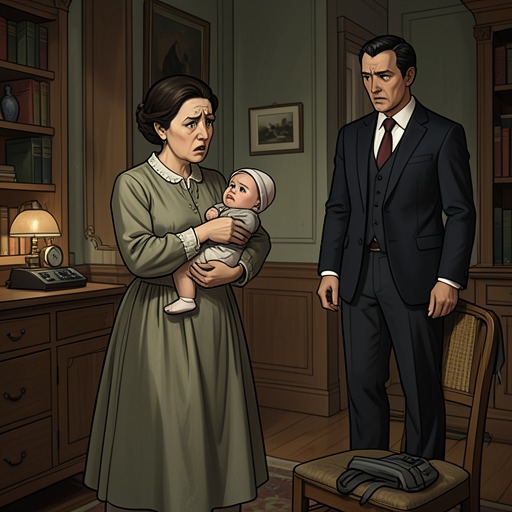
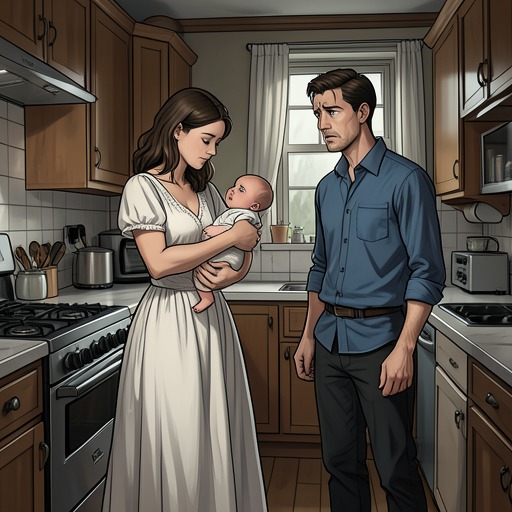
The pregnancy remains a scene of concern rather than uncomplicated fulfillment. During labor, Clare agrees to an epidural as medical staff gather around her; Henry stays beside her, holding her hand. When the fetal monitor indicates that the baby’s heartbeat is very fast, the doctor tells Clare that the baby is scared and asks her to remain calm. The scene locates their hope within medical uncertainty, with Henry present at Clare’s side but unable to make the outcome certain.
A safety net for their daughter
Later, Henry explains that he cannot accept doing nothing to help Alba. He acknowledges that he does not know what will happen and that their fears may come to pass. His concern is not that Alba will necessarily experience her time displacement as a burden: she may love it. But she may instead want an ordinary life, or encounter dangers while displaced and alone.
Henry asks Clare to let him try to provide Alba with a safety net. Clare is distressed, but agrees; Henry embraces her and thanks her. The decision does not resolve the uncertainty around inheritance or guarantee that Alba will need or use the help. It changes the meaning of the earlier wish, however. The small shoe began as an emblem of a child Clare hoped would stay and preserve a part of Henry; after Alba’s birth, the parents’ attention turns toward what they might leave their daughter to help her meet a condition whose consequences they cannot know in advance.
Significance
The expression connects anticipation to the story’s repeated encounters with absence. Clare’s dream translates a desire she struggles to voice directly into a small object discovered in a nest: a sign of a child not yet present. Its delicacy contrasts with the large questions surrounding that hoped-for child—miscarriage, inherited time displacement, and whether the family can protect Alba from experiences beyond their control.
The image does not promise that wanting a child will overcome those risks. Instead, its significance develops as the narrative moves from Clare’s private dreams to the couple’s decisions and, finally, to Henry’s request that Clare let him create a safety net for Alba. A tiny shoe marks the beginning of hope; the later effort to help their daughter shows that hope becoming an obligation of care.