Absence and Lament
The Time Traveler's WifeAbsence and mourning are not merely aftermath in the novel; they exert force on the living, organizing memory, love, and the experience of time. Henry repeatedly returns to his mother’s fatal accident, while his own death makes absence a condition Clare must learn to live with. Across their family, grief appears in different forms: as recurring witness to a past loss, as a presence preserved in objects and art, and as knowledge a child is asked to carry.
The Mother’s Death as a Center of Gravity
On Christmas Eve 1988, Henry sits in the basement Reading Room at Meadowlark House with food Clare has left him and a newspaper that tells him what awaits his younger self that night: at the Get Me High Lounge in Chicago, the twenty-five-year-old Henry will drink until he falls from his bar stool and is taken to Mercy Hospital to have his stomach pumped. It is the nineteenth anniversary of his mother’s death. The calendar date binds the private history of his loss to a recurring crisis in his own life, so that the anniversary is not simply remembered; it is also encountered again through time.
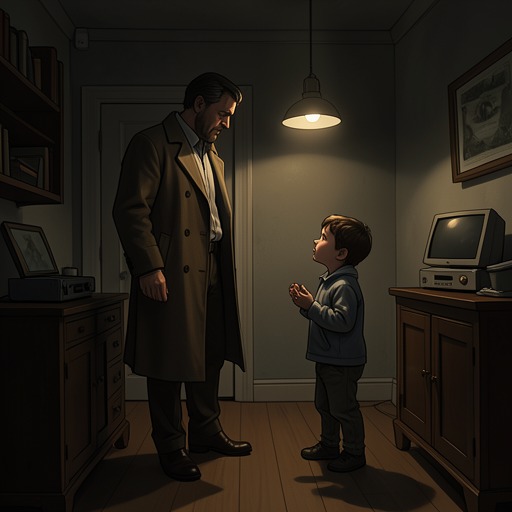
Henry explains the shape of this grief through gravity. His mother’s death, he says, is the pivotal event around which everything else moves. He dreams about it and travels back to it repeatedly, seeing the accident from many positions: in cars, behind bushes, on a bridge, and in a tree. His repeated return turns memory into a form of involuntary witnessing. He has also been present in the aftermath, calling the airport from a nearby gas station so his father can be summoned to the hospital, watching his father arrive, and waiting by the road for his younger self so he can place a blanket around the child’s shoulders. The loss cannot be undone; time travel multiplies Henry’s vantage points on it instead.
The scene of telling makes the grief visible in Henry’s present. As he describes seeing his small, uncomprehending face, he breaks down, and Clare wraps her arms around him while he weeps. His story is at once an account of a past death and a confession of how thoroughly it continues to occupy him. The metaphor of orbit captures that persistence: other events do not replace the loss but circle around it.
Silence, Inherited Knowledge, and Remembrance
The novel also shows grief arriving before a person has the language or readiness to receive it. When Henry accidentally uses the past tense about Lucille, fifteen-year-old Clare notices and asks why. He reassures her that her mother is fine, but the narration makes clear that he is lying. He recognizes the dilemma: refusing to explain will frighten Clare, another lie will not satisfy her, and the truth could alter her relationship with her mother. His slip exposes a future loss before he can decide how to speak of it. Mourning here begins in the gap between what Henry knows and what Clare is prepared to hear.
A different kind of delayed recognition occurs when Clare finds her mother’s poem, “The Garden Under Snow,” among the papers in a desk. A note identifies 1979 as the year her mother lost a baby and attempted suicide; Clare realizes that she now understands what her mother was going through, and stops reading the earlier papers. The poem addressed to Clare offers a surviving trace of her mother’s private feeling. Rather than erasing the difficult history, the discovery gives Clare a way to encounter it through the words her mother left behind.
Henry’s account of his father’s bereavement makes absence feel almost physical: after Henry’s mother dies, her absence, he says, marks every minute of his father’s life and diminishes the dimension of each action. He compares absence to a damaged nerve and a dark bird. These images describe grief as something not present in the ordinary sense yet continually registered, a wound whose effects persist in perception and daily life.
Objects, Waiting, and Life After Henry
Henry’s letter to Clare, written with his death in mind, joins love to the problem of what remains. He describes their love as a thread through a labyrinth and as a net beneath a high-wire walker, something more substantial in the world than he feels himself to be. The images make love a structure that might outlast the person whose life it has supported. At the same time, Henry knows that Clare has waited for him throughout her life, never knowing whether an absence would last ten minutes, ten days, or a month. He asks her not to remain suspended in that waiting after his death, but to carry him within her and live in the world. His plea does not deny the cost of his absences; it names the life Clare has made despite them, including her art and Alba.
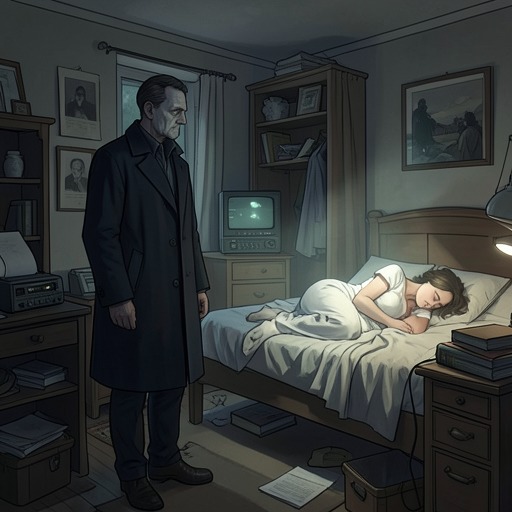
After Henry is gone, grief takes on ordinary, bodily routines. Clare tells Gomez that she is holding one of Henry’s old plaid shirts and breathing in its lingering smell. She walks at two in the morning, once Alba is safely in bed, trying to tire herself enough to sleep. She also conducts conversations with Henry as though he were there, seeing through her eyes and thinking with her brain. The shirt, the walks, and the imagined conversations make mourning a practice of continuing attachment: Henry is absent, but Clare’s daily life still addresses him.
A Child’s Knowledge and the Theme’s Wider Reach
The burden of loss crosses into the next generation through what Alba knows. When Henry asks his ten-year-old daughter how old she was when he died, she answers that she was five. He cannot bear the answer and does not want to hear more about Clare, whom Alba describes as sad. The exchange gives Henry a glimpse of a future in which his death is already part of his daughter’s memory and his wife’s continuing life.
That knowledge reappears in an encounter between seven-year-old Alba and her three-year-old self. The older child runs to Henry, calls him Daddy, and clings to him in tears while Clare and the younger Alba watch. Henry quietly asks the older Alba not to tell her mother that he died; she nods. The request briefly shelters Clare from a truth already known by the child, but the scene cannot make the fact disappear: both versions of Alba are there, and the younger one sees her older self grieving. Across these moments, absence is transmitted not as a single, uniform inheritance but as memory, secrecy, care, and the visible sadness of those left behind.