Chicago Cultural Center
The Time Traveler's WifeThe Chicago Cultural Center hosts the opening of Clare’s long-prepared exhibition and becomes the site of its sudden, intimate rupture: amid the crowd gathered to celebrate her work, Henry vanishes while their young daughter, Alba, calls for her mother.
Exhibition and Setting
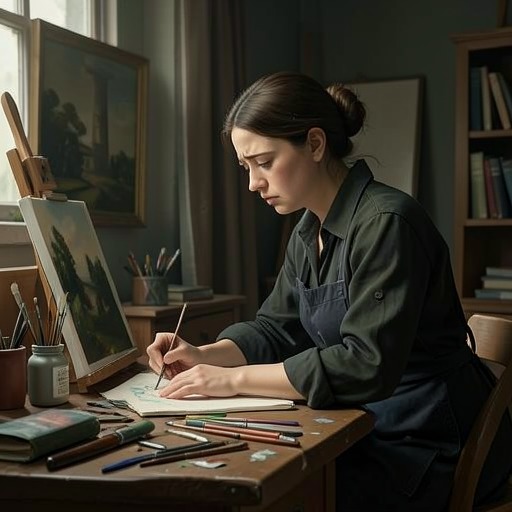
After working without pause for a year, Clare fills the Cultural Center with large bird sculptures made from wire, translucent paper strips, and shellac. Suspended from the high ceiling or set on the floor, the forms catch and transmit light. Some are motorized: a few beat their wings, while two cock skeletons slowly demolish one another in a corner. An eight-foot pigeon presides over the entrance. The exhibition transforms the public interior into a world of delicate, luminous structures and mechanical movement.
The opening is crowded with visitors who circle the works, exclaim over them, and crane their heads toward the birds above. A favorable review in the Tribune has appeared that morning. Clare, exhausted but ecstatic, receives congratulations and flowers, including white roses; more bouquets gather beside the guest book. Her family has driven in from Michigan, and friends and relatives pose together as Charisse takes photographs. The photographs, seen weeks later, will reveal what the celebratory scene partly conceals: dark circles beneath Clare’s eyes and how thin she has become.
Clare’s Public Milestone
The exhibition marks the completion of a year’s concentrated labor and a moment of public recognition for Clare. Its scale and craft are visible in the range of forms, from the towering pigeon at the entrance to the kinetic birds and the paired roosters locked in slow destruction. Visitors’ attention moves upward as well as across the gallery, making the space itself part of the display.
Clare’s happiness is inseparable from fatigue. She smiles through a succession of greetings, and her face hurts from the effort, even as she takes in the finished show and the presence of everyone she knows. The gallery gathers her artistic achievement and family life into one occasion; that convergence makes the interruption that follows especially stark.
Henry’s Disappearance
At the back of the gallery, Henry stands with Alba, who cannot see the exhibition over the tall crowd. He lifts her onto his shoulders, and she bounces there. Later, as Clare’s family disperses and Clare is being introduced to a well-dressed elderly couple by her dealer, Leah Jacobs, Alba asks for her mother. Henry tells her Clare is busy, then bends over and sets Alba down, feeling queasy.
Alba raises her arms and insists that she wants her mother. Henry sits on the floor with his head between his knees, needing to find a place where no one can see him. As Alba pulls his ear, he tells her not to; then he sees his father, Richard, making his way through the crowd. Henry sends Alba toward her grandfather and gives her a small push. She begins to whimper, still calling for her mother. Henry crawls toward Richard, bumps into someone’s legs, and vanishes as Alba screams.
Aftermath and Significance
Clare hears the commotion from across the gallery and tries to make her way through the crowd. Richard has lifted Alba; the people part as he hands her to Clare. Alba wraps her legs around Clare’s waist, buries her face in her shoulder, and holds her around the neck. When Clare asks where her father is, Alba answers that he is gone.
The Cultural Center thus holds two scenes at once: Clare’s visible success and the family’s sudden return to absence. The lively, wing-beating sculptures give the exhibition an image of motion, but Henry’s departure is not an artistic illusion or a movement Clare can follow. The crowd that had gathered to see her work becomes an obstacle between Clare and the moment of his disappearance, while Alba’s repeated call for her mother carries the scene from public celebration into private loss.