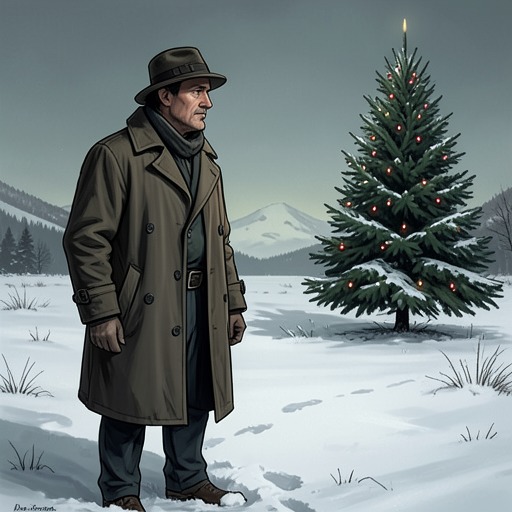
Christmas Eve
The Time Traveler's WifeChristmas Eve is one of the novel’s most charged recurring dates: a family holiday, the anniversary of Henry DeTamble’s mother’s death, and a point where the novel’s interwoven timelines make past and future press against each other. The date gathers the book’s central contrasts—ritual and rupture, intimate memory and public chronology, the desire to remain with loved ones and the limits imposed by time travel. Its significance emerges not from a single episode but from the way distinct Christmas Eves illuminate one another.
A Date Across Interwoven Timelines
The novel presents dated scenes out of chronological sequence, identifying Henry and Clare’s ages as well as the date of each episode. That structure makes Christmas Eve more than a calendar marker. A scene can be future knowledge for one character and painful memory for another, while a later conversation can disclose the meaning of an earlier encounter. The reader must assemble the chronology from these different positions, tracking not only what happened but who knew it, and when.
The pattern is visible in Henry and Clare’s first date at the Newberry Library on October 26, 1991, and in the Christmas Eve passages that place Henry at sharply different ages. In one, he is twenty-four and five across two dates: January 2, 1988, in his adult present, and June 16, 1968, in the past he has entered. Later, on February 9, 2000, Clare wakes beside Henry after he has returned from elsewhere in time. The novel’s dated headings make such shifts legible without making time feel orderly; the same person may encounter a date as anticipation, recollection, or an event already lived through by another version of himself.
The Childhood Loss Behind the Anniversary
On Christmas Eve when Henry is six, he and his mother set out to collect his father from the airport. His father is in Vienna, where the family expects to move, and the plan is to continue together to his grandmother’s home for the holiday. The roads are icy, and his mother, a nervous driver, has agreed to make the airport trip despite disliking both expressways and the drive itself. Henry remembers his own winter clothes and his mother dressed in black, details that hold the family’s ordinary preparations in suspension just before the journey changes their lives.
Their car is struck from behind by a red Corvette whose driver is slightly intoxicated. The impact pushes the family’s 1962 Ford Fairlane toward a slowing truck carrying scrap metal. The collision kills Henry’s mother. The account is delivered years later to Clare rather than staged as a present-tense scene of the crash: the child’s recollection becomes a story he chooses to tell, and Christmas Eve is established as the anniversary around which his grief returns.
Henry’s memories of his mother are not limited to the accident. He recalls hearing her sing Lulu at the Lyric Opera, watching his father play Beethoven, and reciting Blake’s “Tyger, Tyger” at his parents’ party before she lifted and kissed him. These scenes preserve a family life that the anniversary could otherwise reduce to its ending: his mother’s work, his parents’ shared world, and the affection surrounding his childhood remain present in the account. The recollections make the loss personal not by adding detail to the fatal event, but by showing what preceded it and what Henry continues to carry.
The 1988 Christmas Eve and a Story Shared
On December 24, 1988, Henry is at Meadowlark House with Clare. She has left him food in the Reading Room, including roast beef and cheese, milk, an apple, and Christmas cookies. Alongside the meal is a newspaper that makes him confront what will happen that evening to his twenty-five-year-old self in Chicago: he will drink until he collapses and be taken to Mercy Hospital for treatment. The date is also the nineteenth anniversary of his mother’s death. For the older Henry, then forty, the newspaper turns the younger man’s coming crisis into foreknowledge; the day is already painful before the events in Chicago occur in his personal chronology.
Henry sits with his memories and tells Clare about his mother. She is eager for autobiographical details, in part because the list of dates when he visits her is running out and their separation in ordinary time lies ahead. Yet Henry’s account does not give her a route to find him in the present. He offers an intimate history while withholding the names and places that might seem to make it usable as a map. The story is an act of trust and disclosure, but it cannot remove the distance that defines their relationship.
Years later, Henry explains that Clare had seen him travel around Thanksgiving and at Christmas, including his visit to Michigan, when he was watching the accident. He had not told her at the time because the experience was depressing. Clare remembers that an earlier Henry arrived at Meadowlark on Christmas Eve and told her about the accident while upset. What she received then was personal knowledge without the full context: Henry did not identify all the people or places, but the disclosure helped her believe that he was real and gave her a glimpse of his life beyond their meetings. The later conversation reveals that the visit Clare experienced as a past encounter was, for Henry, part of a recurring confrontation with a date he already dreaded.
Family Ritual and the Present Moment
The Christmas Eve of 1991 places Henry within Clare’s family’s established celebration. At dinner, her father gives thanks for family, health, and new friends, as well as for the baby Mark and Sharon are expecting. Henry sits beside Clare and bows his head. His presence is a change within a ritual Clare describes as otherwise like every Christmas Eve she can remember: the familiar table, family members, candles, flowers, silver, and china now include the man whose own memories make the holiday inseparable from loss.
At the family toast, Clare raises happiness and the here and now. Henry answers with a line from Marvell, and Clare briefly wonders how he could know what she is thinking before recognizing the reference as one of his favorite poets. The exchange holds two orientations toward time together: Clare names their present happiness, while the novel’s larger structure makes the moment resonate against Henry’s departures and the dates already inscribed in their shared history. The holiday does not cancel those pressures; it gives them a place at the family table.
Later that night, at 3:14 a.m., Henry quietly enters Clare’s room and joins her in bed. The smallness of the scene matters beside the novel’s larger temporal dislocations: after a family gathering and the memories attached to the date, the couple’s closeness is expressed through a return to the same room and a whispered greeting. Christmas Eve can bring Henry’s absence into focus, but it can also contain a brief, ordinary reunion in the present.
Recurrence, Grief, and What the Date Holds
Christmas Eve repeatedly brings together what the characters experience separately. Henry’s mother’s death belongs to his childhood; the drinking crisis belongs to his younger adult self; his disclosure of the loss occurs in his relationship with Clare; and Clare’s family celebration gives the date another meaning, one grounded in continuity and welcome. The scenes do not erase one another. Instead, their juxtaposition lets a meal, a newspaper, a family toast, or a remembered journey carry more than one temporal and emotional significance.
The structure also complicates the difference between anticipation and recollection. Henry can read about a crisis that his younger self has not yet undergone, while Clare can remember a visit whose importance becomes clearer only when Henry later explains what he was doing. Christmas Eve therefore makes the novel’s time scheme tangible: the date recurs, but not as a simple repetition. Each return changes what the reader and the characters understand, placing private grief beside shared ritual and showing how the past remains active inside moments of apparent celebration.