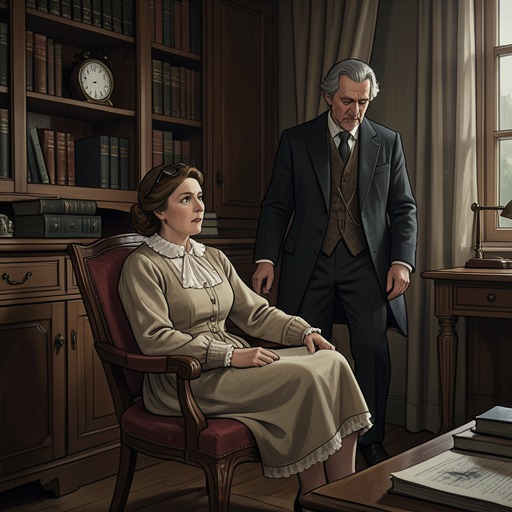
Clare’s list of Henry’s visit dates
The Time Traveler's WifeClare’s list of Henry’s visit dates is her personal chronology of a relationship that cannot follow ordinary time. It gives Clare a way to track Henry’s appearances, but its dates also sharpen the knowledge that each meeting is finite: as the next entry approaches, she counts not simply until his return but toward the years when he will be gone.
A Record of Unequal Time
The list matters because Henry and Clare do not share the same temporal position when they meet. On October 26, 1991, Clare is twenty and Henry is twenty-eight; she encounters him at the Newberry Library without having been there before, and the dated entries of their story place that reunion within a chronology she has been keeping. The list is not a neutral calendar. It records visits whose sequence Clare can anticipate even though she cannot make them continuous.
The dated episodes underscore the asymmetry. A time-travel episode can put Henry in another year while leaving Clare to live through the interval between visits. In one entry, Henry is twenty-four and also five, with the same episode marked across January 2, 1988, and June 16, 1968. The paired dates make the gap between his present and his displaced arrival legible; the list’s function is to give Clare a record amid just this kind of fractured chronology.
Counting the Approaches and Absences
The list becomes emotionally charged when Clare reads its next date as a limit. In April, while sitting with her grandmother and watching her mother work in the garden, she notes that she has not seen Henry for almost two months. The next date on the list is three weeks away, but beyond that she expects not to see him for more than two years. The entries thus organize waiting into measurable intervals while making clear that a date cannot prevent the absence it announces.
Clare recalls that, as a child, seeing Henry had seemed ordinary. Now each visit feels like one less visit to come. Her desire for Henry to prove that their relationship is not an elaborate joke grows alongside her attention to the list: the record can tell her when he is expected, but it cannot supply the reassurance she wants from him. Its precision measures the approach of a meeting without resolving what the relationship means.
A Chronology Across Different Ages
The dates also frame a story in which an event’s place in the calendar does not determine when either character experiences it. In the entries from October 26, 1991, Henry is twenty-eight and Clare is twenty; in a later episode dated February 9, 2000, Clare is twenty-eight and Henry is thirty-six. The changing ages make the passage of Clare’s life visible alongside Henry’s repeated temporal dislocations.
The chronology reaches beyond the period of their courtship and married life. An entry dated October 27, 1984, paired with January 1, 2007, gives Henry’s ages as forty-three and Clare’s as thirty-five; another, dated July 24, 2053, places Henry at forty-three and Clare at eighty-two. The dates therefore do more than mark successive meetings: they expose how one person’s life can move forward while the other repeatedly arrives from a different point in time.
The List’s Lasting Significance
As a record, the list offers Clare order without control. Its entries distinguish an expected visit from an open-ended wait and let her name the distance between them, but they do not change Henry’s involuntary movements through time. The contrast between a precise date and an uncertain reunion turns the list into a measure of both hope and loss.
Its deeper significance lies in the way it makes chronology an intimate practice. Clare’s experience of the relationship is partly organized around looking ahead to the next entry and recognizing that each arrival is also a dwindling resource. The list cannot make the couple’s timelines coincide; it preserves the dates on which they touch, and makes the spaces between them impossible to ignore.