Clare’s portrait of Henry
The Time Traveler's WifeClare’s portrait of Henry is a charcoal drawing made in the Meadowlark orchard, where an unhurried summer afternoon becomes an experiment in whether the past can be changed. The portrait’s initially missing date is not an incidental omission: Henry has encountered it in their home before Clare draws it, and his knowledge of that future version turns a private likeness into evidence of time’s strange continuity. When Clare adds a date and later cuts it away, the drawing registers both the temptation to test causality and her fear of what such a test might cost.
Making the Portrait
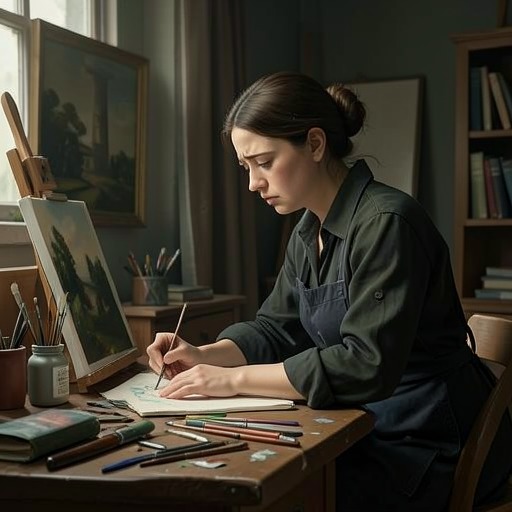
On September 11, 1988, Henry lies with his head in Clare’s lap beneath an apple tree in the orchard. Their lunch remains scattered among fallen apples; Clare, who has been outside to draw trees for her art class, asks to draw him as he rests. She wants to preserve his relaxed, peaceful appearance and asks him not to move, because changing his position would alter the scene she sees. The stillness she requests is difficult for him to maintain, but the sketch makes that fleeting posture durable.
The drawing carries an intimate doubleness from the start. Clare makes it from the living Henry before her, yet Henry recognizes it as an image he has already seen hanging beside her drawing table at home. He knows that this future version is signed but undated. His recognition gives the portrait a history before its making: for Clare it is a new work, while for Henry it is already a familiar object from another point in their shared life.
The Date Experiment
After Clare shows him the finished drawing, she begins to write the date. Henry stops her, explaining that the version he remembers has no date. Clare erases the inscription and writes Meadowlark instead. The place name preserves where the image was made without fixing it to a day, leaving the object consistent with the portrait Henry has previously encountered.
Clare then asks whether writing the date might change anything when Henry returns to his present. Henry does not claim to know what would happen; curious, he encourages her to try. She erases Meadowlark and writes September 11, 1988. The act is small and visible, a few marks on the bottom of a drawing, but it tests a much larger uncertainty: whether an event in Clare’s past can revise an object in Henry’s future, or whether the future he remembers constrains what can happen now.
The scene offers no immediate spectacle to settle the question. Clare jokes that any violation of the space-time continuum is not obvious, while Henry, beginning to feel unsteady, warns that he is about to disappear. The conversation ends with his departure, leaving the experiment unresolved in the moment. The portrait, rather than a theory or explanation, is what carries the question forward into the next encounter.
The Altered Object
When Henry later sees the drawing in Clare’s studio, it is no longer displayed in its usual place. Clare searches beneath the table and finds it dusty with cobwebs. On inspection, Henry sees that the date is still absent. Clare admits she trimmed it off after becoming frightened by his joke about World War III. She had worried that insisting on the test might somehow prevent them from meeting in the future.
The cut edge converts a hypothetical risk into a material trace. Clare’s attempt to write the date has not left the portrait in the state Henry remembers; the date has been removed, and Henry identifies its absence as an alteration. The drawing’s history is therefore not a simple choice between an unchanged past and a changed future. It holds the successive acts together: the portrait was made, the place name replaced the date, a date was written, and then the dated portion was cut away.
Memory, Art, and Causality
The portrait links artistic representation with the novel’s uneven distribution of knowledge across time. Clare draws Henry from direct observation, while Henry’s prior encounter with the finished work makes him a witness to an outcome she has not yet reached. Their different temporal positions transform a studio keepsake into an object that can be read as a record of both anticipation and revision.
Its date matters because the image is otherwise already recognizable. Clare’s likeness of Henry persists across their changing circumstances, but the inscription—or its removal—would place that image at a particular point in time. Henry’s memory supplies a constraint; Clare’s fear supplies the reason to erase the test’s visible result. The portrait consequently gives material shape to an unresolved tension: the couple can touch and alter the marks on the paper, but they cannot easily know what those alterations mean for the future they share.