Clare’s wings
The Time Traveler's WifeClare’s wings are a life-size sculpture made by Clare for Henry after the loss of his feet, and their unveiling transforms an object of art into a response to the limits imposed on his body. Constructed from armature wire, handmade paper, and painted strips, the wings are at once ornamental and unusable: they cannot restore Henry’s ability to stand or fly, but they give visible form to his longing for movement and release.
Design and Meaning
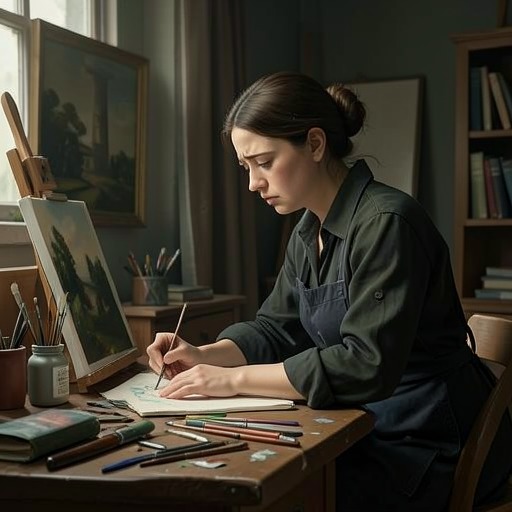
Clare begins in her studio with a roll of armature wire and drawings pinned to the wall. She clears the worktable and tries to imagine a three-dimensional, life-size figure. After shaping a torso, she considers whether to make articulated limbs and feet, then rejects the figure and pushes it beneath the table. What remains of the idea is more focused: she wants to give Henry wings, not construct a substitute body.
She shapes two matching wings by hand, measuring their span with her arms and comparing their symmetry. Hinged together and suspended from the ceiling, they are eight feet across. At this stage they consist of open wire outlines, which Clare describes as graceful and ornamental but useless. That tension between grandeur and practical inability is central to the finished work: the wings promise an image of flight, not a means of achieving it.
Clare rejects white as the sculpture’s defining color. She chooses Red Iron Oxide, the color of dried blood, and Bone Black, reasoning that a terrible angel would not be white—or would be whiter than any white she could make. The angelic image is thus made unsettling rather than pure. Its color and materials bring together beauty and threat, while the choice to make wings alone keeps the work centered on longing rather than on a complete, idealized figure.
Making the Wings
The sculpture develops through a series of deliberate material transformations. Clare cooks two pounds of kozo, a resilient bark fiber, and prepares a pound of white linen in a beater until it becomes pulp. The next morning, she repeatedly lifts a mold and deckle from the vat of dark-red fiber, drains the water, and transfers each delicate layer of paper onto felt. After pressing the gathered sheets, she returns to the wings with the freshly made paper.
The damp paper drapes across the wire like a membrane. Clare twists it into sinews and connecting cords, changing the open outlines into forms she sees as batlike, with the wire still visible beneath the thin surface. She dries the unused paper on sheets of steel, tears it into strips, and paints those strips black, gray, and red. These become feathers, which she plans to sew onto the wings one by one. The finished design therefore grows from an airy framework into a dark, layered surface: the structure remains discernible, but it acquires the appearance of a body and plumage.
The process also gives the object a particular relation to time and repetition. Making the paper requires Clare to repeat the same actions—dipping, lifting, draining, and couching—until she has accumulated a post of sheets. She works amid water and music, then returns after lunch to cover the armature. The sculpture is not a single sudden gesture but the result of measured labor, in which each thin sheet and painted strip adds another layer to the form.
The Unveiling
A week later, Clare arranges for Henry to be brought from the house into her studio, with Gomez helping carry him through the back door and across the yard. The studio is lit by about a hundred candles. A white sheet hangs in the center of the room, and Henry initially looks for a projector. Clare, dressed in dark clothing, moves through the candlelight before revealing what she has made. The presentation makes the wings part of a carefully staged encounter, not merely a finished sculpture placed in view.
Henry responds first with a wry request for feet, underscoring the practical absence the wings cannot answer. Clare identifies the gift as wings and drops the sheet. They hang in the air, wavering in candlelight, dark against the surrounding darkness. Henry sees them as threatening, yet also as carrying longing, freedom, and the possibility of rushing through space. The unveiling does not erase the difference between the sculpture’s promise and his physical circumstances; instead, it brings that difference into focus.
The wings call back Henry’s dreams of hovering and flying, of moving as though gravity had released him from the earth. In the studio, that imagined freedom becomes present as an image he can look at, even though he cannot use the wings to move. Clare sits beside him, and he cannot speak. When she asks him to kiss her, the scene shifts from looking toward intimacy: Henry describes himself as submerged, flying, and released, and the encounter ends with the thought that being wells up in his heart.
Form and Significance
The work draws its force from a contradiction built into its form. The wings are large enough to suggest flight, but Clare calls the initial wire construction useless, and the completed sculpture remains an artwork rather than a device that can carry Henry. That distinction matters: the gift does not present his altered body as something the sculpture can repair. It offers an image shaped around what he misses, while leaving the loss itself unchanged.
Its materials reinforce that doubleness. The wire gives the wings a visible armature; paper supplies a fragile skin; twisted strips suggest sinews and feathers; and red, black, and gray displace the conventional whiteness of an angel. The result is at once decorative and threatening, delicate and bodily. Rather than resolving those tensions, the sculpture holds them together.
For Henry, the wings connect physical limitation with remembered and dreamed movement. Their scale and suspended position make flight visible in the studio, while their silence and ragged edges keep them from becoming a simple emblem of triumph. Their meaning culminates not in escape from the body but in the shared moment between Clare and Henry: the object gives shape to longing, and the intimacy that follows makes that longing emotionally immediate.