Faith and God
The Time Traveler's WifeFaith in God is not a settled doctrine in Henry DeTamble and Clare Abshire’s conversations but a live question that joins cosmology to intimacy. Henry fears that the world’s randomness makes divine purpose hard to believe; Clare, even as her childhood certainty gives way to doubt, wants belief to be true. Their exchange places faith beside competing accounts of causation and freedom, and shows how the same universe can appear to one person as meaningless chance and to another as a world in which meaning might still be granted.
Faith and the Question of Reality
The question first surfaces through a playful but unsettling possibility: Henry wonders whether God might have made people up without telling them. Clare objects that he should not say such things, then points out that he does not believe in God. Henry shrugs and changes the subject, comparing his own reality to Paul McCartney’s. The comparison does not settle anything. Clare’s worried response—that many people know Paul McCartney, while she alone knows Henry—makes the exchange intimate: the discussion of whether anyone is real or created turns on the difference between public knowledge and personal attachment.
This scene gives faith a double aspect. God is not only a proposed explanation for existence but also a figure whose absence or silence could leave people without assurance that they belong to a purposeful design. Henry treats the thought as a joke, yet Clare’s unease suggests that the joke has reached a serious question. Their conversation does not provide proof for either position; instead, it reveals that the possibility of a creator bears differently on them, and that their closeness does not make their beliefs identical.
Chance, Order, and Free Will
Their later discussion makes the disagreement explicit. Henry describes chaos as a condition of greater freedom—indeed, total freedom—but one in which actions have no meaning. He wants both the ability to act and the assurance that what he does matters. Clare answers by asking whether God could make things meaningful while still allowing free will. Her question offers a possible reconciliation: divine purpose need not, in her view, erase human choice.
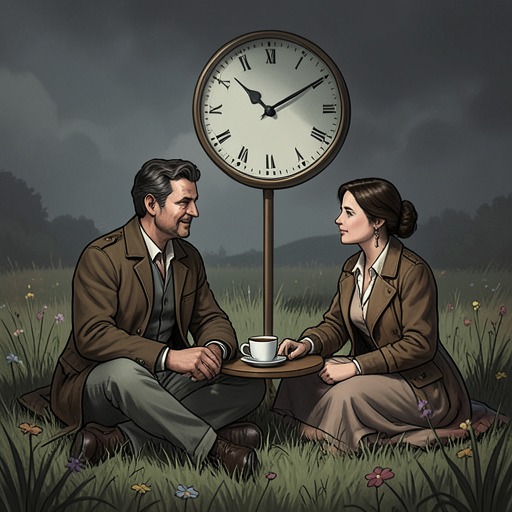
Henry counters that events seem too random and meaningless for God to exist. Clare notices the tension in his position: he has also said that everything seems planned in advance. Rather than treating the contradiction as a minor inconsistency, the scene sets it out as the dilemma they are trying to understand. If the future is already fixed, freedom may be an illusion; if anything can happen, actions may lack significance; and a universe governed by God might promise purpose while leaving room for choice. Henry lays out these alternatives as a block universe in which past, present, and future coexist and everything has happened, a chaotic universe whose variables cannot all be known, and a Christian universe created for a purpose in which people nevertheless possess free will.
The physical ease of the conversation contrasts with its abstractions. Henry eats a Bismarck, then takes Clare’s ankles and holds her feet on his lap as they sort through the possible accounts of the universe. Clare laughs and leans back on her elbows; her feet are cold in his hands. These gestures do not resolve the argument, but they keep it grounded in a scene of trust and touch. The question of free will is discussed not as a detached puzzle but between two people whose relationship itself gives their choices and attachments weight.
Clare’s Changing Belief
At thirteen, Clare cannot choose between her practical skepticism and her romantic feelings about Jesus and Mary. The narrator places this uncertainty in a longer arc: a year earlier she would have answered that God existed without hesitation; ten years later she will favor determinism; and ten years after that she will see the universe as arbitrary, or believe that if God exists, He does not hear prayers, while cause and effect remain inescapable and brutal. Her beliefs are not presented as a straight passage from faith to a final answer. The account follows successive positions, each changing the way purpose, prayer, and causation can be understood.
At this particular moment, Clare says that she wants God and asks whether that is acceptable. Henry responds that it is: belief is hers. Clare immediately distinguishes wanting to believe from wanting the belief to be true. That distinction captures the emotional force of her faith. It is not merely a comfort she elects to retain; it is a hope about the nature of reality, a wish that the world actually be ordered by something beyond chance and causation.
Henry answers with sympathy rather than argument. He compares Clare’s desire for order and God to Thomas Aquinas, whom he describes as a thirteenth-century teacher at the University of Paris who believed in both Aristotle and angels. The example gives Clare a precedent for holding reason and religious belief together instead of treating them as mutually exclusive. Clare responds that she loves angels and wishes she could have wings, fly around, and sit on clouds. Her image of angels carries faith away from the abstract problem of proof and toward beauty, imagination, and the longing to transcend ordinary limits.
The Limits of Reassurance
The conversation also marks a limit in Henry’s ability to share Clare’s religious hope. When she mentions God, he feels an urge to hide, run, or vanish; his bodily response makes the subject difficult even before the argument begins. He nevertheless stays in the exchange, listens to her uncertainty, and tells her that wanting God is acceptable. The difference between them therefore does not simply divide a believer from a skeptic: Clare is already changing, and Henry’s discomfort coexists with a willingness to grant her belief its own legitimacy.
What remains unresolved is precisely what gives the subject its force. Henry wants meaningful action without surrendering freedom; Clare wants a God who could make meaning possible, while recognizing that her own conviction is unsettled. Their talk brings together randomness, predestination, free will, and religious purpose without collapsing them into one answer. Faith appears as a hope that meaning is real, not just desired—and as a question that continues to change as Clare grows older.