Get Me to the Church on Time
The Time Traveler's Wife“Get Me to the Church on Time” is the heading for the wedding-day sequence of October 23, 1993, when Henry is thirty and Clare is twenty-two. The title gives the day a brisk, comic destination, but its urgency also names the couple’s real predicament: Henry may vanish from the present without warning, and reaching the church cannot be taken for granted.
Title and Occasion
The section begins at six in the morning at Blake’s, a bed-and-breakfast on the south beach in South Haven, where Henry wakes to rain. Clare’s parents have arranged the lodging: Henry occupies a small green room under the eaves, while his father sleeps downstairs and other family members have their own rooms. Rain lashes the house as Henry considers whether he can run in the downpour. Wedding preparations therefore begin in weather that makes the day’s movement difficult even before time displacement complicates it.
The heading’s promise of forward motion sits against the novel’s fractured chronology. The story repeatedly gives dates and ages that place Henry and Clare at different points in their lives, then lets their scenes arrive out of sequence. Here, the wedding day is identified by its calendar date and by the couple’s ages, while the title compresses its immediate objective into a familiar, lightly comic phrase: get to the ceremony in time.
The Delay and the Return
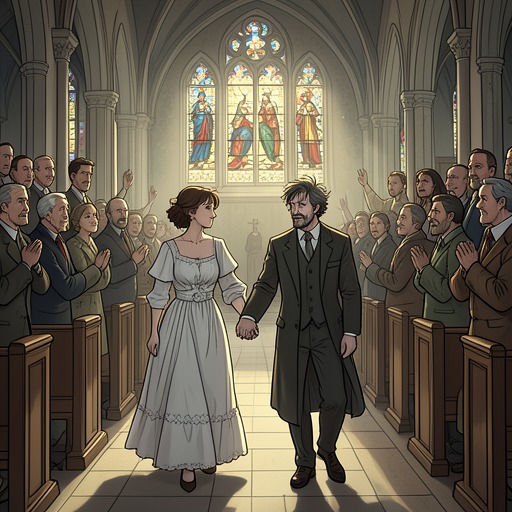
By early afternoon, the wedding party is gathered in the church vestibule. Clare’s father knocks on the room where Henry is dressing; Gomez answers that they need a minute. When Gomez opens the door again, Henry appears fastening his cuff links. He is wet, dirty, unshaven, and looks about forty—older than his stated age of thirty—because he has been away from the wedding day through an involuntary displacement in time.
His arrival is not polished, but it resolves the day’s central suspense. Henry is physically present, and he gives Clare a triumphant smile before walking through the church doors and down the aisle. The contrast between the ceremony’s formal setting and his disheveled appearance makes his return itself the decisive gesture: the wedding can proceed because he has made it back, not because the day has gone according to plan.
Narrative Function
The title turns a wedding-day crisis into a race toward an ordinary social appointment. That lightness does not erase the stakes; it sharpens them. For a couple whose life together is repeatedly interrupted by Henry’s unpredictable absences, arriving at the church is more than punctuality. The section makes the wedding’s threshold—vestibule, dressing-room door, church aisle—the point where threatened absence gives way to a shared public commitment.
The episode also condenses the book’s characteristic collision of intimate life with unstable chronology. The rain, the delayed dressing, and Henry’s altered appearance are concrete signs of disruption, while his smile and walk down the aisle restore the day’s forward direction. The title’s comic imperative thus carries a tender double meaning: Henry must get to the church, and he must return to the present in which he and Clare can marry.