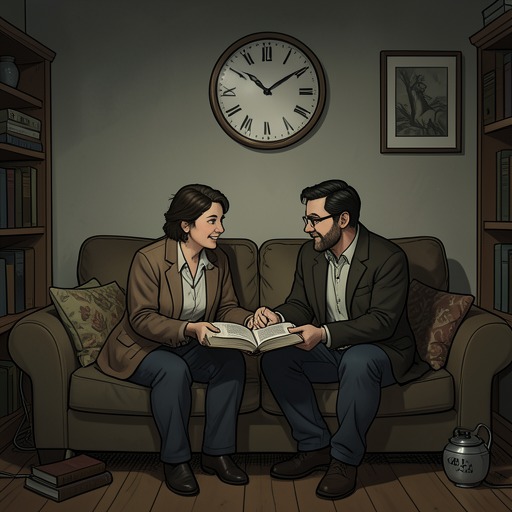
Henry and Clare buy the Ainslie house
The Time Traveler's WifeHenry and Clare buy the Ainslie house in 1994 after a search that gives their different ways of knowing the future a practical, domestic consequence: Henry has already seen the house during a time displacement, and Clare recognizes it by matching his remembered view of the backyard. The purchase makes a future scene part of their present-day choice, while leaving Clare to insist that the choice still be made together and on her terms.
A search shaped by different ways of seeing
In May 1994, when Clare is twenty-two and Henry is thirty, the couple are looking for a house. Clare finds the process remarkable because it lets strangers enter one another’s homes, inspect closets and wallpaper, and ask about gutters. Her attention is methodical and material: she moves through each property slowly, studies the woodwork and appliances, asks about the furnace, and checks the basement for water damage.
Henry approaches the same houses by going straight to the back and looking out the window. Their realtor, Carol, takes his behavior for lunacy; Clare explains it as gardening enthusiasm. After a full day of house hunting, Clare asks what he is doing. His method is not an eccentric preference but an attempt to identify a house he has already encountered in the future.
The future view Henry remembers
Henry tells Clare that he has been inside their home-to-be on a beautiful autumn afternoon. From a back window he saw a brick building that seemed to be Clare’s studio, where she was pulling sheets of blue paper. She wore a yellow bandanna, a green sweater, and her usual rubber apron. Outside, a grape arbor stood in the yard; beside Henry was a little marble-topped table Clare had received from her grandmother. He had been there for about two minutes, long enough to make the view the test by which he now judges houses.
His memory is vivid in domestic particulars, but its timing and implications remain uncertain. Henry cannot say when he will have visited the house, or whether it will be their first. He also admits that he was not close enough to Clare to tell her age. The remembered room and objects make the future feel tangible, while the gaps in his observation prevent that knowledge from becoming a complete plan.
Clare tests the certainty
Clare is troubled by the possibility that Henry’s memory could direct them away from a better house. She asks whether he is absolutely sure and raises the cost of relying on a future glimpse: what if they reject an excellent property because it lacks the right backyard view? Henry answers that the amount of their belongings he saw makes him confident it was their house, while conceding that it might not be their first one. He reassures her that it is a nice place and points to the prospect of a studio at the back.
Clare’s question gives the scene its tension. Henry treats the view as a recognition signal, but Clare understands that recognition can still constrain a decision made in the present. The future may be fixed, as Henry suggests when he says they will end up in the place anyway, yet she does not simply surrender the search to that certainty. She asks him not to let the prediction obscure the possibility of other good houses.
Recognition on Ainslie
About a month and roughly twenty houses later, Clare finds the match on Ainslie, in Lincoln Square: a red-brick bungalow built in 1926. Carol opens the key box and wrestles with the lock. As the door opens, Clare feels that something fits. She goes straight to the back window, sees the backyard, and recognizes both the future studio and the grape arbor from Henry’s account. She decides they will buy it.
Carol is surprised that Clare has made up her mind before seeing the rest of the house and asks about her husband. Clare says he has already seen it, then agrees to tour the house. Her answer neatly joins the couple’s contrasting methods: Henry has seen the home through time, Clare has found it through the present-day search, and the decision becomes theirs when the two views coincide.
A home chosen across time
The purchase turns a displaced memory into a shared point of orientation. Henry’s future glimpse supplies the identifying image, but it does not replace Clare’s own search, judgment, or final recognition. The house is established through specific domestic features—the back window, the studio space, and the grape arbor—rather than through an abstract certainty about destiny.
The scene also preserves a small uncertainty inside the apparent fulfillment. Henry cannot know whether this is their first house, and the couple’s search has included many alternatives before Clare encounters the right view. Their decision therefore holds both inevitability and agency: Henry believes the house belongs to their future, while Clare must still enter it, look out, and choose it in the present.