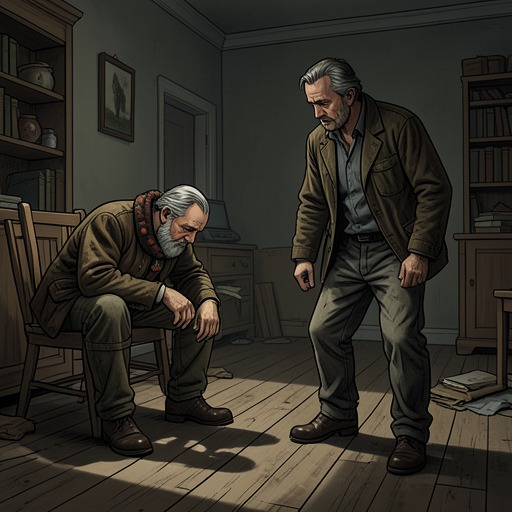
Henry obtains his mother's rings for Clare
The Time Traveler's WifeHenry obtains his mother’s rings for Clare in a difficult encounter with his father, Richard, on May 9, 1992. Henry’s confession that he still sees his dead mother transforms a strained conversation into a moment of shared grief; Richard then entrusts him with Annette’s engagement and wedding rings, which Henry intends to give Clare.
Background and Approach
The scene takes place when Henry is 28. He comes to Richard’s home after Kimy has raised concerns about his father’s deterioration: Richard has been yelling, throwing things, neglecting his violin practice, and living amid disorder. The immediate concern is not only domestic. Kimy says she has not seen him this unwell since Annette died, connecting his present decline to the loss that continues to shape the family.
Henry announces his visit at the door, but the conversation does not begin with the rings or even with Annette. Richard says he is on sick leave, and Henry sees that his hands are shaking. He understands the tremor as the consequence of Richard’s long drinking and the damage it has done to his ability to play the violin. The father’s physical condition makes the estrangement and its costs visible before either man can speak directly about their shared loss.
The Confession
After Henry tells Richard that he is getting married, he asks for Annette’s wedding and engagement rings for Clare, explaining that he believes his mother would have wanted her rings passed to her. When Richard does not engage with the request, Henry insists on a deeper truth: he sees Annette regularly, including in scenes from her ordinary life and at Juilliard. For Henry, Annette’s death has not meant complete absence; his time-displaced encounters have kept her present to him in a way Richard has not known.
Richard’s response is to ask why Henry never told him. Henry says he thought the truth would hurt his father. The exchange reveals that Henry’s silence, which he had intended as protection, has also kept Richard from knowing something central to his son’s continuing relationship with Annette. Richard lowers his head and cries. Henry watches, then brings him toilet paper; they remain together quietly before Richard goes to retrieve the rings.
The Rings and Their Meaning
Richard returns from his bedroom with a small satin pouch and a dark-blue jeweler’s box. He takes out the two rings and gives them to Henry. The careful transfer matters: Richard holds the rings between both hands before placing them in Henry’s cupped palms. The movement turns the request from a simple exchange of family property into an act of trust following the confession.
The engagement ring is an emerald, and both silver rings need cleaning. Henry’s attention shifts from their condition to their future use: they need to be worn, and he knows the person who should wear them. His intended gift to Clare carries Annette’s memory into Henry’s marriage, while Richard’s decision makes that inheritance possible. The rings connect mother and son across death, and father and son across a silence that has only now been broken.
Reconciliation and Narrative Significance
The scene does not resolve Richard’s drinking or restore the violin playing Henry believes he has lost. Instead, its change is intimate and limited: Richard learns that Henry has continued to encounter Annette, Henry hears the question his silence has left unanswered, and the two men share a grief that neither can undo. Richard’s willingness to hand over the rings gives their conversation a tangible consequence.
The episode also brings together the book’s different experiences of loss. Richard’s bereavement is bound to Annette’s death, while Henry’s time-displaced life allows him to see her after that death without being able to make it cease to matter. By giving the rings to Henry for Clare, Richard permits a piece of Annette’s life to continue within the next generation. The inheritance is therefore both an intended wedding gift and a fragile form of family connection, secured not by a claim that grief has ended but by the act of finally speaking about it.