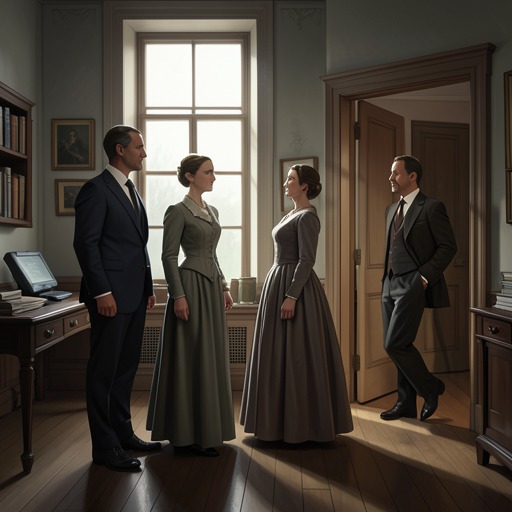
Henry reveals his time travel to Gomez
The Time Traveler's WifeHenry’s disclosure to Gomez turns a collection of disturbing clues into an explanation: Henry is an involuntary time traveler, and the discrepancies in his age, appearance, and history are consequences of dislocation rather than ordinary deception. The conversation also exposes the different timelines Henry and Clare inhabit: he first meets her in 1991, while she has known him since childhood. Gomez’s demand for an account becomes the occasion for Henry to name the condition and for their friendship to take on a new, practical significance.
The confrontation
Gomez presses Henry to explain the signs that do not fit together. He raises Henry’s assault on a man, Ingrid Carmichel’s recent suicide attempt, Henry’s suddenly older appearance and graying hair, his ability to pick a Yale lock, and the fact that Clare possessed a photograph of Henry from before she had met him. The questions bring together private distress, criminal behavior, and evidence that Henry’s life does not follow a single ordinary chronology. They are not abstract suspicions: Gomez is asking about things he has seen or learned, and Henry has to reckon with the photograph as news even to himself.
The photograph sharpens the temporal puzzle. Gomez says it was taken outdoors in June 1988 and that Henry looks more like his present, older self than the younger-looking man Gomez had seen a couple of weeks earlier. Henry had not known Clare possessed it. The image therefore does more than confirm that Henry appeared in her life before their meeting at the library; its changing resemblance to him makes his age itself part of the evidence.
Henry names the condition
Henry finally gives Gomez the central fact plainly: he is a time traveler. He describes an episode that began at work on May 9, 2000, after a presentation to members of the Caxton Club. While reshelving books in the stacks, he suddenly found himself on School Street in 1991. The displacement left him without clothes, and he hid under a porch while cold and waiting for someone to pass. He then took a young man’s clothes and cash, leaving the man in his underwear. Henry presents the assault as a desperate response to being stranded without clothing, while acknowledging that it frightened the victim and that his appearance in the neighborhood invited further trouble.
Henry describes the condition as unpredictable and beyond his control: he cannot choose when it happens or where or when he will arrive. The repeated practical consequences have pushed him into a catalogue of illegal ways to obtain clothes, money, or transportation, including lock-picking, shoplifting, pickpocketing, robbery, breaking and entering, and car theft. His account does not treat these actions as harmless; it connects them to the material danger of arriving unprepared while showing how the disorder has shaped his conduct. When Gomez raises murder, Henry says he knows of no such act and also denies ever having raped anyone.
Two timelines and the photograph
Henry explains that his first meeting with Clare took place in October 1991, when she was twenty and he was twenty-eight. Clare, however, first met him in September 1977, when she was six and he would have been thirty-eight. She has known him throughout her life, while in 1991 he is only beginning to know her. That asymmetry explains how a photograph could predate Henry’s own first meeting with Clare: an event belongs to different points in their respective histories, and the order in which the relationship is experienced is not shared.
Gomez has already asked Clare about Henry and has heard her account, but he admits he did not believe it. Henry responds that Clare is truthful and asks what proof Gomez expects. When Gomez says Clare told him that Henry disappears, Henry confirms that disappearance is one of the condition’s recurring features. He says it may take minutes, hours, or days, but that it will happen. The exchange moves the conversation beyond an explanation of past irregularities: Gomez now has a direct description of what he may witness himself.
The disclosure becomes proof
The conversation is interrupted when Henry becomes nauseated. He leaves the table with Gomez following, and then abruptly disappears. The narrative shifts to Henry’s return to the Newberry Library: he is in the stacks without clothes, finds the clothing and book cart from his work nearby, gets dressed, and resumes shelving. The Reading Room appears to be carrying on normally; its clock shows 4:15, and a colleague offers to get coffee. Henry has been away for less than fifteen minutes. His disappearance gives Gomez’s newly acquired knowledge an immediate, observable counterpart and demonstrates how a time displacement can divide one continuous conversation into radically different experiences for the two men.
Friendship and narrative significance
Henry tells Gomez that he needs him to know the truth because Gomez will save him repeatedly in the years ahead. The remark makes the confession more than an attempt to answer an interrogation: it is an opening toward reliance. Gomez’s questions begin with suspicion about Henry’s violence and unexplained changes, but the disclosure gives those signs a common cause without erasing their consequences. The episode also makes the novel’s unequal temporal knowledge visible in a compact sequence: Clare already knows Henry across years he has not yet lived with her, Gomez has heard the story before he can believe it, and Henry can explain the pattern only from within a life repeatedly interrupted by displacement.