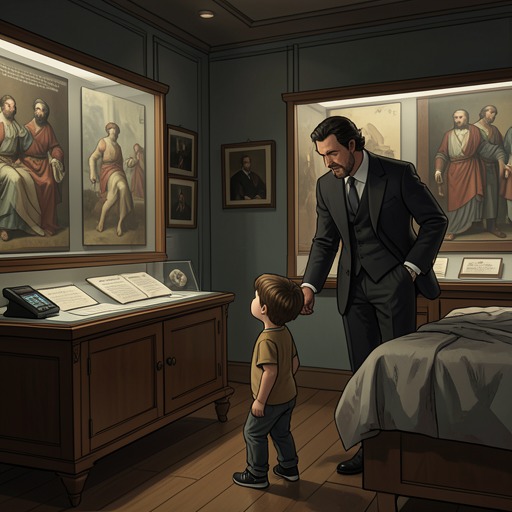
Henry’s first time-travel experience at the Field Museum
The Time Traveler's WifeHenry’s first time-travel experience at the Field Museum is the formative episode in which the adult Henry meets his five-year-old self on the night of that child’s birthday. Displaced without warning from 1988 to 1968, Henry recognizes the museum as the setting of his own earliest memory and becomes the guide who helps his younger self through the encounter. The scene makes time travel not simply an interruption of ordinary life but a cause-and-memory loop: the adult remembers having been visited, and now discovers that he himself was the visitor.
Causes and Background
The episode begins after Henry returns home at 4:03 a.m. on a bitter January morning in 1988. He has been dancing, is partly drunk, and is utterly exhausted. As he fumbles with his keys, dizziness and nausea overtake him; when he raises his head, he is on a museum floor in another year. The date heading identifies the destination as June 16, 1968, at 10:46 p.m., when Henry is five years old and his adult self is twenty-four.
The sudden transition is consistent with the condition Henry later describes as a disorder without a dependable rule. Exhaustion can precede an episode, but he cannot choose its timing or destination, and this displacement comes as he is trying to get home rather than attempting to travel. He arrives without clothes or belongings, leaving him to solve an immediate practical problem before he can make sense of what has happened.
What Happens at the Museum
At first, the museum’s displays make Henry think he may have landed in the Stone Age. A red exit sign corrects that impression: he is in the twentieth century, in the Field Museum. Recognizing the location brings the scene back to his fifth birthday and to the realization that he is about to become the adult visitor he once encountered. The museum is familiar to him as a memory, but his present task is to reproduce the encounter from the other side.
Henry looks for clothing in the museum offices and finds a suit on a coat rack, along with a dinosaur T-shirt. He takes the shirt for the child and puts on the suit himself. Then he returns to the Great Hall and waits, uncertain how long it will take for the younger Henry to appear. The adult has to arrange his movements around the scene he remembers: he stands where the visitor had stood and calls to the child by name.
When five-year-old Henry appears, the adult speaks gently, tells him he is there to guide him, and throws him the T-shirt. The garment reaches the child, who steps into the light wearing it down to his knees. The adult sees a small, dark-haired boy who is still secure in the ordinary world of his parents. For the child, the stranger and the impossible change in circumstances are frightening; for the adult, the sight clarifies that the life he remembers as beginning at this encounter is now beginning before his eyes.
The Meeting and Its Immediate Aftermath
The two Henrys walk through the museum together, talking about things that fly and things that slither and sharing Oreos. The child tells the adult about his parents, Mrs. Kim, who is teaching him to make lasagna, and a friend who will soon move away. The conversation gives the adult a glimpse of the younger Henry’s ordinary life, even as their meeting places that life inside the unusual chronology of time travel.
The encounter ends when the child cries out, reaches for the adult, and disappears. The T-shirt remains as warm, empty cloth in the adult’s hands. Henry understands that the child will now go home and remember the experience as a wonderful dream; his mother will laugh at the account and say that time travel sounds fun. The adult’s memory of having been visited is thus connected to the very encounter he has just made possible. The narrative confirms the importance of the scene by identifying it as the first time.
Narrative and Thematic Significance
The episode’s paired dates and ages make its chronology legible while preserving the difference between the two characters’ knowledge. In 1988, Henry understands that the child is himself and recognizes the memory he is about to create. In 1968, the five-year-old has no comparable explanation: he encounters a stranger, accepts the offered shirt, and later files the visit as a dream. The same event therefore belongs to the adult’s remembered past and the child’s immediate present, while the reader sees the causal connection that neither perspective alone can fully establish.
The T-shirt gives that connection a concrete form. Henry’s recurring inability to carry possessions across time makes clothing an urgent problem on arrival, but here he finds a way to turn the need into care for his younger self. When the child vanishes, the shirt’s persistence in the adult’s hands marks what has been transferred even though the people cannot remain together. Their meeting establishes the pattern that defines Henry’s condition: time displacement separates him from ordinary continuity, yet it also makes him a participant in memories he had previously understood only from the other side.