Henry’s hypothermia and double amputation
The Time Traveler's WifeHenry’s hypothermia and double amputation begin with an involuntary disappearance into a winter night and end with both feet removed above the ankles. The episode makes the danger of his time displacement brutally physical: stranded in snow without protection, Henry can neither control when he returns nor carry anything with him, and his survival leaves him dependent on medical care and changes the practical terms of daily life for him and his family.
Causes and Circumstances
Henry’s time travels can arrive without warning and leave him naked, with no clothes or money. He describes becoming a desperate version of himself who must hide and scavenge; episodes may follow recognizable triggers, but can also interrupt an ordinary moment without explanation. The winter episode is one of the most dangerous consequences of that condition: Henry vanishes and is left exposed to the cold, with no way to choose his destination or protect his body.
The narrative places the crisis on January 7, 2006, when Henry is forty-three. He comes to in snow in Grant Park, in an open space with no buildings or trees. It is night; traffic moves along Lake Shore Drive, the Art Institute is dark across the snow, and dawn is only a faint line over Lake Michigan. Henry cannot feel his feet. The scene’s cold, emptied landscape gives the episode its immediate stakes: he must reach shelter before the exposure kills him.
The Crawl to Shelter
Henry stands despite being unable to feel or move his feet, then staggers through the snow, falling and getting up until he can only crawl. He crosses a street, crawls backward down concrete stairs while gripping a handrail, and reaches a pay phone with his hands and knees raw from the salt. The sequence measures survival in strained, diminishing movement: walking gives way to crawling, but he continues toward the possibility of help.
Henry calls for assistance from the Monroe Street Parking Garage and tells the person who answers that he is near the guard station. He tries the station door, but it is locked. Through its reinforced window he can see a space heater, a jacket, a desk, a chair, and video monitors: shelter and warmth are plainly visible yet inaccessible. With no one responding to his cries, he curls up before the door and wraps his hands around his feet. At last, he disappears again.
Rescue and Medical Treatment
Henry’s next appearance comes at home, where Clare and their daughter, Alba, have spent the day without him. Clare is nearly asleep on the porch after putting Alba to bed when a crash sounds in the living room. Henry is on the floor, shivering and white with cold; he asks for help through chattering teeth, and Clare runs for the phone. His return is not a safe resolution to the disappearance but the beginning of an emergency.
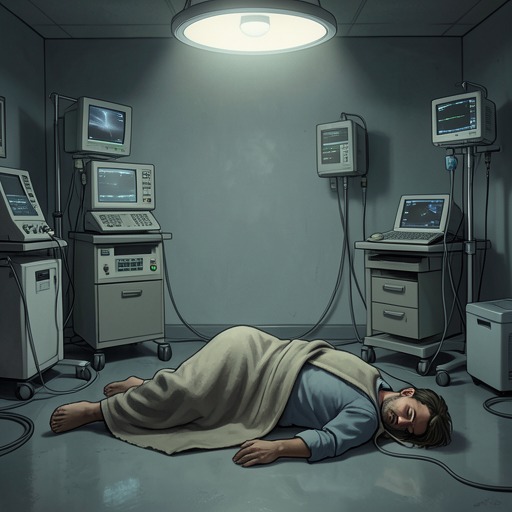
At the hospital, staff wrap Henry in blankets and insulating material, monitor his temperature and vital signs, and pack his feet in cold packs while they work to raise his core temperature. The doctor explains that the team must warm him before they can assess the damage. The waiting is made visible through Henry’s uncontrollable shivering, which shakes the bed, and through Clare’s vigil beside him. The initial treatment cannot restore what the cold has destroyed.
When doctors begin rewarming Henry’s feet, morphine eases the pain. His feet are immersed in hot water, changed repeatedly as they cool it. Clare watches for the bright redness that would signal living tissue: color gradually returns around the ankles and appears in patches on the left heel and toes, but the right foot remains mostly pale. After an hour, the staff dry his feet, place cotton between his toes, and arrange a frame above them so that nothing touches them. The uneven return of color offers no simple recovery; the frostbite has gone too far.
Amputation and Immediate Aftermath
By September 27, 2006, Henry is in Mercy Hospital. Clare sits beside his bed while their friend Gomez sleeps on the other side. A tent-like frame lifts the blankets away from the place where Henry’s feet should be: both have been amputated above the ankles that morning. After surgery, the doctor asks Clare what should be done with the feet. Reattachment seems to her the obvious answer, but she can only shrug and look away. The exchange captures the irreversible gap between the instinct to restore Henry’s body and the reality of what has happened.
When Henry wakes and learns where he is, he stares toward the foot of the bed and reaches beneath the blanket. Clare closes her eyes as he begins to scream. The moment is his first direct encounter with the loss, not an abstract medical fact but a change he must discover by touch. The scene’s focus on the covered bed, his reaching hands, and Clare’s closed eyes keeps the recognition intimate and stark.
Life After the Injury
After Henry returns home, his body is present while his attention seems withdrawn. He spends his days in bed, often turned toward the window and drifting through morphine-laced sleep. Alba brings him an orange, a newspaper, or her teddy, but her offerings remain untouched on the nightstand. Clare helps with basic care, including food and changing pajamas, while a nurse visits daily to change Henry’s dressings. The family’s small gestures of care meet the distance created by his pain and withdrawal, without immediately closing it.
The loss also changes the physical layout of ordinary life. When Kimy urges Henry to get up, he tells her he cannot because he has no feet. She points to his wheelchair and presses him to bathe and shave, but the chair cannot pass through the bathroom doorway. Her practical insistence meets a built environment that has not accommodated Henry’s changed mobility. The obstacle is neither his will alone nor the wheelchair alone: the doorway makes a routine necessity difficult to reach.
Henry later teaches Clare to cook from his wheelchair. The kitchen counters and cabinets are too high for him, so he and Clare work at the kitchen table, where he guides her through dicing onions and preparing other ingredients. They make sauces, lasagna, desserts, eggs, salmon, and pizza; Alba eagerly asks for more dessert. When Clare cooks dinner by herself for the first time, Henry encourages her, and the family shares the meal. Teaching and eating together do not erase the amputation, but they establish a new pattern of participation: Henry contributes knowledge and company while Clare works at the counter-height tasks he cannot reach.
Significance
The episode carries Henry’s time displacement out of the realm of the uncanny and into an enduring bodily consequence. Earlier disappearances leave him to improvise clothing and evade discovery; this one exposes him to a cold that cannot be escaped simply by returning. The crucial reversal is that Henry does return, but not to an intact body or an unchanged life. His dependence, pain, and altered mobility continue after the winter scene has ended.
The aftermath also distinguishes bodily injury from the barriers surrounding it. Medical staff respond with monitoring, warming, and surgery; Clare and Kimy provide care at home; yet the bathroom doorway and unreachable kitchen fixtures make ordinary tasks harder. The family’s adjustments—wheelchair use, hands-on assistance, and cooking at the table—show that Henry’s life after amputation is shaped by both the injury and the spaces through which he must move. The event therefore marks a lasting change in his body while making accessibility, care, and shared domestic work part of the story of survival.