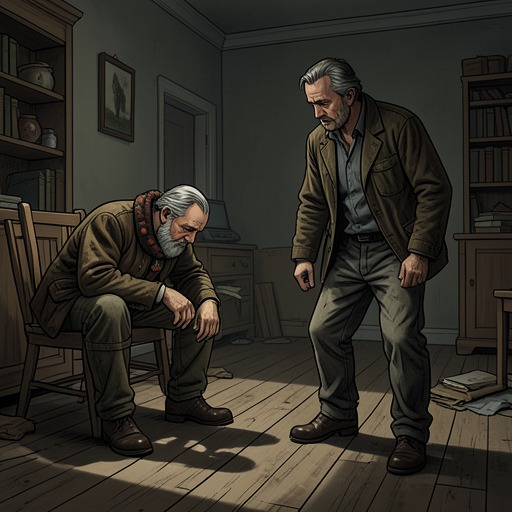
Henry’s reconciliation with Richard and receipt of his mother’s rings
The Time Traveler's WifeHenry’s reconciliation with Richard culminates in his receiving his dead mother Annette’s engagement and wedding rings, but the objects are only handed over after Henry breaks a long silence about his mother. The scene joins two losses—Richard’s deteriorating life after Annette’s death and his lost capacity to play music—to an unusual disclosure: Henry has continued to encounter Annette through time travel. What begins as a visit to a father in decline becomes a painful exchange of family memory, followed by a concrete gesture toward Henry’s future marriage to Clare.
Background and Immediate Crisis
By May, Richard has been on sick leave since March. Henry finds him in a state of serious decline: he is drinking, throwing things, and no longer practicing the violin. When Henry asks what is wrong, Richard holds out his shaking hands. The doctor has told him that the nerves are damaged and will not recover, ending his ability to play. The loss is not only occupational; music has been central to Richard’s life, and the news makes visible the consequences of years of drinking.
The crisis is also apparent to Kimy, who ordinarily visits and helps care for Richard. She tells Henry that Richard has been yelling and throwing things and will not let her into his apartment. When she has checked on him, she has found trash, beer and lemons in the refrigerator, and clothes piled on the bed. She has not seen him this unwell since Annette died. A crash from upstairs interrupts Henry and Kimy’s conversation, prompting Henry to go to his father. Their concern establishes the practical and emotional circumstances of the visit: Richard is increasingly isolated, while the people around him can see that grief and alcoholism have overtaken his daily life.
Henry’s Disclosure
Richard is silent when Henry tries to talk with him. Henry changes the subject by announcing that he is going to marry Clare. Richard’s curiosity—who would marry his son?—is not presented as an insult; Henry believes he is genuinely asking. Henry shows him a photograph of Clare looking toward Lighthouse Beach, then explains that he wants to give her Annette’s rings because he thinks his mother would have wanted that.
Richard challenges Henry’s right to claim what Annette would have wanted, pointing out that Henry barely remembers her. Henry answers with information he has withheld: through time travel, he has seen Annette hundreds of times since her death. He has encountered her in the neighborhood and at places associated with her life, heard her sing, and spoken with her. He describes time travel not only as a burden but as something that has sometimes allowed him to see his mother when he needed to. In making that disclosure, Henry insists that his relationship with Annette did not end with the accident that killed her, even though Richard has lived with her absence as a final loss.
Henry’s account also turns the conversation toward Richard’s own grief. He tells his father that Annette would have wanted him to be happy and would have disapproved of the way he let her death undo his life. Richard weeps openly at the kitchen table. Henry watches, then brings him toilet paper; they sit together for several minutes. The exchange shifts their relationship from accusation and guardedness toward shared mourning. Richard asks why Henry never told him. His question registers the cost of the long silence, as well as the shock of discovering that Henry’s time travel has preserved a connection Richard believed was gone.
The Rings and Their Meaning
After they speak about Annette and their earlier family life, Richard slowly goes to his bedroom and returns with a small satin pouch. Inside a dark-blue jeweler’s box are the two rings. He holds them for a while before placing them in Henry’s cupped hands. The transfer is hesitant and deliberate: Richard does not simply produce inherited jewelry, but entrusts Henry with objects bound to his marriage and to the person both men have lost.
The engagement ring has an emerald, which catches green and white light from the window; the silver rings need cleaning. Henry thinks they need to be worn and knows whom he wants to wear them: Clare. His request therefore links his parents’ marriage to his own intended marriage without suggesting that the two relationships are identical. The rings carry Annette’s memory into Henry’s future, while Richard’s decision to give them marks a change in their relationship. The reconciliation does not erase Richard’s alcoholism or restore his musical ability, but it enables an act of trust that had seemed uncertain at the start of the visit.
Narrative Significance
The episode is structured around unequal knowledge. Richard regards Annette as irretrievably dead, while Henry’s involuntary travels through time have allowed him repeated encounters with her. Henry’s disclosure makes that difference explicit, and it transforms the meaning of his request: the rings are not merely a keepsake from a mother he scarcely remembers, but a gift he wants for Clare from someone he continues to know. The scene brings a private, extraordinary experience into a strained family conversation and makes it the basis for a new exchange between father and son.
The rings also give the conversation a material conclusion. Words first expose the damage caused by silence; the small pouch and the two pieces of jewelry allow Richard to answer with an action. His gift cannot repair the years of drinking, replace his lost capacity to play, or undo Annette’s death. It does, however, let him participate in Henry’s marriage and place a part of his own history in his son’s care. The scene’s reconciliation is therefore real but limited: a moment of recognition and inheritance amid continuing loss.