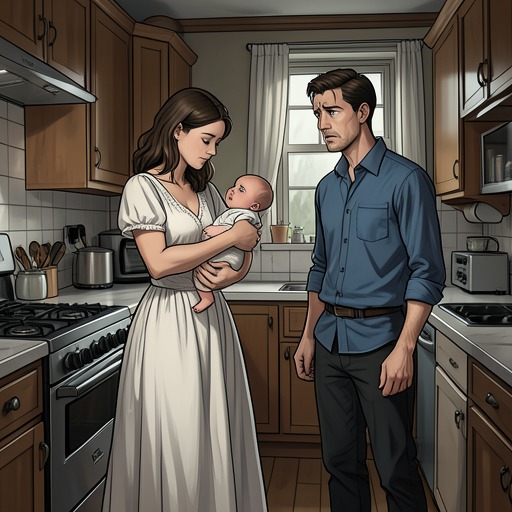
Henry’s vasectomy and Clare’s unexpected pregnancy
The Time Traveler's WifeHenry’s vasectomy and Clare’s unexpected pregnancy mark a reversal in the couple’s effort to decide whether they can safely have a child: after repeated losses, they agree to stop trying, but their different experiences of time leave that decision unable to close the question. The resulting pregnancy is Clare’s sixth, following Henry’s operation, and renews the uncertainty that their choice was meant to end.
Background and the decision
In spring 1996, about two years into their marriage, Clare and Henry decide to try for a baby without discussing the choice at length. Clare knows Henry is pessimistic, but avoids asking whether he has seen a future without a child. She also tries not to dwell on the possibility that his time-travel difficulties might be hereditary or affect a pregnancy. Her desire for a baby overwhelms those concerns, while the couple’s repeated miscarriages make the wish increasingly fraught.
By June 2000, Henry has decided to have a vasectomy without telling Clare. He waits at a medical office on Sheridan Road, near Diversey, and thinks of the procedure as an end to his prospects of becoming a father. The choice follows the couple’s long and painful attempts to have a child, but Henry makes it in private rather than as the outcome of a shared conversation.
A shared decision to stop
Clare discovers Henry’s plan, and the couple discuss it in the dark. She tells him to go ahead if he has to; she is no longer willing to keep trying for a baby. Henry rejects the idea that this means he has won, describing the decision instead as necessary. The exchange shifts their relationship to parenthood from hope and persistence toward resignation, while showing that the decision is shared only after Henry has already taken steps toward the operation.
Henry thanks Clare, and they make love without worrying about the consequences. The moment is shaped by their different timelines: Henry has come from November 1986, a period in which Clare was fifteen, while she experiences the night as part of their married life. Four weeks later, he has the vasectomy. Clare then discovers that she is pregnant for the sixth time.
The pregnancy and its cause
In September 2000, Clare tells Henry she is pregnant. At first, he reacts with disbelief, but quickly understands how it happened: for him, the night in question belongs to 1996, when they were desperately trying to conceive. Clare, by contrast, remembers it as only weeks earlier, after their decision to stop. Henry recognizes that his movements through time have connected two different stages of their reproductive history, making the pregnancy possible after the operation without undoing the fact that the procedure has taken place.
The pregnancy is therefore not a simple reversal of their decision. It arises from the gap between Henry’s chronology and Clare’s, and from the earlier intimacy in which they were still trying for a child. Their choice to stop trying cannot govern an encounter Henry experiences years earlier; the event turns their private history into a cause neither can neatly control.
Consequences and significance
The pregnancy does not resolve the couple’s fears about inherited time travel or the risks surrounding childbirth. During Clare’s labor, Henry stays beside her and holds her hand as medical staff attend to her and monitor the baby’s heartbeat. The scene carries their long-standing concern into the birth itself: their wish for a child remains inseparable from anxiety about what the child may inherit and what the parents can protect her from.
That concern returns years later when Henry argues for genetic research involving their daughter, Alba. He wants to leave her a safety net in case she does not want to live with time travel, even though the research may not work and Alba may never need it. The connection places the sixth pregnancy within a larger arc: the child once feared as a possible inheritor of Henry’s condition becomes the reason he seeks help for the next generation. The vasectomy and pregnancy thus embody a central tension in the story—love and deliberate choice persist, but cannot fully master the consequences of time and heredity.