Here and now
The Time Traveler's Wife“Here and now” names the fragile present that Henry and Clare seek to share despite Henry’s involuntary time travel. It moves from a toast to a plea for continuity and, later, to a question about whether Henry would surrender time travel if he could still meet Clare. The phrase does not make the present secure; it gives a name to what their life together keeps putting at risk.
A toast to the present
At a family gathering, Clare raises her glass to Henry and to happiness, adding “To here and now.” The toast places their relationship alongside other beginnings and chance: Mark toasts beginnings, Sharon answers with chance, and Alicia’s exuberant list of snow, Jesus, her parents, catgut, sugar, and new red Converse High Tops turns the gathering toward the particulars of a life. Against the uncertainty carried by chance, Clare’s words affirm the happiness of being together in this moment.
Henry answers gravely, “To world enough and time.” Clare briefly wonders how he knows the line, then recognizes it as an allusion to one of his favorite poets rather than a reference to their future. The exchange lets the language of the present sit beside language of duration. Clare names the moment they possess; Henry’s toast invokes the abundance of time that their circumstances will not reliably grant them.
Continuity under threat
The phrase becomes more urgent during Christmas Mass, where Henry tries to remain beside Clare through a public ritual. As the congregation stands and the service proceeds, he silently wishes to stand quietly and inconspicuously, repeating “here and now.” The words are not an abstract assurance: they attach his wish for continuity to an exact place and occasion, among Clare’s family and the people who know her.
Clare senses that Henry is close to disappearing. She takes his hand, and later, as the Mass continues, tries to steady him by reaching through a hole in his coat pocket and squeezing him. Henry leaves the church; the door swings shut behind him. In the elementary-school bathroom where he has arrived, he lies curled on the tile and thinks, “Here I am. Solid.” The private insistence echoes the congregation’s ritual setting, but the difference is stark: Clare remains at Mass while Henry has been displaced into another place and time.
On the tile floor, Henry calls the thing he wants “Continuity.” He appeals to the possibility of a God who might want people to be good, and thinks of Clare’s goodness and faith while asking why she should be embarrassed before the people at church. The wish for continuity is therefore bound to more than Henry’s physical presence: his disappearance interrupts Clare’s public moment and makes their shared participation in it impossible. The tiny porcelain fixtures acquire iridescent auras; he recognizes that there is no stopping the next displacement and is gone again.
Memory, choice, and divided time
In a later conversation, Clare asks whether Henry would stop time traveling if he could do so without consequences. He asks whether he would still meet her; she points out that he has already met her. Henry answers that he would stop. The exchange turns the expression’s wish for a stable present into a question of choice: Henry would give up the condition that removes him from the present, provided their meeting and relationship remained intact.
Clare describes the asymmetry that such a choice would not erase. She would retain memories that Henry had not yet lived through; being with him would feel like being with someone who had amnesia. She has felt this way since their arrival, and Henry jokes that she could watch him lurch forward into each memory until he has collected the complete set. His response acknowledges the gap without resolving it. Their shared history belongs to both of them, but not at the same time or in the same sequence.
Recurrence across a nonlinear life
The dates associated with these scenes emphasize how unstable ordinary chronology is for Henry. The Mass episode belongs to the Christmas sequence, while another dated scene pairs January 2, 1988, when Henry is twenty-four, with June 16, 1968, when he is five. Elsewhere, a scene links October 27, 1984, to January 1, 2007, with Henry forty-three and Clare thirty-five; the reunion with elderly Clare is dated July 24, 2053, when she is eighty-two and Henry is forty-three. Such paired dates place markedly different stages of life in the same narrative field, clarifying why a toast to the immediate moment can carry such weight.
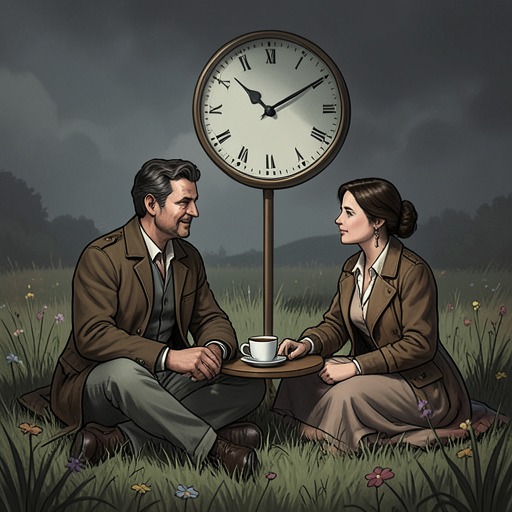
At the reunion in 2053, Henry finds Clare as an old woman sitting at a table beside a window, with a teacup at her elbow and the lake beyond. He recognizes her, and she comes to him; he takes her into his arms. The scene gives the language of presence a future fulfillment, but not a permanent guarantee: it is a reunion across decades, not an escape from time’s divisions. “Here and now” thus gathers the novel’s central tension into a compact expression. It is both an ordinary claim to the moment and a wish made necessary by the repeated possibility of absence.