Ingrid Carmichel
The Time Traveler's WifeIngrid Carmichel is Henry DeTamble’s former girlfriend, a figure whose striking public image gives way to evidence of deep unhappiness and repeated suicidal crises. Henry’s relationship with Ingrid ends when he meets Clare Abshire, yet Ingrid remains present in the novel through other characters’ memories, Clare’s encounters with her, Henry’s dream, and a final time-displaced meeting. That last encounter places Henry beside Ingrid on the day she will die, confronting him with the difference between knowing the future and being able to alter it.
Identity and Background
Henry remembers meeting Ingrid at a Fourth of July party in 1988. In retrospect, he describes her as an incandescent blonde whose wealth, beauty, and ennui formed a kind of armor. The polished image is an important part of Ingrid’s characterization, but the account of her later life unsettles it: she has attempted suicide repeatedly, and by 1994 Henry finds her markedly changed from the woman preserved in his memory.
Ingrid’s difficulties become known to Henry through conversations with Gomez Gomolinski. When Gomez lists the questions raised by Henry’s behavior and changing appearance, he also asks why Ingrid tried to kill herself. Henry initially recognizes the 1991 overdose as another episode in an established pattern, observing that it would have been her fourth attempt. The fact is not treated as a single isolated crisis; it points to a history that the people around her know about but cannot thereby resolve.
Relationship with Henry
On Christmas Eve in 1988, Henry is alone in Chicago. His father’s invitation is half-hearted, his usual neighbor is away, and Ingrid rebuffs his request to spend time together, reminding him that it is Christmas Eve and that people have families to attend to. The exchange places their relationship amid Henry’s loneliness and gives no indication that Ingrid will become his long-term partner. Soon afterward, Henry meets Clare and ends his relationship with Ingrid less than twenty-four hours later. He tells Clare that he did not know she existed while he was dating Ingrid and argues that his earlier relationship cannot make his later commitment an act of retroactive infidelity.
At a Violent Femmes concert, Clare sees Henry confronting Ingrid in a hallway. Their close physical position initially makes the encounter look like an embrace, but Clare realizes they are arguing. Ingrid’s controlled expression gives way to anger and near tears; Henry withdraws, throws up his hands, and leaves. The scene makes the end of the relationship visible to Clare, who is watching from outside it, and connects Henry’s past to the unease that remains between him and Ingrid after the breakup.
Celia Attley later tells Clare that Henry dumped Ingrid harshly and that she is trying to help Ingrid recover. Celia brings Clare to meet Ingrid, but the introduction does not ease the situation. Ingrid suspects Clare has come to gloat, and Clare, uncomfortable in Ingrid’s presence, tries to leave. Ingrid grabs her arm, accuses Celia of bringing her there to rub the breakup in, and tells Clare to tell Henry that he can go to hell. Her parting threat that she will see him there gives the exchange an ominous force, though the scene presents it as an expression of anger rather than a literal disclosure of what will happen.
Repeated Crisis and Its Effects
The novel’s fragments make Ingrid’s distress recur across different perspectives and times. In a dream, Henry imagines having sex with a faceless Ingrid in her parents’ house. A nature program on television turns into a parade in which Clare appears isolated; Ingrid takes a bow and arrow and shoots toward Clare, and Henry wakes after imagining himself attacking Ingrid. The sequence is dream material, not an event in the characters’ shared history. Its violence instead shows Henry’s fear and unresolved emotional entanglement taking an indirect, distorted form, with Ingrid appearing in a nightmare that joins the end of their relationship to his life with Clare.
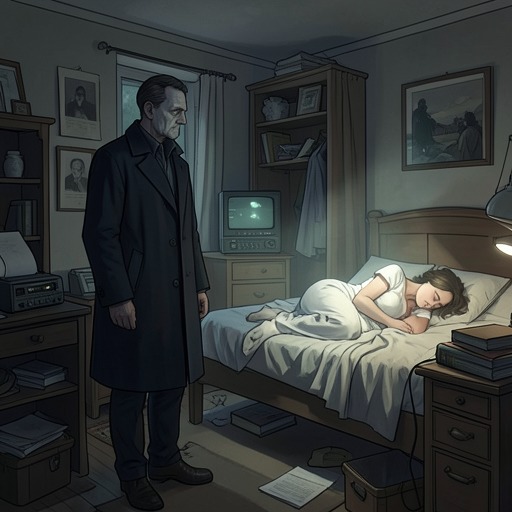
That earlier violence in the dream contrasts with Henry’s helplessness during his later visit to Ingrid. In December 2006, a sudden time displacement carries him from the present into the night of January 2, 1994. He arrives at Ingrid’s apartment, where she recognizes him, although he has never visited the apartment in his own experienced chronology. His memory still holds the glamorous woman of 1988; the Ingrid before him is gaunt, hard, and tired. Their different positions in time give the encounter its particular strain: Henry has arrived knowing what will happen, while Ingrid is living the day without the same knowledge.
Henry realizes that this is the day Ingrid will die and hesitates over what to say or whether he can prevent it. When Ingrid raises the possibility of her own death, Henry rejects it, but she says it is the option she likes best and leaves the room before returning with a gun. She asks whether he loved her; he answers yes. Ingrid calls him a liar and fires. The scene ends with the shot, connecting the suicide attempts Henry has heard about to a death he witnesses in the past. His foreknowledge does not give him control over the event.
Narrative Role and Significance
Ingrid’s story is presented in fragments rather than as a continuous account of her life. Information about the breakup comes through Henry’s explanation and Clare’s observations; her suicide attempts are mentioned in conversation; her later condition is encountered through Henry’s involuntary journey into 1994. The shifting chronology makes the reader assemble her history from partial, uneven views, just as Henry’s memories cannot encompass the person she became after their relationship ended.
Her presence also tests the limits of Henry’s time travel. He can appear in a moment that belongs to Ingrid’s past, speak with her, and know that she is in danger, but the scene does not turn that knowledge into rescue. The contrast between his preserved image of Ingrid and the exhausted woman he meets underscores how much of another person’s life lies beyond a former lover’s memory. Through Ingrid, the novel connects the aftermath of a brief relationship with the persistence of suffering, and makes the difference between witnessing an approaching death and preventing it painfully clear.