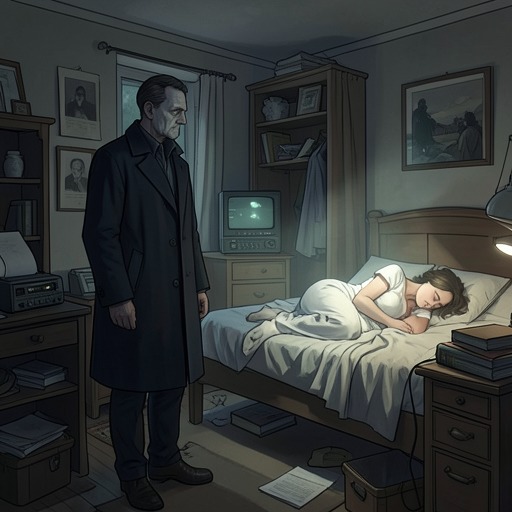
Ingrid's 1991 suicide attempt
The Time Traveler's WifeIngrid's 1991 suicide attempt is a painful event revealed retrospectively: Henry tells Gomez that Ingrid overdosed on Valium, and that this was her fourth attempt. The disclosure also foreshadows her death by suicide in 1994 and exposes the lasting anger and helplessness Henry associates with their relationship.
Disclosure and Context
The attempt emerges during a conversation in which Gomez presses Henry for explanations. He wants to understand, among other things, why Ingrid tried to kill herself eight days earlier and why Henry seems to have aged rapidly. Henry responds by asking how Gomez knows Ingrid. Gomez says he knows Celia Attley, whose account has brought the attempt into the conversation. Henry then asks how Ingrid tried to die, and Gomez identifies an overdose of Valium.
Henry places the attempt in 1991 and immediately adds that it was Ingrid’s fourth. His response indicates that Gomez did not know the extent of Ingrid’s previous crises: Henry points out that Celia has been selectively informative. The number changes the meaning of the reported overdose. It is not presented as an isolated incident but as part of a repeated history of suicide attempts.
Henry’s Knowledge and the Later Outcome
Henry knows more than the circumstances of the 1991 attempt. He tells Gomez that Ingrid succeeded in taking her own life on January 2, 1994, shooting herself in the chest. This later death makes the earlier disclosure carry a tragic double meaning: the attempt was one episode in a history that continued beyond the conversation’s immediate subject, and it did not mark the end of Ingrid’s suicidal distress.
The disclosure is also bound to Henry’s own experience of loss. He says that, six years after Ingrid’s death, he is still angry with her and regards her death as a waste. He describes her as severely depressed for a long time and says she had sunk further into that depression. He also says he could do nothing for her. The account establishes the limits of what Henry believes he could offer, without suggesting that his efforts could have controlled the outcome.
Relationship and Aftermath
Henry connects the attempt and Ingrid’s depression to the conflict between them: their inability to do anything about her condition was one of the things they used to fight about. His anger after her death therefore coexists with the recognition that she had suffered for a long time and with regret over his own helplessness. The disclosure makes their former relationship part of the emotional aftermath of her death, rather than merely background to Henry’s later life.
Gomez initially treats Henry’s account with suspicion, calling it a sick joke and demanding proof. That disbelief underscores how extraordinary the revelation sounds in their conversation; Henry’s matter-of-fact account presents the attempt, the repeated history, and the later death as knowledge he possesses before Gomez can accept it. The scene thus links a private history of depression and suicide to the novel’s wider pattern of uneven knowledge across time, while keeping the emotional consequence grounded in Henry’s grief and unresolved anger.