Meadowlark House
The Time Traveler's WifeMeadowlark House, the Abshire family home outside South Haven, Michigan, is more than a family setting: it is the material archive of Clare’s childhood and of a relationship whose two participants do not share the same chronology. The house gathers recurring visits, Christmas rituals, private refuge, and family grief into one place, while Henry’s time-displaced appearances make its accumulated memories legible to Clare but not always to him.
Setting and History
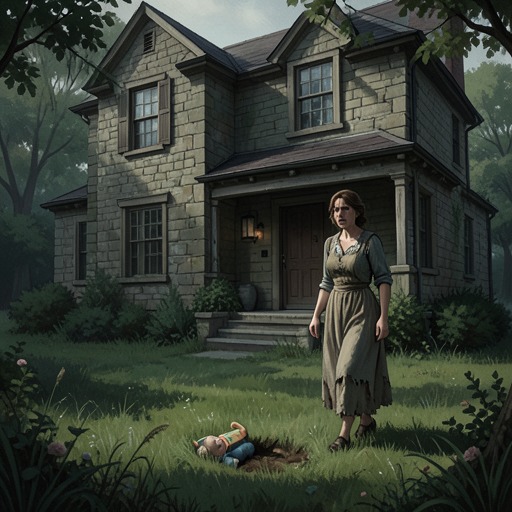
Clare describes her family as living outside the small lakeside town of South Haven, in a house that originally belonged to her maternal grandparents, the Meagrams. Her grandfather, a lawyer, died before Clare was born; her grandmother lived in the house until Clare was seventeen. Clare’s father, also a lawyer, met her mother while working for her grandfather. The house therefore precedes Clare’s immediate family: it is inherited not only as property but as the setting around which family history has formed.
The building’s architectural reputation is part of that inheritance. Clare says it appears in books about the Arts and Crafts movement and jokes that her father may have married the house as much as its owner. Meadowlark House was built in 1896 by Peter Wyns for Mary Henderson and Dieter Bascombe as a wedding present. The couple divorced two years after moving in and sold it; later, the Meagrams’ house became the Abshire home. Its origins thus contrast an intended wedding gift and brief first marriage with the longer family life the building subsequently contains.
The scale of the house is made concrete when Henry asks how many rooms it has: Clare answers twenty-four. Its grounds and interior include a garden, fountain, orchard, bedrooms, and a large basement with several rooms. The abundance of spaces matters to the novel’s structure: Henry can arrive in the house at different ages and moments, while Clare’s memories attach to rooms and objects that do not belong to his continuous experience.
The Basement and Henry’s Refuge
The basement’s Reading Room is a storage room for old books and magazines, with a furnace on the other side of the wall. In childhood, Clare secretly brings Henry there, creating a hidden domestic refuge inside the family home. During a blizzard, with Etta unable to complete her grocery shopping and the household short on food, Henry is stranded there for three days, reading old Reader’s Digests and living on sardines and ramen noodles. The episode makes the room a shelter, but one defined by scarcity and by Clare’s responsibility for someone whose presence cannot be explained to the rest of the household.
That role becomes more deliberate as Clare grows older. At fifteen, she arranges a small room for Henry next to the furnace room, on the side away from the bicycles. She has allowed her family to believe that she spends time in the basement reading, so her actual visits do not appear unusual. When Henry arrives, he has wedged a chair under the doorknob and made a nest from pillows, chair cushions, and blankets. Clare has left the back door unlocked and brings him food. The concealed room is both a practical refuge and a private arrangement maintained through Clare’s careful management of what her household sees.
The Reading Room also gives the house an unusual continuity. Henry can use it as a hiding place even when he has entered a period of the family’s past unknown to his present self. On a later visit, when he is caught in cold, rainy weather near South Haven and has no money, he heads for Meadowlark House hoping to dry out in the Reading Room and find something to eat. The house is a destination he can seek despite not knowing where in time he has landed; its basement offers the same basic promise of cover and food across separated episodes.
Arrivals, Memory, and Unequal Time
For Clare, Henry’s visits to Meadowlark House accumulate into a childhood history. At one Christmas, when Clare is seventeen, she comes down the basement stairs with snow still in her hair, embraces Henry, and wishes him a merry Christmas. Her excitement is set against his continuing sadness: her greeting briefly changes the atmosphere, but does not resolve the loss he is carrying. The scene captures the difference between their experiences of the same place. Clare can welcome a familiar visitor; Henry arrives with a life and knowledge she cannot yet share.
The asymmetry persists when Henry first joins Clare in the present for a family Christmas. On arrival, Etta greets them at the house, and Clare introduces Henry to her. Nell appears at the dining-room door, while Clare leads Henry upstairs to show him her bedroom. A wren’s nest, the first of the many bird nests he has given her, sits among the room’s keepsakes. Henry recognizes it as an object but does not know its history; Clare sees the souvenirs as records of their shared past, while for him they are unfamiliar. The bedroom makes visible the central imbalance of the house’s memory: it has preserved signs of Henry’s earlier visits, but he has not lived through them in the order Clare remembers.
Family rituals give the building another kind of continuity. At Christmas Eve dinner, Henry sits beside Clare as her father says grace, and the scene resembles the Christmas Eves Clare remembers, now altered by Henry’s presence. The following day includes presents, breakfast, and dinner with the family gathered around the tree. Henry recognizes the scene as the happy family life he longed for during Christmases spent at a restaurant with his father and the Kims. Yet he also senses tension beneath the household’s composed surface: the family members are acting out their roles and trying to preserve a cease-fire. The house can stage belonging without making its conflicts disappear.
Garden, Family Life, and Loss
The garden is closely associated with Clare’s mother, Lucille. When the family visits, Clare often passes through the front door and goes straight out the back to find her mother there, in good weather or bad. When Lucille is well, she kneels among the beds, weeds, moves plants, and tends roses. When she is ill, Etta and Philip bring her downstairs, wrapped in quilts, to sit in a wicker chair near the fountain or beneath the pear tree, where she can watch Peter working. The garden remains a place of activity and attention even as Lucille’s health changes.
Its life is recorded through particular details: red-headed finches at a new feeder, dahlias near the sundial, and a lavender rose that Lucille keeps because it is vigorous despite its color. One summer, Lucille and Alicia test whether music affects plants by having Alicia practice cello in the garden for hours each day. Lucille credits the music with an unusually plentiful tomato crop and points to an enormous zucchini; the experiment is regarded as a success but is never repeated, because it was the last summer Lucille was well enough to garden. The garden thus holds both the family’s playful experiment and the boundary imposed by illness.
After Lucille’s death, Henry remembers her through the seasonal rhythms of the house and grounds. In summer, family visits bring children to the fountain and lawn, and Lucille, often still in gardening gloves, rises to greet them. Henry describes her as unfailingly kind to him, even though she could wound Clare with a glance. His account also distinguishes Lucille’s absence from Clare’s grief: Clare becomes withdrawn and unable to resume ordinary activity, and Henry feels that the person he loves has receded from him. Meadowlark House remains a place of family gathering, but the garden’s former center of life is gone.
House as Shelter and Symbol
Meadowlark House’s significance grows from the contrast between permanence and discontinuity. Its architecture, rooms, heirlooms, and recurring customs persist; Henry does not. Clare’s bedroom contains keepsakes whose histories bind her to earlier versions of their relationship, while Henry encounters them without recognition. The house can therefore preserve evidence of shared experience without giving the two characters equal access to it.
The basement and garden express complementary forms of care. In the Reading Room, Clare protects Henry by concealing and feeding him; in the garden, Lucille’s tending, and later her confinement to a chair, make care visible as both routine and vulnerability. The house’s Christmas gatherings promise welcome and familial belonging, but the tensions Henry notices show that ritual cannot erase conflict. Its rooms hold safety, secrecy, memory, and bereavement at once.
The novel also places Meadowlark House within a chronology that its inhabitants cannot experience uniformly. A scene at the house may be a first meeting for one person and a remembered encounter for another; what Clare has long understood as part of her history can remain entirely new to Henry. The building’s continuity gives the reader a stable geography for these crossings, while the changing knowledge of its occupants prevents home from meaning simple arrival. It is both the place Clare comes from and the refuge Henry repeatedly seeks, a setting in which shared love leaves tangible traces even when the people who made them cannot remember those traces together.