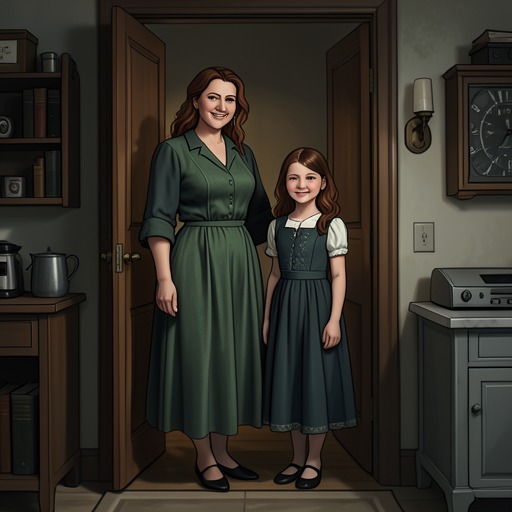
Older Alba visits her younger self
The Time Traveler's WifeOlder Alba’s visit to her younger self brings the family’s future into the backyard as a child whom they already know and love. On a June afternoon in 2005, the encounter joins the two versions of Alba in play and affection, then reveals that the older girl knows Henry is dead in her future. Henry’s quiet request that she protect Clare from that knowledge makes the scene both a reunion and an exercise in keeping grief at bay.
The Encounter in the Backyard
On Sunday, June 12, 2005, Clare enters the kitchen and sees Henry looking out toward the yard. Alba, three years old, is sitting on the ground with a barefoot girl of about seven. The older girl has long dark hair and wears a dirty Cubs T-shirt; she and the younger Alba face each other as the child gestures as though she is flying. Clare initially asks who is with their daughter. Henry explains that the girl is Alba from an older time, traveling through time.
Clare considers going outside to meet her, but Henry begins to caution against it. Before he can finish, both children run toward the house hand in hand. The younger Alba calls the newcomer a big-girl version of herself. The arrival is not a formal introduction so much as an eruption of recognition and play: the two Albas cross the threshold together, while Clare and Henry watch the future enter their present family life.
Recognition and Reunion
The older Alba greets Clare as her mother, then sees Henry, calls him Daddy, runs to him, and begins to cry. Henry bends over her and rocks her. The moment makes clear that this is not an unfamiliar future visitor: the older child recognizes both parents, and her embrace of Henry carries the force of a reunion. Clare watches while holding the younger Alba’s hand; the small child, open-mouthed, observes her older self clinging to their father.
Henry whispers to the older Alba, asking her not to tell her mother that he died. She nods through her tears. The request exposes what the scene’s tender welcome cannot conceal: Henry knows that his future absence is a fact in the older child’s life, while Clare and the three-year-old are not to be told. The older girl’s grief is therefore present in the room but carefully contained, as Clare comforts her without being given its cause.
A Family Outing Across Time
After the older Alba has washed her face, the family leaves for ice cream. Clare drives; the younger Alba sits in front, and the older girl rides in the back beside Henry. The adults make halting conversation, steering around facts that might reveal too much to Clare or to the younger child. The older Alba mentions that her grandfather is teaching her Saint-Saëns’ second violin concerto. Henry prompts her about a school play, then realizes that it belongs to a later year in her own chronology. Their conversation is shaped by unequal knowledge: ordinary details can be shared, but even a small reference to the future must be handled cautiously.
At Zephyr, they order two banana splits, a chocolate malt, and a vanilla cone with sprinkles. The children eat eagerly, while Clare and Henry barely touch their ice cream and avoid looking at each other. The everyday outing offers the family a brief common present, but it cannot make their different timelines coincide. When the older Alba grows tired, Henry carries her to the car. As they drive up Lincoln Avenue, she vanishes, returning to her own time. Clare meets Henry’s eyes in the rearview mirror, while the younger Alba asks where the other girl has gone.
Grief, Knowledge, and Protection
The visit takes on added significance in light of Henry’s own relation to death and temporal recurrence. On Christmas Eve 1988, he describes his mother’s death as the pivotal event around which everything else revolves, and recounts repeatedly traveling to the scene of the accident and its aftermath. He has seen himself at multiple points around the event, including comforting his younger self and watching his father arrive at the hospital. The memory is not a single recollection held at a distance; it is a scene to which he returns through time.
That pattern gives the encounter with older Alba a generational echo without making the two experiences identical. Henry has repeatedly revisited the death that shaped his childhood; Alba arrives carrying knowledge of the father’s death that awaits her. In the backyard, he cannot change what the older child knows, but he can hold her and ask her to shield her mother from it. The scene turns temporal displacement into a family problem of care: who knows the future, who must be protected from it, and what can still be offered when an outcome cannot be prevented.
The visit also recalls Henry and Clare’s earlier anxieties about having a child. When they decided to try for a baby, Clare was afraid to ask whether Henry had seen a future without one, and worried that his condition might be hereditary or affect their hopes of parenthood. Their daughter’s eventual time displacement makes that concern part of the family’s lived reality, but the 2005 encounter presents Alba not as a medical question: she is a daughter who returns to her parents, plays with her younger self, and grieves for her father. Henry’s tenderness and his request for silence hold together the joy of seeing her and the knowledge of what she has already lost.