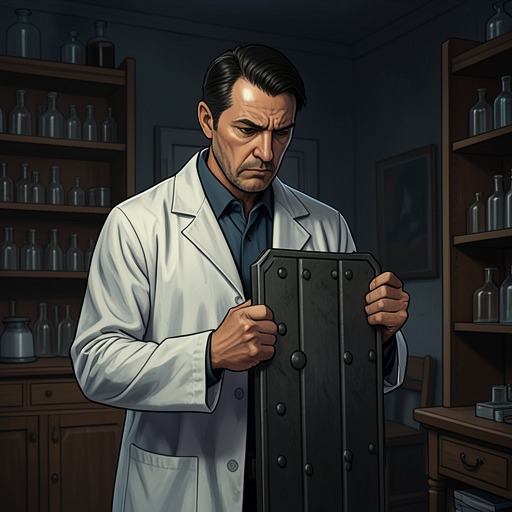
Risperdal
The Time Traveler's WifeRisperdal, the brand name Henry gives to risperidone, is a future antipsychotic that he tries to obtain ahead of its commercial release in the hope that it will suppress his involuntary time travel. Its role shifts from a prospective solution to a source of acute medical danger: Ben Matteson compounds a version from a recipe Henry supplies, and Henry is later found rigid and unresponsive on a kitchen floor. The attempt ends in emergency treatment at Mercy Hospital and leaves open whether the crisis resulted from a drug side effect, an imperfect recipe, or both.
A medication sought from the future
Henry’s interest in Risperdal grows out of his search for a way to control his time-displacement condition. In a discussion with Ben about possible medication, Henry names Risperdal as his ideal choice, but explains that it will not be marketed until 1994. He considers Clozaril and Haldol as alternatives, making clear that Risperdal is not an available prescription he can simply obtain in the present: access to it depends on knowledge of its future availability.
Later, Henry pursues the drug more directly. He tells Ben that he needs something capable of blocking his dopamine receptors, then hands over a paper with a chemical formula and asks him to make it. Henry identifies the drug as risperidone, marketed as Risperdal, and says it will not be commercially available until 1998. The different dates given for its marketing frame his knowledge as information drawn from different future reference points; the immediate practical fact is that Henry wants Ben to prepare it before it can be bought commercially.
The paper Henry produces is not an ordinary prescription. When Ben asks where the information came from, Henry says he copied it from the 2000 edition of the PDR and identifies Janssen as the manufacturer. The episode turns the time traveler’s future knowledge into a working pharmaceutical formula, but knowledge of a drug’s ingredients does not make its effects predictable or ensure that a homemade preparation is accurate.
An uncertain promise of control
Ben questions the plan before making the drug. Henry has previously tolerated antipsychotics poorly, and Ben asks whether Risperdal works in a radically different way. Henry acknowledges that its mechanism is not known to him, offering a technical description of its effects on serotonin and dopamine receptors before dismissing the detail. Ben remains unconvinced that this new drug will be meaningfully different from Haldol.
That exchange establishes the uncertainty built into Henry’s experiment. The drug is presented as a possible means of countering the bodily process behind his time travel, but neither Henry nor Ben can establish from their conversation that it will work safely for him. Henry’s future-sourced information supplies a name, a formula, and an account of the drug’s class; it does not resolve his individual intolerance to antipsychotics.
The kitchen emergency
On Monday, September 27, 1993, Clare enters Henry’s apartment because they are due to attend The Ghosts of Versailles at the Lyric Opera. She initially takes the darkness to mean that Henry is absent and worries that he will make them late. Hearing breathing from the kitchen, she finds him fully clothed on the floor, held in a rigid pose and staring straight ahead. His groan sounds strained and inhuman to her, and she calls 911.
Clare also finds Henry’s Rolodex and calls Ben. Ben’s response identifies the crisis as a possible drug reaction: he tells her that the drug is mimicking Parkinson’s and that Henry needs dopamine, urging her to pass that information to emergency responders. His intervention gives Clare a possible explanation and treatment clue while the paramedics are arriving; it does not yet establish exactly what caused Henry’s condition.
After the ambulance takes Henry to Mercy Hospital, he is admitted, injected, and intubated. He lies attached to a monitor, relaxed and asleep by the time Ben reaches his room. The journey from a planned opera evening to intensive emergency treatment makes the cost of Henry’s attempt concrete: the medication intended to give him greater control has instead left him in a state requiring urgent medical care.
Compounding, responsibility, and limits
At the hospital, Ben apologizes and says that he should not have made the drug for Henry. Asked what happened, he says there are several possibilities. The reaction could be a side effect that might happen to anyone; alternatively, Henry may have supplied an inaccurate recipe, which Ben could not check. Because the formula was difficult to memorize, Ben could not verify that what he prepared matched what Henry had given him.
The episode does not settle which explanation is correct. It leaves the practical and ethical responsibility divided between a medication with uncertain effects for Henry and a compounded preparation whose accuracy Ben could not confirm. Henry’s ability to bring information from a future drug reference does not remove the ordinary limits of pharmacy, dosage, and bodily response. Risperdal therefore marks both the ingenuity and the peril of his effort to treat time travel as a condition that can be chemically managed: the formula travels backward, but the consequences unfold in the present, where Clare and Ben can only respond to the emergency.