Time travel
The Time Traveler's WifeTime travel is the novel’s central condition of involuntary displacement: Henry is pulled out of the present and deposited elsewhere in time, unable to choose his destination or carry clothing, money, or identification with him. It is at once a practical ordeal, a source of danger and estrangement, and the force that makes his and Clare’s shared life unfold across radically unequal timelines. The narrative’s dated, alternating scenes make that inequality part of the reader’s experience: an encounter may belong to one character’s past and another’s future, while the story itself moves between moments rather than following a single chronology.
Definition and Experience
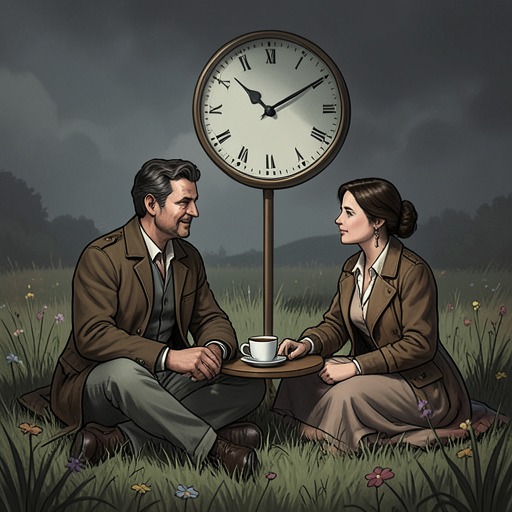
For Henry, displacement can begin with a momentary lapse of attention or a sudden feeling of dizziness. It can also interrupt an apparently ordinary domestic scene: while reading the Sunday Times with coffee and Clare dozing nearby, he may find himself watching his thirteen-year-old self mow a lawn in 1976. Episodes can last only moments, like a radio struggling to hold a station, or leave him in a place and era from which he has no immediate route home. He may arrive amid a crowd or entirely alone; he cannot predict whether he will appear in a field, a house, a car, a beach, or a school.
The condition repeatedly removes Henry from the material circumstances of his life. A book, familiar clothes, his home, and even a kettle left about to whistle can vanish from his immediate surroundings when he is displaced. He arrives naked and must wait to see whether he will return; if he does not, he walks until he finds shelter or people from whom he can obtain clothes. His lack of money and identification makes each journey a problem of concealment and survival, with the possibility that attempts to get help may lead to detention.
The episodes affect Henry’s bodily balance and his ability to act. He describes sensations of vertigo and falling before his hands and feet seem to disappear from their expected place. He may have only an instant to try to hold on, and that struggle can damage him or nearby possessions. In other episodes he becomes nauseated, and displacement leaves him exposed to unfamiliar surroundings before he has grasped where or when he is. The movement is not presented as a controlled journey so much as a sudden loss of the present.
Henry identifies exhaustion, loud noises, stress, standing suddenly, and flashing light as possible triggers, but these are clues rather than a dependable explanation. His own account insists on the uncertainty: he cannot establish a rule that would let him stay put or reliably anticipate the next episode. To Clare, he compares his chronology to a recording repeatedly stopped, replayed, and advanced too far; sometimes he gets lost in time and does not know when he is. The analogy conveys the disorder of his experience without making it a sequence he can command.
Displacement and Survival
A journey can turn the familiar world into an immediate practical challenge. At twenty-four, after a night out, Henry returns home exhausted and disoriented, then finds himself in the Field Museum in 1968, on the night of his fifth birthday. Recognizing the museum and remembering that he is supposed to be present for that earlier moment, he has to secure clothes before he can take part. He searches the museum’s gift shop and obtains T-shirts, then heads toward the upper floors. The episode joins two versions of his life in one place: the adult must act in the past in order to be the person who had been there as a child.
Henry’s account of travel also emphasizes its social consequences. Outside ordinary time, he sees himself as transformed into a desperate version of himself: a thief and vagrant who runs and hides, startling older people and astonishing children. This is not simply an inward experience. His unexplained appearances make him a spectacle to strangers, while his need to acquire clothes and avoid detection turns each arrival into an encounter with the rules and suspicions of ordinary life.
The danger of displacement becomes especially clear in the episode associated with the Monroe Street Parking Garage. In January 2006, Henry finds himself at night in snowy Grant Park, with his feet numb and no clear sense of how long he has been there. He recognizes the dark Art Institute across the snow and the traffic along Lake Shore Drive, then struggles to get warm. The account records him trying to cross the snow and reach a pay phone. Time travel has not delivered him to an abstract historical scene; it has left him physically vulnerable in a specific Chicago night, with the immediate task of getting help.
Agency, Inheritance, and Family
Henry cannot control the onset of his own displacement, but his conversations with younger Clare show how he tries to make its logic intelligible. He explains that his life does not progress in the same orderly fashion as hers: he may be at school, then suddenly somewhere else, rather than experiencing the day in a continuous sequence. His tape analogy helps describe the resulting gaps and repetitions, but it does not offer a way to prevent them. For Clare, learning this is part of learning who Henry is; for Henry, explaining it means translating a private, disorienting condition into terms another person can follow.
The condition is also genetic. When Henry meets his ten-year-old daughter Alba, he recognizes that she is a time traveler like him. Alba tells him that she can sometimes go where and when she wants, and Dr. Kendrick regards her as a prodigy. Yet she cannot choose never to travel: when Henry asks whether she can avoid going altogether, she admits that she cannot. Her experience differs from his in the degree of apparent control, not in the fundamental fact that travel can happen against her wishes. Their encounter makes the condition a family inheritance, while leaving open a consequential difference between father and daughter.
Alba’s displacement creates its own unevenness of time within the family. At Lighthouse Beach, Henry is forty-two and Alba is ten; the two spend an evening together as a father and daughter, swimming, building a sandcastle, and eating food from a vendor. Alba asks why Henry never visits her mother in the future. He says that he would be there if he could. As she gets to her feet, Alba disappears, leaving Henry holding the damp nightgown she had been wearing and looking at her footprints. The abrupt separation gives physical form to the limits of their time together: closeness is real, but neither its duration nor its ending is theirs to decide.
Time, Knowledge, and Narrative Form
The novel makes temporal displacement a principle of its storytelling as well as its subject. Dated sections identify Henry and Clare at different ages, then place their experiences beside scenes set years earlier or later. Their meeting at the Newberry Library, for example, is marked as a first date in October 1991, when Henry is twenty-eight and Clare is twenty. Elsewhere, the narration shifts between the adult Henry’s present and moments in his childhood, or between Henry and Clare’s experiences of a shared relationship. The dates give readers a way to reconstruct sequence even as the scenes refuse to arrive in chronological order.
This structure repeatedly separates what the characters know. Henry may arrive in a moment whose significance Clare has not yet learned, while Clare’s long acquaintance with him can include memories from a time he has not reached in his own life. The reader must therefore keep track of more than calendar order: each scene carries the character’s age, position in time, and knowledge of the relationship. The result is not merely a puzzle about when events occurred. It makes anticipation, recognition, and loss depend on who has already lived through a moment and who has not.
Henry’s explanation of the condition brings its practical, genetic, and emotional dimensions together. He describes it as a disease he cannot control, and recounts the need to lie and steal, the fear involved, his work with Dr. Kendrick, and his and Clare’s repeated meetings. He also tries to explain the way he lives outside the temporal constraints that govern most people. What he cannot make ordinary is not only travel itself, but a life continually interrupted by it: the effort to hold a job, remain with Clare, and inhabit domestic routines competes with a condition that can remove him from them without warning.
Presence, Absence, and Return
Henry’s desired ordinary life is composed of small domestic pleasures: reading in bed, coffee, the library stacks after closing, and observing Clare in her daily work and rest. Those details matter because displacement repeatedly separates him from precisely the things he values. His account presents home not as a place he can always reach, but as a set of people, objects, and routines that may become inaccessible the instant he disappears. Clare, whose life includes waiting for him, experiences the other side of the same rupture: his absence is not a journey she can join or follow.
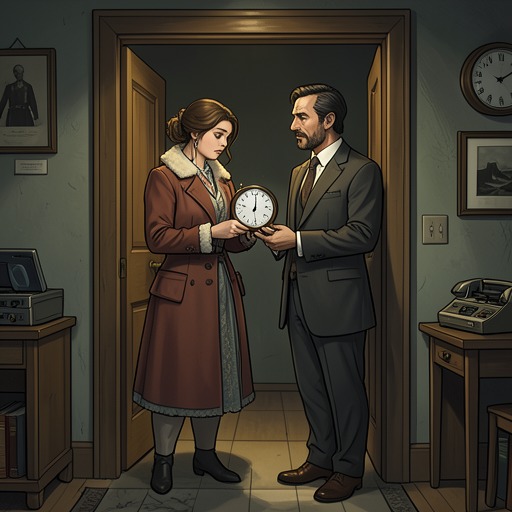
The final movement of this motif reverses the usual direction of the family’s waiting. In July 2053, Henry finds himself in the house of eighty-two-year-old Clare. He approaches a room where she sits by a window, sees the lake outside, and at first recognizes only that the woman seems familiar. When Clare turns and sees him, her face changes to joy; Henry understands that she is his wife, now old, and takes her in his arms. The scene does not undo the years of separation or make travel controllable. Instead, it gives the novel a reunion across the very distance that has governed Henry’s life: a return to Clare made possible by the condition, but still arriving outside his command.</n Time travel therefore works on two scales at once. Within the story, it is a hazardous and inherited condition that disrupts bodily safety, ordinary work, and family life. In the novel’s form, it breaks linear sequence and asks readers to assemble a relationship from moments that the characters do not experience in the same order. Its deepest consequence is the tension between presence and absence: Henry can be carried beyond the present, while the people he loves must continue living in it.