Winter
The Time Traveler's WifeWinter is not merely a season in the novel; it is a recurring physical threat that exposes how little control Henry has over his body, his whereabouts, and the people he loves. Snow and cold can confine him in the Reading Room, make a familiar journey deadly, or become one of the dangers he fears when time displacement takes him beyond his own moment. Yet winter also frames acts of care and intimacy, so its meanings gather around both peril and shelter.
Isolation and makeshift shelter
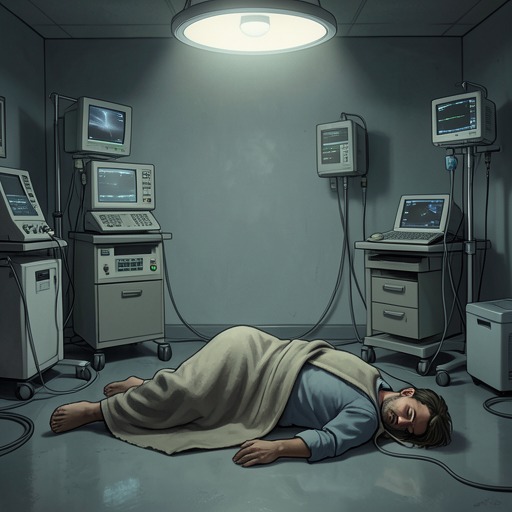
During the 1967 blizzard, Henry is stranded in the basement of Meadowlark House, hidden in the room Clare and her family call the Reading Room. Clare recounts the episode during their first date at the Newberry Library: she had smuggled him into the basement, and the storm closed school and work while Etta was unable to complete the grocery shopping. With little food available, Clare worried about feeding him. Henry spent three days reading old Reader’s Digests and living on sardines and ramen noodles. The episode makes winter an obstacle to ordinary movement and provision, but also a measure of Clare’s care: she keeps him concealed and supplied as best she can.
The basement’s improvised refuge is not comfortable abundance. It is a storage room beside the furnace, stocked with old books and magazines, where a hidden visitor must endure whatever provisions happen to be at hand. The contrast between the family home above and Henry’s cramped, secret shelter below gives the storm a practical consequence: it intensifies the work of looking after someone who cannot freely come and go. Winter isolates Henry, while Clare’s efforts create a fragile pocket of safety within that isolation.
A danger Henry names
When Clare asks Henry what frightens him, he answers that he fears cold and winter, alongside police, being displaced to a dangerous place or time, becoming stranded, and losing her. The list links seasonal exposure to the particular risks of his condition. Cold is not an abstract dislike: a time traveler may arrive without control over his circumstances, and being stranded in the wrong time can leave him exposed to dangers he cannot readily escape. His fear of winter therefore belongs to the same field of vulnerability as his fear of losing Clare.
Henry’s answer also turns winter into a point of candor between the couple. Clare reassures him that she is not going anywhere; he admits that he worries she will tire of his unreliability and leave. The seasonal fear is thus spoken within a conversation about the security of their relationship. Winter signifies bodily danger, but the scene also shows Henry’s awareness that his involuntary absences place emotional demands on Clare.
Ice, impact, and family loss
The most devastating winter memory belongs to Henry’s childhood. On Christmas Eve, when he is six, he rides in the passenger seat of a white 1962 Ford Fairlane as his mother drives to the airport to meet his father, who is in Vienna finding an apartment ahead of the family’s planned move. The morning is gray and snowy; the streets are coated with unsalted ice. Henry remembers the clothes he wears for the trip—winter coat, knit hat, boots, jeans, sweater, underwear, tight wool socks, and mittens—and his mother dressed entirely in black.
The bad weather makes an ordinary family journey perilous. Visibility is poor, the car’s defroster is inadequate, and traffic crawls along the expressway at roughly fifteen or twenty miles an hour. His mother stays in the right-hand lane, following a truck at a cautious distance. A red Corvette driven by a slightly inebriated dentist enters behind them and cannot slow down on the ice. The collision shoves the Fairlane forward just as traffic slows, and Henry’s mother pumps the brakes without effect. Winter here is not atmospheric background: the slick road turns a minor impact into the beginning of a fatal chain of events, binding the season to Henry’s lifelong grief for his mother.
The novel places that remembered accident alongside another Christmas Eve in Henry’s life. In 1988, forty-year-old Henry spends the day in the Reading Room at Meadowlark House, where Clare leaves roast beef and cheese, an apple, milk, and Christmas cookies. A newspaper tells him that his twenty-five-year-old self will drink himself unconscious that evening at the Get Me High Lounge and be taken to Mercy Hospital. The date is the nineteenth anniversary of his mother’s death. The contrast between food and the forecast of collapse, between a concealed winter refuge and the younger self’s Christmas Eve crisis, makes the season carry memory as well as immediate danger.
The season in the novel’s divided chronology
Winter’s significance emerges through a narrative that repeatedly sets differently aged versions of Henry and Clare beside one another. Their first date is dated October 26, 1991, while another scene is marked January 2, 1988, in Henry’s present and June 16, 1968, in the earlier time to which he has been displaced. A later scene places twenty-eight-year-old Clare and thirty-six-year-old Henry on February 9, 2000, after he has returned from elsewhere. These dated crossings show why seasonal experience cannot be reduced to a single linear calendar: winter may be a childhood memory for one Henry, a forecast crisis for another, and a setting in which Clare cares for the man who has just returned.
At the far end of the chronology, the novel gives winter a different shape. On July 24, 2053, Henry finds Clare as an old woman in a room facing the lake. He approaches through a dark hallway filled with galoshes and raincoats; morning light falls on the room, and Clare rises to meet him. The scene is not a winter episode, but its weathered clothing and lake-facing home recall the practical world of cold and protection that recurs elsewhere. It closes the temporal pattern through reunion rather than escape: winter’s repeated threats cannot be undone, but the novel’s final meeting places care and recognition beyond the season’s power to separate them.