Altair-4
The TommyknockersAltair-4 is presented first as a remote world where David Brown is stranded, but later as a place where things are stored rather than the home of a species or people. That revision changes the scale of the story’s danger: the name suggests a distant planet, while the explanation behind it describes a more fundamental and unsettling condition of displacement. David’s apparent exile there becomes both a family crisis and a question about what it means to be somewhere at all.
A destination disclosed through signs
The first clear indication that David has gone beyond reach appears in chalk on a blackboard: “DAVID BROWN IS ON ALTAIR-4”. The message is not presented as an ordinary report. A kachina doll speaks in response, and green light seems to emerge from its wooden surface; its face opens into a grin as it tells the witness that David has gone too far. A second doll compounds the warning, saying that the person who sees it is lost as well and using David as a reason to remain in Haven. Altair-4 therefore enters the narrative through an alarming message whose source and implications are entangled with the town’s altered life.
The idea of David’s location also appears in what the town’s inhabitants build and know. One construction is described as a device for channeling force, assembled with knowledge its maker cannot explain; the thought of David Brown passes into the same uncertain account. In this context, Altair-4 is not merely a point on a map. It belongs to a chain of uncanny knowledge and power that makes the boundary between Haven and elsewhere difficult to understand.
A family’s dream and the town’s decision
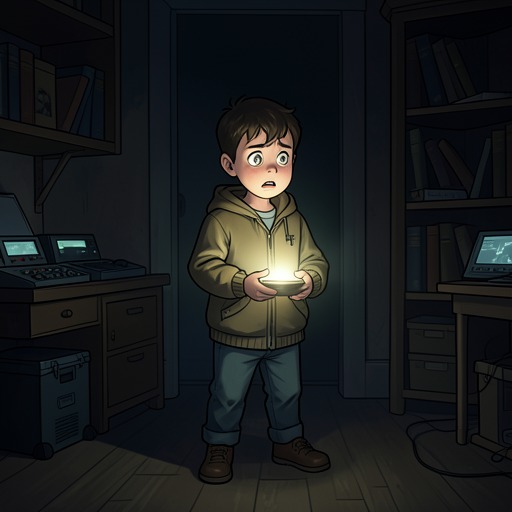
David’s grandfather dreams of a dark, cold landscape cut by immense cracks. In the dream, David calls for help, saying that it hurts to breathe, that he is frightened, and that he cannot find his way home after being made to perform the trick. The landscape gives the family’s fear a setting, but the dream also joins David’s absence to the circumstances of his disappearance: his brother Hilly had made him do a magic trick, and David has become lost afterward. When Hilly later names Altair-4 with unusual calm and clarity, he connects David’s predicament to the Tommyknockers nursery rhyme. The name thus moves from a frightening inscription to a claim spoken by David’s brother.
The town’s inhabitants eventually acknowledge that David is on Altair-4. They also know that time moves at a different rate there: less than a year has passed on Altair-4 since Earth was flung out of the sun, so David has only recently arrived from that location’s point of view. This difference offers a reason that he might still be alive, but not a guarantee. They recognize the possibility that unfamiliar microbes could kill him, and conclude that he should be left alone for the time being. Their decision is shaped not only by uncertainty about the place but by a wish to keep outsiders away from Haven: travelers can be discouraged with fake roadwork and detour signs, while the town’s clock-tower image will not register on film.
The place behind the name
In a later confrontation, Gardener considers the possibility that he will be sent to Altair-4 to look after David, imagining that they could both die there from lack of air, food, or protection from cosmic rays. Bobbi’s apparent counterpart rejects that understanding. Altair-4, she explains, is not really a planet by that name, just as the Tommyknockers are not truly a people called by that name. Names are pasted onto things in different places, imperfectly; the underlying things simply are. Altair-4 is described as a place where things are stored, usually things that are not alive, and compared to a cold, dark attic.
The same explanation denies that the Tommyknockers are a people, race, or species from Altair-4. The usual science-fiction expectation of an alien population with a home world therefore fails: both the inhabitants’ name for themselves and the supposed world are provisional labels. The attic comparison is especially consequential for David’s story. It makes the place sound less like a world built for life than a space in which things can be put away, leaving the question of how a living child might survive there unresolved.
A route home, and an unresolved danger
Altair-4 remains a practical destination even after its description as a label for a place of storage. Near the end, the words appear on a video terminal without a keyboard, as though the system responds to a question before it is entered. A separate file instruction reads “BRING DAVID BROWN BACK FROM ALTAIR-4”, turning the name into the target of an explicit recovery effort. Another character’s thought briefly connects David Brown with Hazel, showing that his fate continues to surface in the minds of people beyond his immediate family.
The closing image supplies the clearest outcome: David’s hand finds the blanket and pulls it up, and he and Hilly sleep in each other’s arms. The narration situates them an immense distance from the sun and from the galaxy’s axis, preserving the cosmic scale associated with Altair-4 while showing the brothers together again. The return is tangible, but the place’s rules remain strange and its earlier risks are not erased. Altair-4’s narrative function is therefore double: it names an apparent exile, then exposes how inadequate a name can be for a reality that the story cannot neatly classify.