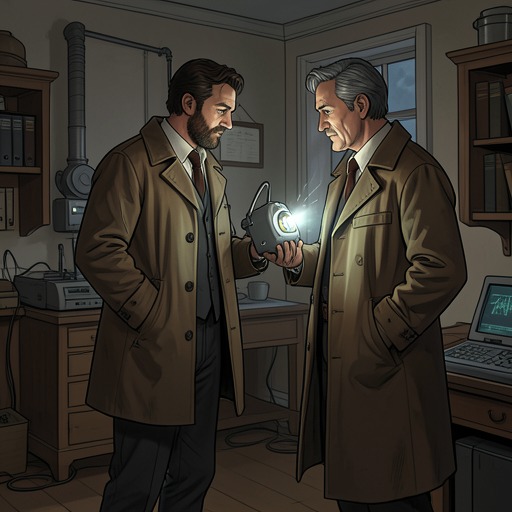
Benton Rhodes
The TommyknockersBenton Rhodes, known as Bent, is a state trooper whose investigation of the explosion that killed Ruth McCausland brings Haven’s concealed collective behavior into view. On the evening of July 24, while driving out of town with fellow trooper Peter Gabbons, Bent cannot stop thinking about the severed arm he has recognized as Ruth’s. His response to the death, and to the town’s eerie return to ordinary business, makes him one of the clearest witnesses to the widening distance between Haven’s people and their former lives.
Identity and Introduction
Bent is a state trooper serving in and around Haven. The novel introduces him on patrol with Peter Gabbons, called Jingles, a week after David Brown’s disappearance. As the two officers drive away from Haven around eight in the evening, Bent’s mind returns to the remains left by the explosion and to his instant recognition of the severed hand and arm. He tries to order himself to stop thinking about it, but the thought persists; the scene establishes both his shock and his inability to dismiss what he has seen.
The troopers’ radio receives little beyond static. Bent suspects interference from the microwave dish near Troy, a mundane explanation that sits uneasily beside the events weighing on him. The communications failure is more than an inconvenience: Bent and Jingles are trying to make contact as they leave a town where ordinary signals, ordinary explanations, and ordinary conduct are increasingly unreliable.
Ruth McCausland’s Death and Bent’s Response
At the explosion site in Haven Village’s town square, Bent covered Ruth’s arm with a blanket. The other body parts could not be covered, and he thought there was nothing to be done about them, but he made that small gesture for Ruth. It is an intimate, practical act of respect amid an aftermath that he experiences as senseless. Nearby, volunteer fire chief Dick Allison grinned as though the scene were a community supper rather than an explosion that had killed a woman Bent considered fine.
Bent’s attention also fixes on the dolls associated with Ruth. Their presence tugs at his mind, though he cannot yet explain why, and he later remembers that she had collected dolls. He regrets not having known her well enough to use the familiar name by which Butch Dugan called her. His uncertainty about the significance of the dolls is part of a larger pattern: he notices clues and contradictions without yet understanding the system behind them.
What disturbs him most is the contrast between the death and the town’s routine. He sees people continuing to eat at Haven Lunch and shop in the market as though nothing has happened. Ruth had been known, respected, and loved by many of them, yet their behavior gives Bent a chill. That moment changes his immediate aim: he begins seriously wanting to get out of Haven.
The Explosion and the Suspicion of Foreknowledge
Witnesses place the explosion at about 3:05 in the afternoon, within roughly half a minute. The town-hall clock had struck three five minutes earlier. On the drive back toward Derry, Bent imagines the minute before the blast: at 3:04, people across town lay down and covered their ears; at 3:06, they got up and resumed their activities. His picture encompasses customers and workers in stores, people at Haven Lunch, children at the playground, and players on the town tennis courts, where a ball rolls away as the players take cover.
This imagined interval gives a pattern to Bent’s suspicions. The blast sent glass across Main Street at roughly 110 miles per hour, yet no one suffered even a cut arm. The only casualties were Ruth and her dolls. Bent wonders how Haven’s residents could have escaped injury unless they knew what was coming. He also recalls that Allison and selectman Newt Berringer called the event a furnace explosion and claimed not to know the victim’s identity, though Bent believes they did know. The official account, the physical damage, and the town’s collective behavior do not fit together.
Bent’s questions remain unresolved, but the evidence changes the explosion from a local accident into a mystery of shared knowledge and deliberate concealment. His recollection does not establish exactly what every resident knew or intended; it shows how the combination of synchronized sheltering, selective casualties, and false explanations has made him doubt the town’s public account.
From Haven’s Mental Network to Flight
Elsewhere in the unfolding events, Haven’s inhabitants display a growing ability to know and act together. Ruth realizes that this knowing has become as natural to the residents as a heartbeat, even as she recognizes that it is changing the town for the worse. When the townspeople prepare to search for David, their minds link involuntarily; they join in a mental call powerful enough to reach far beyond the area, yet conclude that David is not lost but “not-there.” The search they are preparing is therefore futile. These scenes place Bent’s suspicions within a broader transformation: collective awareness can coordinate action, but it does not guarantee care, peace, or sound judgment.
The network also intensifies conflict. During the hot, dark search for David, Ruth struggles to keep people moving, but the searchers are not genuinely cooperative; fistfights break out before midnight. Mental communication, far from producing harmony, seems to worsen the disorder. Bent’s reaction to the town’s indifference after Ruth’s death belongs to this same moral dislocation: Haven can be connected without behaving as a community in the humane sense.
Ruth’s attempt to leave makes the town’s hold more explicit. Once on Derry Road, she resists the urge to drive as fast as possible, feels like a lucky escapee, and looks repeatedly in the rearview mirror for people who might come after her. She expects them to insist that she return, believing that they love her too much to let her go. Bent’s desire to escape echoes this pressure, although the supplied scenes do not show him making the same attempt or reveal what becomes of him.
Narrative Role and Significance
Bent functions as a skeptical observer whose attention turns a frightening aftermath into a chain of concrete questions. He registers the blanket over Ruth’s arm, the missing injuries among spectators, the failed radio, and the residents’ sudden readiness for an explosion. These details make his unease evidentiary as well as emotional: he is not simply repelled by violence but alert to the mismatch between what Haven claims happened and what its behavior suggests.
The wider events deepen the significance of his response. Haven’s people can share knowledge, search through a linked mental chorus, and assemble without gathering in one place, while ordinary civic routines continue alongside concealed change. At a later stage, Dick Allison and Newt Berringer want the town closed but avoid placing force fields across most roads because an inexplicable barrier might alert outsiders. The attempt to manage who can enter Haven extends the pattern Bent has begun to suspect: public explanations and familiar routines mask a town increasingly organized around shared knowledge and control. His wish to leave is therefore a personal reaction to Ruth’s death and an early measure of how far Haven has moved from ordinary life.