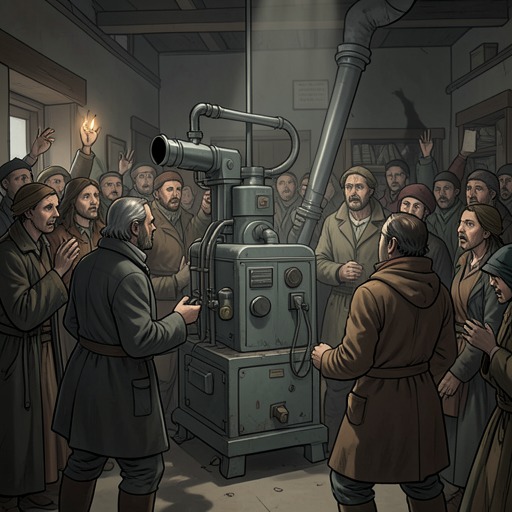
Bobbi’s in trouble!
The Tommyknockers“Bobbi’s in trouble!” is the repeated conviction that breaks through James Eric Gardener’s despair and sends him toward Roberta “Bobbi” Anderson. First felt as an intuition stronger than ordinary reasoning, it recurs as an urgent voice, changing the course of his attempted suicide and becoming the force that drives him onward despite fear and physical exhaustion.
The first intuition
Gardener is close to killing himself. He has stayed more or less sober for three years, but sobriety has not relieved his turmoil: his anger about nuclear weapons has hardened into obsession, his poetry and mind have deteriorated, and when he is not drinking he wishes he were. Alone except for Bobbi, he sees little reason to continue. As he prepares to jump into the water, however, a certainty arrives that reverses his attention outward: Bobbi needs to talk to him, and she is in serious trouble. He does not experience this as a trick or a request for help on his own behalf; the conviction concerns her.
The intuition does not immediately erase his suicidal plan. Gardener imagines calling Bobbi, making their conversation sound ordinary, telling her he is fine, and then returning to the breakwater to jump. The gap between that imagined farewell and his certainty that she needs him makes the expression a turning point rather than a simple reassurance: he is still intent on dying, but he has been given a reason to delay.
Recurrence and confirmation
The warning returns as Gardener walks. When he questions the Tommyknockers, the response is not an explanation but the same message, delivered in a deep, frightening voice that feels as sure as a loon calling across an empty lake. He quickens his pace, though fear of the Tommyknocker man remains with him; on the stairs from the beach, he notices that his nose is bleeding again.
At a Mobil station, Gardener hangs up and stands in wet socks, shrunken pants, and an untucked shirt as motorcycles pass on Route 1, heading for Maine. The warning persists, but he tries to dismiss it: Bobbi might simply have gone to Utica for the Fourth of July. The thought does not convince him. He considers that explanation as implausible as his own applying for an internship at a nuclear plant, and his belief that she is in trouble survives the attempt at rationalization.
The warning drives him onward
Gardener has encountered strange musical transmissions before and knows they need not mean that he is going crazy. Yet after the light-socket incident, the sound of Dr. Hook is louder than earlier visitations. When the music fades, the warning returns with greater urgency. Gardener turns from the western view, resumes walking up Route 9, and soon is almost running, feverish and very tired.
The expression’s force comes from its repetition and from what it interrupts. Gardener begins the sequence ready to die, still imagining suicide even after he decides to contact Bobbi. Each renewed summons makes that inward plan harder to follow and directs his movement toward her instead. The warning supplies no account of what has happened to Bobbi; its significance is the certainty it creates and the action that certainty demands.