Dick Allison
The TommyknockersDick Allison is a Haven resident whose authority shifts from practical concealment to collective command. He helps contain information, supports the town’s exclusion of outsiders, and joins the Shed People in directing a mass pursuit of Jim Gardener. As the transformation advances, his increasingly altered body and merged mental voice make him both an agent of Haven’s control and one of its visible products.
Identity and Place in Haven
Allison appears within the town’s everyday civic and commercial life, but the emerging mental network gives him access to other residents’ thoughts and allows him to act beyond the limits of an ordinary local official. At the Haven Lunch, he can pick up what people are thinking as they discuss the police; later, he takes part in decisions about keeping Haven closed. His significance lies less in a fully developed private history than in the way the story makes him a point of contact between town administration, shared thought, and coercive action.
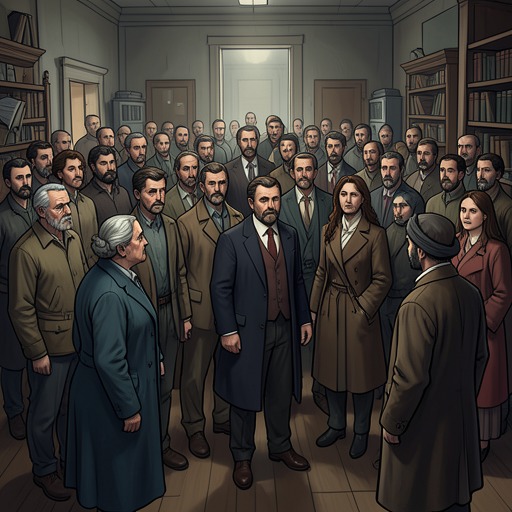
The novel also places Allison inside the group known as the Shed People, the residents most closely associated with Bobbi Anderson’s shed and the work taking place there. His involvement has a bodily mark: as the crisis deepens, his skin grows increasingly transparent and rough, while the center of his face swells into a snoutlike shape. The change makes his allegiance physically legible. He is not merely helping to preserve the group’s secrecy; he is being remade by the process that secrecy protects.
Concealment and Control
Allison participates in Haven’s effort to restrict movement into and out of town. When John Leandro approaches, the residents could have established force fields along most roads, but Allison and Newt Berringer decide against placing an inexplicable barrier where an outsider might see it and carry the story away. Their choice is a calculated form of concealment: Haven is to remain closed, but the means of closure must not reveal itself to the outside world. Leandro consequently drives past the town-line marker without encountering an obstacle, unaware that the residents have left him a way in while expecting that he will not find a way back out.
The same pattern of control shapes Allison’s role in the police communications deception. Bent Rhodes and Jingles Gabbons expect to hear from their dispatcher, Tug Ellender, but their transmissions are actually being handled by Buck Peters from the garage of Elt Barker’s Shell. Allison and other townspeople concentrate on the officers’ minds, relaying what they learn to the men operating the substitute radio. The deception does not rest only on Buck’s imitation: the listeners help anticipate the responses the officers expect, and the operators reinforce the false impression with static. Allison’s contribution belongs to a larger collective method in which access to thought turns routine communication into an instrument for steering outsiders.
Ev Hillman and the Route to the Farm
Allison’s opposition to Ev Hillman becomes explicit during the attempt to keep the older man from reaching the old Garrick farm. On the morning of the journey, Ev and Butch Dugan leave in a Jeep Cherokee carrying a large gunnysack tied with hayrope. Ev guides Dugan through a succession of increasingly remote roads—from Route 69 and gravel in western Troy to hardpan, rutted dirt, and an overgrown logging track. Dugan knows the region from years of work, but discovers that Ev knows its back roads far better.
A mile and a half beyond the town line, with the farm still several miles ahead, Ev abruptly pulls the Cherokee to the roadside and demands that Dugan identify the thought he has just heard. Dugan recognizes it as a French phrase meaning that the war is over, but protests that people cannot read minds. The moment exposes how thoroughly the town’s mental reach has unsettled even its opponents: the private thought is no longer safely private, and the journey toward the farm is also a passage into the network’s territory.
The Town’s Changing Body
During the crisis, Allison and Newt Berringer sit at Newt’s house playing cribbage while waiting for the telephone to ring. Their game is knowingly pointless because each can read the other’s hand, yet they use it to pass time while expecting Bobbi to report that Gardener is dead and that the next phase of the work can begin. The ordinary card game, stripped of uncertainty, becomes a small image of a community whose shared knowledge has not made it wiser or more humane.
When the screams associated with Bobbi’s burning reach the residents, Allison bolts from the cribbage table, eyes wild and hair standing on end. He runs for the door but strikes the wall several feet to its right and falls. The reflexive, disoriented movement makes him part of the townwide bodily shock rather than a detached observer of it. At the same time, his expectation that Bobbi’s death will permit the work to continue reveals how completely the group has organized itself around the project at the farm.
Command and Pursuit
After the screams, the town’s mental activity gathers around a new imperative. Allison’s mind returns in a low pulse, emotionally shaken but clear enough to issue a direction: everyone is to go to Bobbi’s farm and stop Gardener before he can do anything else. Hazel McCready takes up the thought, and other voices reinforce it until the Shed People’s separate minds have welded into one commanding voice. The repeated demand is to stop Gardener before he can do anything to the ship.
The command converts Allison’s private mental signal into coordinated public action. Residents abandon what they are doing and head for the farm; Rosalie Skehan leaves water running over the fish at her sink, and Elt Barker sets out on his Harley. Freeman Moss drives his pulp truck despite his regret at having liked Gardener, while Andy Bozeman and his wife join the rush in their Oldsmobile. She carries a molecule-exciter capable of raising the heat of a two-inch spot by roughly one thousand degrees in fifteen seconds, and hopes to get within five feet of Gardener. The range of means and motives in the procession shows how a shared order can unify the town without erasing individual hostility.
Change and Narrative Significance
By the time the town’s defenders move toward the farm, Allison’s face has begun to swell along with the faces of Newt and the other people who have spent time in Bobbi’s shed. He curses the decision to let the drunk remain, slamming his fist against the dashboard as he races with Newt in Dick’s pickup. His complaint is revealing: he understands Gardener as an obstacle to the group’s work, while his own changing appearance indicates that the work has already altered him.
Allison embodies the double action of Haven’s transformation. He helps preserve the town from outside scrutiny through concealed barriers and manipulated communications, but the same inward-looking community turns its shared mental capacity into a weapon against Gardener. His eventual command does not arise from a single ruler issuing orders; it forms through repeated thoughts that other residents hear, echo, and obey. That movement from individual signal to collective pursuit gives Allison’s role its force: the town’s intimacy has become a mechanism of control, and its promise of common purpose culminates in a drive toward violence.