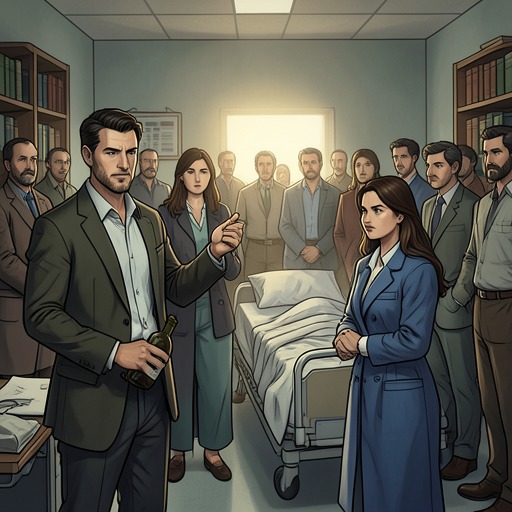
Freeman Moss
The TommyknockersFreeman Moss is a woodsman and pulp-truck driver whose practical generosity first brings Jim Gardener into Haven, then whose exceptional technical abilities make him valuable to the transformed town. His arc turns on that contrast: a man who once offers a stranded traveler warmth and coffee later helps maintain the machinery at the alien ship and confronts Gardener with a gun when Gard returns to Bobbi Anderson’s farm.
Identity and First Encounter
Moss enters the story outside Haven, where rain-soaked Gardener has walked from a ride near Augusta and is beginning to feel the cold. Moss stops his pulp truck, offers him a place in the cab, and introduces himself. Gardener accepts the warmth and the lift, as well as coffee left from Moss’s dinner and a cigarette. The truck is worn and difficult to drive, but it gets them moving through the rain.
Moss lets Gardener out just over the Haven town line at about a quarter to seven. He apologizes for not having spare shoes to lend, wishing he had brought them despite the weather. Gardener tells him his friend lives less than a mile up the road, though Bobbi Anderson’s place is actually three miles away; he does not want Moss to feel obliged to drive farther. Moss accepts this and continues home. The small deception leaves Gardener alone with the distinction he is trying to preserve: Haven is where he has arrived, but Bobbi’s house is not simply his own home.
Work at the Excavation
Later, Moss is among the people drawn into Haven’s new collective life. When the town’s residents act together after the explosion at the clock tower, they do not need to assemble in one place to be connected: the transformed community functions as a network of silent voices. Moss’s later work at the excavation shows the practical side of that shared capacity. He transports a cumbersome system of pumps from Bobbi’s dooryard to the trench, a job he completes alone over much of a Thursday, using about five hundred batteries.
Moss moves the equipment with a device resembling a metal detector paired with a handset and curved antenna. By manipulating the controls, he guides heavy components through the air and into place. Gardener recognizes that this is not ordinary labor-saving equipment: a device capable of moving construction materials so readily could dramatically reduce the cost of a large project. Its usefulness, however, depends on a substantial supply of power, linking the town’s technical ingenuity to its continuing demand for energy.
Moss recruits Gardener to help carry supplies by giving him a heavy pack connected to the radio controller. The load grows lighter as the work proceeds, while Moss operates the lifting device and explains that Gardener is unlikely to use it as effectively as one of the transformed people. Gardener tries the controls, but Moss soon takes them back. Even with the device’s assistance, the work exhausts Moss: the two men spend the rest of the day moving the equipment, and Gardener has to help the older man back to his truck.
The effort does not end with that punishing day. Moss returns promptly the next morning in a battered split-grille Pontiac, carrying a dinner bucket and ready to resume work. Gardener respects him more than the other helpers and likes him, a judgment built through repeated labor rather than through a single display of technical skill. Moss comes back again on Saturday and raises the pumps to full capacity. He sets each of the four pumps to move thirty-five gallons per minute, for a combined rate of 8,400 gallons an hour. By the following morning, however, he has not returned, and Gardener understands that Moss, like other workers, has finally been depleted.
Ties to the Changed Town
Moss’s work is part of a larger transformation in which knowledge and coordination have become ordinary features of Haven life. The inhabitants have been acquiring knowledge without noticing when it began; what once would have seemed extraordinary feels as automatic as a heartbeat. The town’s mental connection allows people to act in concert, but it does not make them peaceful or ethically unified. During the search for David Brown, the residents’ joined minds create an overwhelming signal, yet David is understood to be not-there rather than merely lost. In another search, tempers flare and fistfights break out despite the same capacity for mental communication.
The town’s shared consciousness also explains why its cooperation cannot be treated as a simple sign of harmony. Its residents can remain linked while continuing separate routines, then gather rapidly when a crisis requires action. Moss’s technical work belongs to this collective effort, but his later actions show that participation in the network does not erase individual choices. He remains a particular man, with a history of practical kindness toward Gardener and a later allegiance that puts the two men on opposing sides.
The evidence of the town’s change is not limited to machinery. When Bobbi’s screams spread through Haven, the residents stop what they are doing and drift into the village streets. Their first response is distress, followed by anger, and they know who has caused the cries. That collective reaction foreshadows the danger Gardener will face at the farm: the town’s unity can focus into pursuit and conflict as readily as it can mobilize people to work.
Return to the Farm and Death
After Bobbi has disappeared, Moss does not come to the excavation that morning, leaving Gardener alone there for the first time since her disappearance. When Gardener later returns to Bobbi’s farm, Moss arrives first in the same pulp truck that once carried Gardener into Haven. He is waiting in the dooryard and supporting himself with a metal whirligig stand. Gardener recognizes him as one of the people who has come against him, but their earlier acquaintance still gives the encounter a personal charge.
Gardener addresses Moss by name and tells him he should have stayed home and watched the Red Sox. The remark recalls an ordinary domestic life that now feels far removed from the immediate danger. Moss has rushed out of the house in a down-filled vest with no shirt beneath it. He pushes the vest aside, revealing a Colt Woodsman, and draws the gun. Gardener stands facing him while holding the whirligig’s post, one foot raised.
Gardener ducks, and Moss’s attention shifts to the whirligig as it begins to spin. The apparatus produces a green, umbrella-shaped flare that is an illusion rather than a source of heat beneath it, but the fire at the device’s perimeter is real. Moss is at the edge of that circle; his trousers and vest catch fire, and he drops the gun as he retreats. The whirligig spins faster, spreading the flames outward. Moss is killed in the blaze, which also burns across the dooryard and reaches the surrounding vehicles. His death completes the reversal in his relationship with Gardener: the driver who once helped him reach Haven has become an armed opponent of his return to Bobbi’s farm.
Narrative Significance
Moss’s part in the story joins two forms of transportation and power. At first, his battered truck carries a vulnerable stranger through bad weather; later, alien-influenced technology lets him move machinery through the air and support the excavation. Both episodes make him a practical intermediary, someone whose value appears through what he can get moving and where he can take it. But the same town that turns unusual knowledge into routine also draws people into a collective struggle whose consequences are not benign.
The return of the pulp truck at the farm makes that change especially legible. It is the vehicle that once brought Gardener safely to Haven, now driven by the man who confronts him there. Moss is neither reduced to his technical usefulness nor introduced as an inevitable enemy: the story first gives him a recognizable act of kindness, then establishes his repeated commitment to the town’s labor, before ending his arc in the conflict surrounding Bobbi. The movement from ride to excavation to fatal confrontation gives his brief but consequential role its shape.