Haven's Mass Becoming
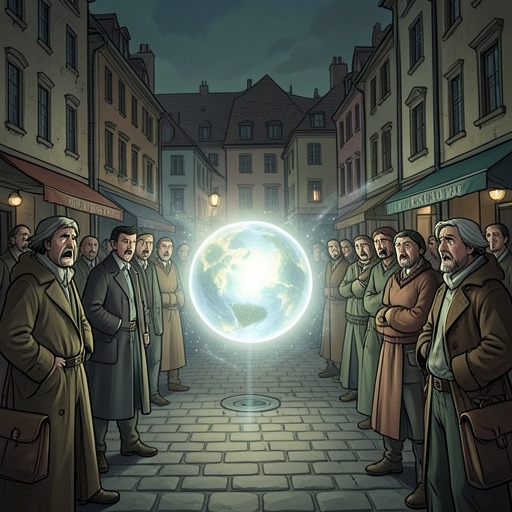
The TommyknockersHaven's Mass Becoming is the gradual, town-wide transformation through which a buried alien power reshapes Haven’s bodies, knowledge, and social bonds. Beginning with symptoms that could be mistaken for illness or a punishing summer, it advances into shared thought and physical change, until the townspeople’s love for one another becomes inseparable from the force holding them in place. Ruth McCausland, among the first to recognize that the change is dangerous, gives the process its clearest human measure: to remain in Haven is to be drawn into it, while trying to leave means escaping a community that insists it loves her.
Early Symptoms and the Spread of Knowledge
Ruth was unusually close to the town’s emotional center, and she was consequently among the first to feel the change. A headache began in July, sometimes faint and sometimes suddenly pounding behind her forehead. On July 4, the pain became bad enough that she canceled her plan to see the fireworks in Bangor with Christina McKeen. She went to bed beneath a lingering evening light, but the heat and humidity kept her awake; the summer had been among the stillest and hottest she could remember. The discomfort and sleeplessness initially offered ordinary explanations for what was beginning to happen.
The bodily symptoms were followed by bad dreams and a new, difficult-to-name capacity. On the day the Paulsons’ house burned, Ruth realized that for a week or more she had been knowing things she had no right to know. The knowledge had arrived without spectacle: it felt as natural and constant as her heartbeat, and was shared across Haven. But recognizing that it was there also meant recognizing its danger. The town’s new awareness was changing Haven, and the change was not good.
That knowledge did not make Ruth an all-knowing observer. She could sense that something was wrong without understanding all of its workings, and her own thoughts were increasingly entangled with what the town shared. In the week between the Paulsons’ fire and Hilly Brown’s second magic show, her headaches and disrupted sleep persisted as the social consequences became harder to ignore. The transformation unfolded not as a single revelation but as an accumulating disturbance: bodily pain, half-remembered dreams, and facts that seemed to belong to everyone at once.
A Community Made into a Network
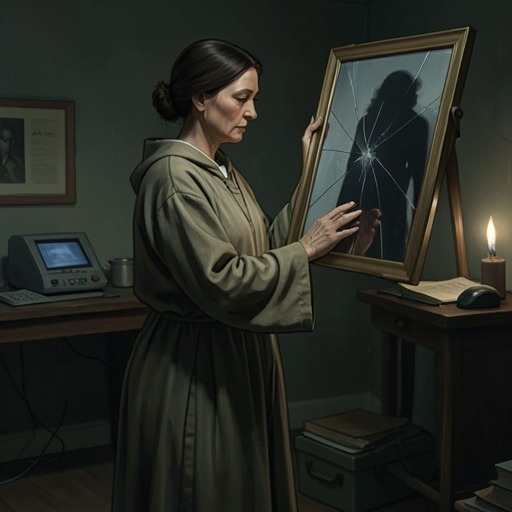
Several days before David Brown disappeared, Ruth understood that Haven had begun to ostracize her. No one attacked her in the street, and she could still sense traces of the town’s old kindness. Yet people turned to watch her walk from home to her office in the town hall. She kept her head up and her face serene while her head throbbed and the previous night’s terrible dreams clung to her. Beneath the town’s surface civility, she knew its people were waiting for her to “become.”
The town’s everyday institutions registered the change in quieter ways. Ruth continued to receive bills, circulars, and catalogues, but no personal letters. After three days without any, she went to the post office, where Nancy Voss stood behind the counter and looked at her expressionlessly. As Ruth spoke, the weight of Nancy’s stare seemed almost physical. From within the office came a humming and spiderlike scratching sound; Ruth could not identify the apparatus making it, though it sorted the mail. A routine trip to collect letters had become an encounter with an altered, impersonal system—and a stark demonstration of Ruth’s isolation.
Ruth later understood the transformation as a shared pool of thought: a communal well of knowledge that she would once have dismissed as madness. She knew that Bobbi Anderson had started it inadvertently. Bobbi and her friend from Troy were spending twelve- and fourteen-hour days at the dig, intensifying the process, although Ruth could not know precisely what they were doing. The friend remained a blank in the town’s shared awareness: Ruth knew him only from having seen him on Bobbi’s porch, and sensed that he stood outside the communal net.
The dig’s concealed object came to Ruth in a dream. She saw a silver cylinder about two hundred feet across, with a smaller steel cylinder projecting from its center; a plus sign was etched into the protruding piece. On waking, she understood the image as a gigantic alkaline battery buried in the earth and granite behind Bobbi’s house—larger than Frank Spruce’s dairy barn. The comparison was not literally true, but it gave form to what Ruth could otherwise only sense: Bobbi had found an immense power source and become its prisoner, while the same force was galvanizing and imprisoning Haven. It was growing stronger.
The transformation also altered bodies. Ruth’s dolls, speaking throughout the night, told her that her brain was changing and that an X-ray of anyone in Haven would reveal the change to a neurologist. Her teeth, too, were “becoming”; her brown eyes were fading toward hazel, as she had noticed the bright blue eyes of Beach Jernigan changing in the same direction. The dolls named the process an invasion from space and directed her to look for its signs in Beach’s eyes, Wendy’s, and her own. Ruth understood the bodily change not as an abstract alteration but as being eaten up: the familiar self was being consumed from within.
Escape, Resistance, and the Town’s Embrace
Ruth’s increasing knowledge did not translate into a safe path of action. Her mind warned her to let the change run its course: Haven’s people had loved her, and their voices still seemed truthful when they said that they did. But that love carried a threat. If Ruth interfered, the town might kill her gently, with love. The warning made the transformation’s central contradiction plain: its shared affection was real, yet it served a collective force that could absorb or destroy anyone who resisted.
She nevertheless tried to get away. Once on Derry Road, Ruth fought an urge to drive her Dart as fast as its age allowed. As the village fell behind and the rustling voices receded, she felt like a lucky escapee from a den of lions, but also expected pursuit. She kept checking the rearview mirror for vehicles coming to bring her back. The town’s love had become a mechanism of confinement: in her mind, they would insist she return because they loved her too much to let her go.
The effort to escape did not free her from the transformation. She later came to a stop outside the Fannins’ house, left the key in the car, and lost three hours. When she returned to herself, the town-hall clock was striking six, and an incisor lay on her lap. The missing time and the lost tooth made the process tangible: resistance could interrupt her awareness, but it could not preserve her body from changing.
Consequences and Significance
Ruth’s dolls offered a grotesque commentary on what was happening. Their story joined the altered brain, lost teeth, and changing eye color to the familiar imagery of cheap science-fiction invasion films. The allusion did not make the threat less real; it made the impossible recognizable, then turned that recognition inward. The invaders were not somewhere beyond Haven. Their signs were in the eyes of the townspeople and in Ruth’s own changing body.
The event thus transforms a small town through both extraordinary power and ordinary social life. Shared knowledge spreads without announcement; the post office still handles its mail; neighbors still appear to care. Yet these familiar arrangements now carry the force of the change, and personal attachment can threaten the person it embraces. Ruth’s trajectory—from headache and bad dreams, through dawning knowledge and ostracism, to a failed escape marked by lost time and a tooth—reveals the human cost of Haven’s Becoming. The town does not simply learn that something has invaded it: its residents are made part of the invasion, and their community becomes the means by which it advances.