Haven, Maine
The TommyknockersHaven, Maine, is the small central-Maine town where Roberta “Bobbi” Anderson stumbles upon the buried spacecraft on June 21, 1988. At first it is a place of chosen retreat: a familiar community, a large wooded property, and a life that Bobbi has come to accept as her own. As the novel develops, however, the town’s ordinary ties and routines are overtaken by a shared mind and physical changes linked to the activity in Bobbi’s shed. Haven’s transformation turns the security of belonging into a force that makes departure increasingly perilous.
Setting and Bobbi’s Long Stay
Bobbi’s discovery takes place while she is walking with Peter, the aging beagle Jim Gardener gave her in 1976. She had left college the previous year with only two months remaining before her degree, moving to the property her uncle left her. The dog, once a puppy, has become a measure of the years she has spent there; by 1988, she is thirty-seven, and what she once thought would be a temporary stay has lasted thirteen years.
The property is still commonly called the old Garrick place. It has only 180 feet of frontage on Route 9, but its diverging rock-wall boundaries enclose a vast, pie-shaped tract. An old rear boundary lies about three miles into forest, and beyond the western edge are miles of New England Paper Company wilderness, marked on the map as Burning Woods. Most of Bobbi’s trees are valuable hardwood, relatively untouched by the gypsy-moth infestation. On the day she finds the buried object, she is out looking for firewood, despite already having a cord and a half stored and hoping to cut three more for winter.
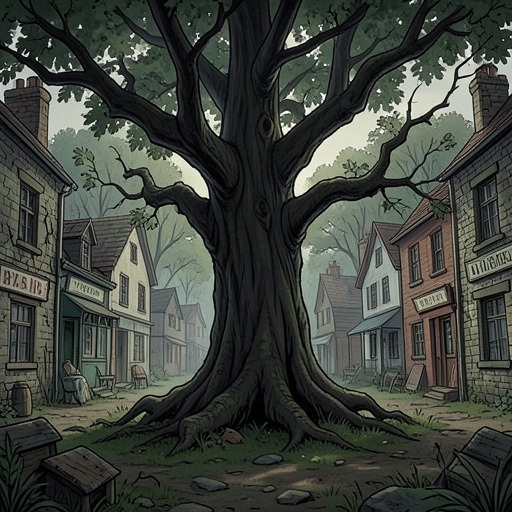
The town is introduced through the ease of a summer walk rather than through crisis. After a rainy spring, Bobbi enjoys the lush greenery on the first day of summer, swats mosquitoes, and lets Peter lead at his own pace. She recalls that she had once expected to remain in Haven only long enough to recover from adolescence, her sister, and her withdrawal from college. Years passed into thirteen, and her present expectation is that she may spend the rest of her life there, apart from occasional duty trips to visit her publisher in New York. The town, the place, and the land have gradually become a home she accepts rather than a stopover.
A Quiet Town Drawn into Bobbi’s Story
Haven’s relative quiet is part of its initial appeal. Bobbi describes it as a good place to rest, though it lies in a part of Maine many tourists pass by on their way elsewhere. The countryside and the town’s rhythms make it possible for her to settle into a life of writing, woodcutting, and familiar routines. That rootedness is set against the larger journeys of Jim Gardener, who is away on the New England Poetry Caravan in late June, reading in Fall River and then in Boston, Providence, and New Haven.
The contrast between a settled home and a place that can be left becomes increasingly important. Bobbi’s stay began as a retreat from unsettled circumstances, but it has become a long-term attachment to the town and land. Meanwhile, the events gathering around the buried spacecraft reach beyond her private property: Haven’s residents become participants in a shared change, and outsiders arriving in town encounter a community whose ordinary public life no longer tells the whole story.
The Community’s Collective Change
The town’s altered character becomes visible in the days around Ruth McCausland’s funeral. On a brisk, clear day in late July, outsiders come into Haven, and the Haven Lunch fills with visitors ordering hearty breakfasts. Yet many leave their food half-eaten; their appetites fade, their expressions lose their animation, and conversation in the crowded restaurant dwindles. The pleasant weather and familiar New England summer setting remain, but the town’s social atmosphere has shifted beneath them.
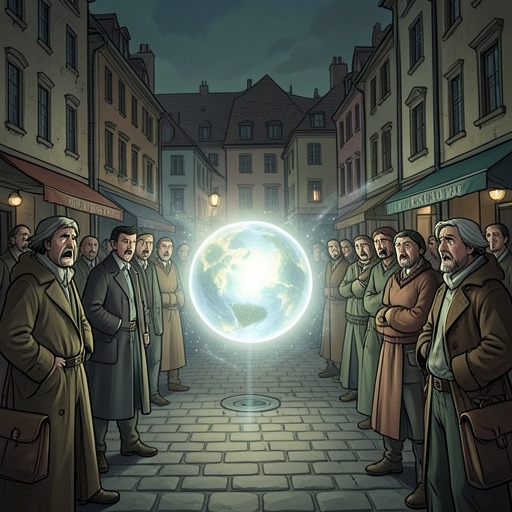
At the funeral, townspeople answer the church bells and gather together. Families and residents from across Haven arrive, including Tremains, Thurlows, Applegates, Goldmans, Duplisseys, and Archinbourgs. As they assemble, their minds draw together into one mind, alert to the outsiders and to any discord in thought. The bells summon a community in which private consciousness is becoming collective; the gathering is not simply a public observance but a sign of Haven’s new unity and its growing separation from those who have come from outside.
The same shift shapes Ruth’s wake at the library, where the group has agreed the institution will be renamed the Ruth McCausland Memorial Library. Residents eat and drink, but their outward conversation conceals a silence in which little is said aloud. Their attention is on Bobbi and the other people who have entered the shed and disappeared into its green light. Once the last outsiders leave after the graveside benediction, Haven’s residents have the town to themselves again. The funeral’s public language of mourning and remembrance thus coexists with the private coordination of a changed community.
The Shed, Communication, and Confinement
By August 2, the transformation has acquired an informal leadership and a new means of communication. Six people meet in Newt Berringer’s office late in the afternoon: Newt, Dick Allison, Kyle, Hazel, Frank Spruce, and Adley McKeen, the most recent to have spent time in Bobbi’s shed. Although the meeting is taking place close to five o’clock, the clock in the town’s tower still reads five past three. The familiar civic landmark appears intact but is no longer a reliable measure of ordinary time; the account also notes that a bird could fly through the tower, because there are no birds left in Haven Village.
The six discuss their concerns without speaking aloud. Across the town, thought-language is becoming more common, with communication taking the form of images as much as words. This new mental connection accompanies the residents’ growing physical dependence on what is happening in the shed. Their concern includes Bobbi’s condition, and the people who have been drawn into the shed’s influence are no longer simply neighbors observing a strange event from a distance.
The need for batteries exposes the cost of that dependence. Dick has sent two underage youths to Derry in a pickup truck to obtain them, because it is becoming harder for Haven residents to leave town. Older people such as Dave Rutledge or John Harley would likely die before reaching the Derry city line; younger residents such as Newt and Dick might travel farther, but would also be expected to suffer as the physical changes associated with the shed progressed. The possibility of leaving does not provide an easy escape: the outside environment has become hostile to the changing residents, while conspicuous protective equipment would invite attention. Haven’s inward-looking unity therefore carries a material consequence—its inhabitants are increasingly trapped within the place whose transformation binds them together.
From Refuge to Enclosure
Haven’s significance lies in the reversal of its promise. For Bobbi, the town first offers a place to settle after college and recover from earlier upheaval; its wooded land and quiet routines make staying seem like a choice. Later, the same rooted community becomes a collective system whose members watch outsiders, communicate without speech, and organize their concerns around the shed. The movement from individual refuge to shared, restrictive belonging gives the town’s changing landscape a human counterpart.
The novel marks that change through ordinary local details made unreliable or altered: the familiar lunch counter where visitors cannot finish breakfast, the church bells that draw the townspeople into a single mind, the library wake where outward talk masks inner silence, and the tower clock fixed at the wrong time. The forest remains a place for work and wandering, but it is also the setting of Bobbi’s discovery and the growing influence that reshapes the town. Haven is therefore not merely the backdrop to the buried spacecraft’s emergence; it is the community most directly remade by it, and the place where belonging and confinement become difficult to separate.