Haven’s Ecological Transformation
The TommyknockersHaven’s Ecological Transformation is the spreading ecological damage that turns the woods around the buried spacecraft into a landscape of absent birds, dead wildlife, and endangered animals. The change is first legible through animal behavior and unexplained deaths; later, the silence itself becomes evidence that the ship’s influence reaches beyond the human excavation. Peter’s fate makes that environmental warning personal and exposes the cost of treating other lives as instruments.
Early Warnings in the Woods
When Bobbi Anderson uncovers a small section of metal, Peter approaches it, then backs away, sits, and gives a single low howl. His reaction makes the object seem dangerous before Anderson can say what it is. At first, the evidence can still be explained away: she has encountered a dead woodchuck nearby and reasons that it may have eaten poisoned bait. But there are no flies around the carcass, a detail that unsettles the ordinary explanation even as she dismisses a connection to the object.
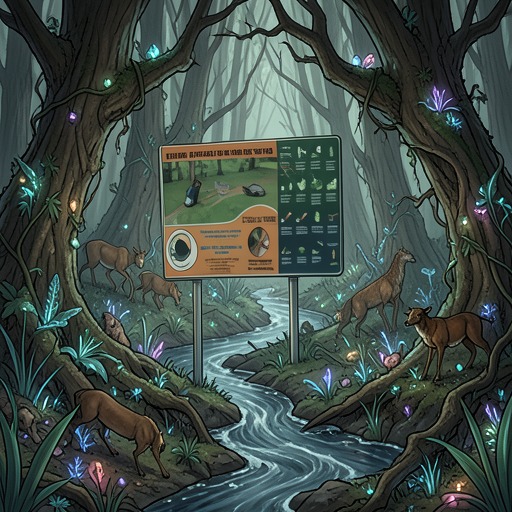
The warning becomes harder to contain as Anderson investigates. On the slope below the trench she finds a dead sparrow, a crow, and three more birds: another crow, a blue jay, and a scarlet tanager. None bears visible marks, and none has attracted flies. Their deaths are not presented as a single dramatic catastrophe; they accumulate around the dig as small, troubling absences that turn the local woods into evidence of an environmental effect.
Silence as Evidence
By the time Bobbi Anderson and Jim Gardener are together in the woods, the absence of birdsong has become conspicuous. During an intimate reunion, Gardener notices that no bird is singing; later, looking at Anderson, he again registers the stillness and the woods’ threatening character. The silence changes the setting from a refuge for the two characters into a sign that the surrounding life has been diminished.
Gardener connects the quiet to a possible danger emanating from the spacecraft. He fears that it may be leaking something, and imagines the consequences for wildlife unable to understand or flee an industrial hazard. He compares the prospect to a nuclear-plant disaster: people might escape if warned, but owls, woodpeckers, and tanagers could not be told to leave. The comparison is his fearful interpretation, not a confirmed technical explanation, but it gives the dying animals a distinct place in his moral calculation. The novel’s ecological crisis is not merely scenery for the excavation; it raises the question of who can recognize danger and who must bear it without warning.
The Reach of the Transformation
The loss extends beyond wild birds. Gardener observes that insects, birds, and beasts seem to have disappeared from the area, and says that the site repels everything except the people who remain there. The disappearance of bugs is striking because he contrasts it with the ordinary expectation of waking up covered in insect bites during a Maine summer. His observation broadens the evidence from scattered carcasses to a changed local environment, while leaving the exact mechanism uncertain.
The transformation also reaches into Haven itself. In the August heat, the town is described as having entered the dog days, but there are no dogs left in Haven—apart from the possibility of one in Anderson’s shed. That qualification points toward Peter, whose presence is hidden from the ordinary community and whose experience is bound to the excavation. The seasonal phrase, usually associated with summer’s heat, acquires a harsher meaning when the animals that give it its familiar life are gone.
Peter and the Human Cost
Peter’s reactions trace a disturbing progression. He first howls at the exposed metal; later, his fear and trembling give way to a growl and a snarl so unlike his usual behavior that Anderson recognizes rage in it. She can entertain the possibility that the spacecraft has killed a woodchuck, and can accept other strange changes in her dog, but cannot accept the possibility that Peter’s fury is directed at her. The change therefore unsettles not only her understanding of the woods but also her trust in a companion she knows well.
Gardener’s concern deepens when he recalls Peter’s fear of thunder and wonders whether Anderson has put him in the shed. He has seen green material on her dress and hairs, clues that connect Peter to something she is concealing. When he finds Peter connected to equipment in the shed, the animal’s altered state is no longer only an ecological signal: it is also evidence of what the work has done to an individual creature. Peter’s running movements in the liquid suggest continued life and motion, but his condition fills Gardener with despair and anger at Anderson. The contrast is stark: the people pursue the buried technology while the animals register its effects, disappear from the landscape, or become entangled in the project itself.
Significance
The ecological transformation unfolds through observations that are easy to minimize one at a time: a dog’s howl, a woodchuck attributed to poison, birds without visible wounds, a conspicuous absence of flies, and then a woods without birdsong. Repeated details make denial progressively more difficult. The animal deaths and disappearances give the spacecraft’s influence an environmental scale before the characters can establish its precise cause.
The novel also distinguishes human agency from animal exposure. Gardener can imagine warning people and evacuating them; he knows that wildlife cannot receive such a warning. His analogy with nuclear contamination frames the spacecraft as a possible source of dangerous leakage, while the narrative’s accumulating animal evidence keeps the harm immediate and local. Peter concentrates that ethical problem: loved and familiar, he cannot be reduced to a symptom, yet his suffering is bound to the human decision to keep digging. Haven’s altered ecology thus measures the widening consequences of the excavation and the lives its participants fail to protect.