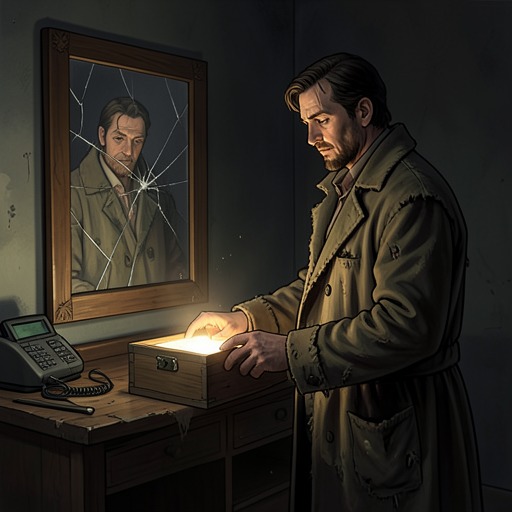
Heeley's disappearing device
The TommyknockersHeeley’s disappearing device is a homemade machine Hilly Brown builds into an orange-crate stage to make objects disappear and reappear. It first seems to offer the boy a genuinely astonishing magic trick; when he uses it on his younger brother David, however, the device takes the performance beyond anything Hilly can undo. Its story links improvised household technology to the gap between making a machine work and understanding what it can do.
Construction and Operation
Hilly conceals the device inside an orange crate covered by a sheet. He assembles it from batteries David had seen in his room and components taken from an old Texas Instruments calculator that Hilly stole from the bottom of his mother’s desk. A foot pedal from his mother’s sewing machine, hidden in a fold of cloth, is wired to the apparatus with spring-connectors she had bought for him in Augusta. The stage is therefore both a performance surface and a cover for the controls: Hilly can activate the device while appearing to perform a conventional trick.
The machine works by making an object vanish and then return. During Hilly’s first demonstration, he places a tomato on the platform, covers it with one of his mother’s silk scarves, and secretly steps on the pedal. After a brief hum, the lump beneath the scarf disappears. He removes the scarf to show the bare platform. The device’s effect is not merely an illusion that deceives the audience: it actually removes what Hilly has placed on the stage. That distinction is the source of both its apparent marvel and its danger.
The Magic Show
Hilly presents the invention at his second gala magic show, hoping above all to impress his father. Although the tricks now work in a way that would have been impossible with ordinary stagecraft, the audience responds with polite applause rather than amazement. Hilly cannot understand why spectators remain unmoved when he believes he has made something extraordinary happen.
His routine repeats the same basic disappearance and return with increasingly large objects. After the tomato, he makes a radio disappear and brings it back; the radio is his father’s, and Hilly has made it lighter by using its eight D-cell batteries in the apparatus. The technical escalation does not create a stronger performance. Hilly has mistaken an actual effect for a varied show, and the repeated structure leaves the audience bored even as the machine’s capabilities become more consequential.
David’s Disappearance
Hilly had planned to work up to a Grand Finale, but the lack of audience interest unsettles him. He skips the proposed disappearing bookcase, exercise cycle, and motorcycle, and turns instead to the disappearing little brother. The change is an impulsive leap from objects he can handle as props to a person whose absence cannot be treated as another routine.
Hilly places David, covered by a sheet, on the platform and activates the device. The sheet settles, and Hilly pulls it away: David is gone. The response differs from the earlier polite applause. Bryant Brown sits up, and Marie Brown and Mrs. Crenshaw stop their conversation, while Ev Hillman looks worried. But nobody immediately investigates the stage to establish what has happened. Ev leaves, partly retreating from the possibility that his birthday gift contributed to Hilly’s distress, and Hilly is left alone with the result of his act.
Failure to Reverse the Effect
After Ev has gone, Hilly returns to the platform and presses the concealed pedal, expecting the sheet to rise into David’s shape. The machine hums, but David does not reappear. Hilly tries again, now pleading inwardly for the device to work and promising to give David his G.I. Joe toys, including the MOBAT and the Terrordome. These attempts do not restore his brother. The apparatus has demonstrated that it can remove and return objects, but Hilly’s experience supplies no assurance that he can reverse its action on David.
The contrast with the tomato and radio tricks is decisive: those demonstrations allowed Hilly to control the sequence and receive the object back, whereas the disappearing little brother becomes an absence he cannot repair. The device’s capacity is shown more clearly than its underlying mechanism or limits. Its operation does not make Hilly its master; he can trigger it, but he cannot make it answer to his wishes once David has vanished.
Significance
The device makes the ordinary materials around Hilly—batteries, calculator parts, sewing-machine pedal, orange crates—part of an invention with consequences beyond his understanding. Its apparent simplicity and successful demonstrations encourage him to treat a real disappearance as an enlarged version of a magic trick. The escalating scale of the performance exposes the flaw in that assumption: the machine can repeat an effect, but repetition is not control, and a trick that returns a tomato or radio does not guarantee that David will return.
Hilly’s show also turns the difference between spectacle and consequence into the device’s central irony. The audience is bored by genuine marvels when they take the form of repetitive tricks; the moment the invention affects David, the effect is no longer entertainment. What began as a machine designed to win recognition instead becomes the instrument of Hilly’s guilt and fear, while its failure to bring David back marks the boundary between the power to make something happen and the knowledge needed to govern it.