Leandro’s Death in Haven
The TommyknockersJohn Leandro’s death in Haven is the fatal culmination of his attempt to report what is happening in the town: he gets past its boundary, but the evidence he hopes to gather cannot protect him from the town’s airborne threat or its weaponized machinery. His death closes his own investigation, not the story; David Bright’s subsequent certainty that Leandro has died becomes the point at which the report reaches the authorities.
Background and Stakes
Leandro’s return to Haven follows a moment of hard-won trust. Standing at a phone kiosk, he tells Bright what he has uncovered and recognizes that the story is too dangerous to keep to himself. He expects to go back into town, where something might happen to him, and wants someone else to know what he is pursuing. Bright may find him exasperating, but Leandro trusts his honesty and believes he will not betray him. The decision to share the scoop marks a shift from chasing a story alone to accepting that its consequences may exceed his control.
On the drive back, Leandro does not know that Haven has become, in effect, a separate country, with its borders policed. The local crisis has escalated while he has been away, but he encounters none of the town’s new arrangements as a clear warning. He is thinking about his report and, in an ordinary counterpoint to the danger ahead, eating cheeseburgers as he drives. The gap between his routine journey and Haven’s emergency makes his entry a collision between a reporter’s familiar world and a town that has become perilous and isolated.
Entry into Haven
Leandro’s radio begins to lose its signal near the Baptist church, the sound giving way to a rising murmur of other voices. As nausea sets in, he pulls over and puts on an oxygen mask; the queasiness subsides, though his nervousness remains. In the mirror, he sees an expression of unusual seriousness in his own eyes. He is uneasy about the change, but understands that there is no longer any point in pretending he is outside the story.
The town line itself offers no visible barrier. Haven’s defenders have considered closing the roads, but in the confusion they choose not to place an inexplicable force-field obstacle where outsiders might encounter it and carry word back beyond town. Leandro, unaware of that decision, drives past the marker without difficulty. The absence of a checkpoint or other obvious obstruction gives him no reason to grasp how completely the town has withdrawn from the world around it.
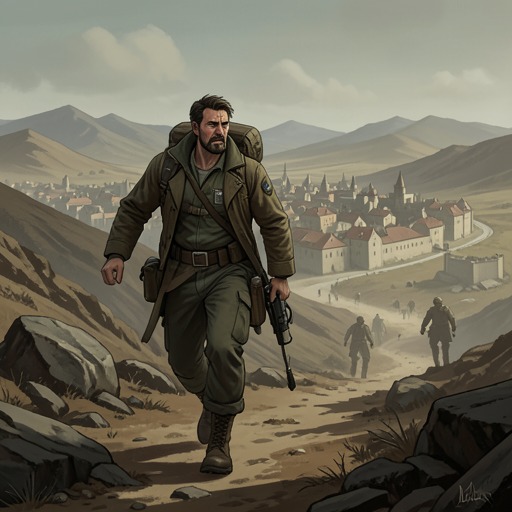
About two hundred yards inside Haven, his Dodge stops. Unlike many local vehicles, it has not been modified to withstand the electromagnetic field emitted by the buried ship. The engine will not turn over, leaving Leandro stranded inside the dangerous zone. He tries the ignition again, then gathers his camera and steps out, watching the woods beside the road and reacting to a sound behind him. He sees nothing, but the failed car has already changed his task: he is no longer simply driving toward a story; he must find his way on foot.
The Vending-Machine Attack
A Coca-Cola vending machine that had stood outside Cooder’s market approaches through the air. Leandro first interprets the sight through the language of advertising and absurdity, imagining that he has blundered into a strange commercial. Then he recognizes what the machine represents as a photograph: an everyday object flying along a rural road. He reaches for his Nikon, still trying to record the impossible even as the machine accelerates toward him.
The machine strikes Leandro as he tries to get out of its path, and his camera hits the roadside. It turns back toward him. He attempts to reach the disabled car, then throws himself away from the machine’s next approach. The scene repeatedly gives him a brief opening to think, move, or document what is happening, only for the object to turn and come after him again. The camera, initially his tool for making the extraordinary visible, cannot stop the attack or secure the image he hoped to take.
Leandro draws his pistol and fires four times from his knees. The third shot breaks the vending machine’s glass, but the rounds do not halt its advance. The machine strikes him and kills him. Afterward, it turns back toward Haven Village, spilling coins along the road. That mundane trail of quarters, nickels, and dimes underscores the reversal: a familiar machine has become an autonomous threat, while the reporter trying to make it legible is no longer able to tell what he saw.
Aftermath and Narrative Significance
The account makes a distinction between Leandro’s death and the survival of his story: the scoop remains, although its reporter does not. Bright had promised to give Leandro until four and had intended to keep that promise. He did not dismiss Leandro as a liar, despite finding his claims difficult to believe. As the afternoon passes, Bright’s attention returns to Leandro’s desk and the covered word processor, and his growing sense that something has happened hardens into certainty that Leandro is dead.
Bright’s response carries the report beyond Haven. He calls the state police barracks, where he speaks with Andy Torgeson, a longtime acquaintance, and begins recounting the investigation. The call is, to Bobbi Anderson and Jim Gardener, effectively a long-distance call to the Dallas Police. Leandro’s attempt to make sure someone knew what he had found thus acquires its consequence after his death: Bright keeps faith with the story and sends its warning outward.
The scene’s central irony is that Leandro succeeds in crossing Haven’s boundary only because the danger is not presented to him as a barrier. His oxygen mask helps him breathe in the poisoned air, but it cannot neutralize the electromagnetic field that disables his car or the machine that attacks him. The vending machine’s familiar commercial form makes the threat appear momentarily absurd, then becomes the means of his death. Leandro cannot deliver his scoop himself; the trust he placed in Bright ensures that the scoop outlives him.