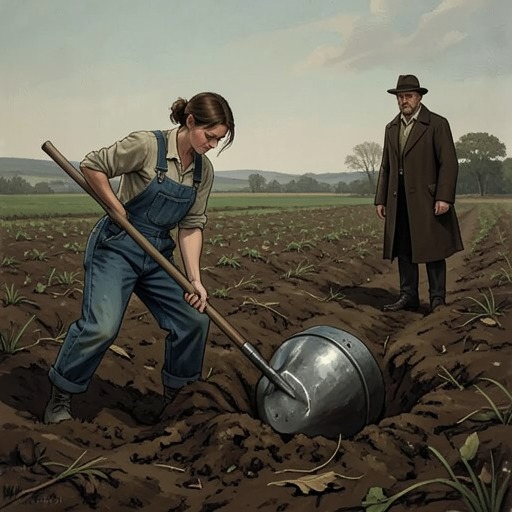
Roberta “Bobbi” Anderson
The TommyknockersRoberta “Bobbi” Anderson is a solitary former college student living on her uncle’s property in Haven, Maine. On June 21, 1988, while looking for firewood with her aging dog Peter, she stumbles upon a gleam of buried metal. Her recognition that the object is a spacecraft transforms a routine afternoon into the discovery that sets the novel’s central plot in motion.
Identity and Background
In 1976, Anderson left college two months short of completing her degree and moved to her uncle’s property in Haven. The move had left her lonely; Jim Gardener brought her Peter, then a puppy, and the dog became part of her daily life. By 1988, Peter was an old beagle, blind in one eye. His age offers Anderson an unignorable measure of her own: at thirty-seven, she can no longer sustain the comforting idea that adulthood is merely a clerical error that will eventually be corrected.
The property, still commonly called the old Garrick place, stretches far beyond its narrow frontage on Route 9. Its rock-wall boundaries lead into a large, rough forest, with more wilderness beyond the western edge. Anderson knows the land through work and familiarity: she has already laid by a cord and a half of wood and wants to cut three more cords to carry her through the winter. Her discovery comes not during an expedition but within this established, practical routine.
The Discovery
On the afternoon of June 21, 1988, Anderson is out with Peter looking for a place to cut wood. She trips and scrapes her face. After checking her bloodied hand, she looks for an ordinary obstacle, expecting a fallen tree or a rock in the Maine ground. Instead, she sees a gleam of metal under the forest dirt, touches it, and brushes away some of the soil.
The small glimpse changes the scale of the scene. What first appears to be an exposed piece of metal becomes, in Anderson’s mind, evidence of a spacecraft. She understands that the object in the earth is a ship from space and considers that it may have landed or crashed there long ago, perhaps millions of years earlier. The book makes the discovery an abrupt threshold: a stumble in familiar woods opens onto a history far beyond the human timescale.
Certainty and Interpretation
Anderson recognizes that the speed of her conclusion is not what troubles her most. It is the certainty behind it. She tries to imagine keeping an open mind, but the struggle, as she frames it, will be to remain open to what her sister Anne would call sanity. Anderson refuses to dismiss the possibility merely because it seems extraordinary; she sees refusing to follow a logically supported line of speculation as a limitation rather than proof of reason.
She briefly sets the discovery against familiar explanations and cultural references, including the Air Force’s closed file on flying saucers, ancient-astronaut theories, the Bermuda Triangle, and the biblical image of Elijah being taken up in a wheel of fire. None dislodges her conviction. Her decisive response is not a cautious hypothesis but a recognition: the thing is a ship, and it has been buried for a very long time. Fear, awe, and restless excitement accompany that certainty, establishing the emotional mixture that attends the novel’s opening revelation.
Narrative Role
Anderson’s stumble gives the novel its initiating event, while the narrative’s opening reflections place that accident beside the idea of fate. The old saying about a kingdom lost for want of a nail supplies a pattern for thinking about consequences that begin with something small; the metal glint in the ground becomes the first visible link in a much larger chain. The contrast between her practical search for winter firewood and the cosmic scale of what she finds makes the discovery feel both accidental and momentous.
The buried ship first appears as an obstruction in a landscape Anderson knows well, then becomes an object whose meaning reorganizes that landscape. Her immediate certainty makes her not merely the finder of the craft but the first interpreter of its significance. The novel begins with her ordinary life still intact around the discovery, even as the object beneath her feet has already made that ordinary understanding impossible.