Ruth McCausland's Clock-Tower Signal
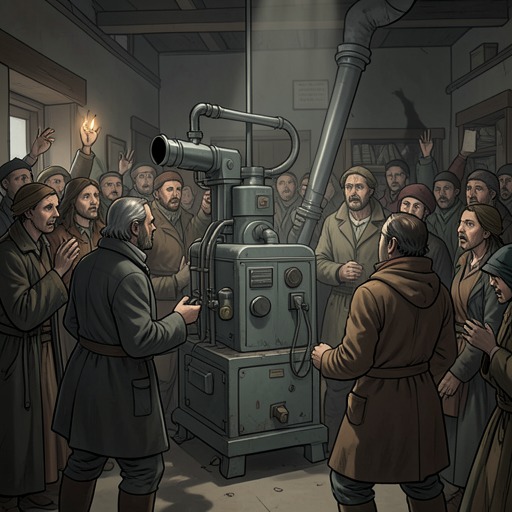
The TommyknockersRuth McCausland's Clock-Tower Signal is Ruth's last act of resistance to the Tommyknockers: as their influence overwhelms Haven, she turns her dolls into a device intended to send a warning beyond the town. The plan culminates in an explosion at 3:05 P.M. that destroys the town-hall clock tower, kills Ruth, and nevertheless reaches Jim Gardener as a partial signal. Its failure as a reliable escape or rescue mechanism does not erase its success as testimony: Ruth recognizes the voices as alien, acts on that knowledge, and dies sane.
Causes and Preparation
By Friday, Ruth understands that a brief respite on Wednesday and Thursday has only interrupted an ongoing process. She is being driven toward the same alien madness she sees taking hold of Haven, and although part of her mind recognizes the danger, it cannot stop what is happening. The voices of the dolls remain a possible source of truth amid the confusion. In the schoolroom, she takes her sharpest kitchen knife and begins the work of sending a signal.
The town has started calling the green light Tommyknocker-light, and Ruth accepts Tommyknockers as the name for the force behind it. In her thoughts, the townspeople’s love for her has become homicidal, yet their continued fear of her suggests that she may still have time to act. The signal is her remaining chance to be heard, seen, and understood. This motive gives the improvised apparatus its urgency: she is not simply making strange inventions but attempting to alert someone outside the town to the threat within it.
Ruth opens each doll and installs a small gadget assembled from C-cell batteries, wires, electronic-calculator circuit boards, and cardboard toilet-paper cores. She uses the French madame, a nineteenth-century clown, a Kewpie, and the rest of her collection, sewing each incision closed with coarse black thread. The cardboard cores are meant to channel the force the devices will generate. Ruth does not know how she learned to build them; the knowledge seems to have arrived from the same air into which David Brown disappeared, a connection that joins her signal-making to the story’s wider, unexplained transformations.
The task is personally costly. Ruth thinks of the dolls as the only children she ever had, even as she continues to prepare them for the signal. She wires them together in a chain with extension cords, exposing the copper at the ends and fitting it into an M-16 firecracker that she had confiscated from Beach Jernigan’s fourteen-year-old son, Hump, about a week before the town’s madness began. Her work depends on objects that are ordinary, salvaged, and precarious; the chain links her beloved dolls to a firecracker whose reliability will become decisive.
The Journey to the Clock Tower
Ruth draws a shaky picture of the town-hall clock tower, with the clock hands set at three. The drawing has been made during one of her increasingly long blank periods, so it also registers the pressure on her own mind. After leaving her dolls and apparatus aside, she sleeps uneasily while the alien voices continue to mingle with her thoughts. By Sunday, she has waited for the time to act.
At a quarter to one on a clear summer day, Ruth leaves her house for the last time. She locks the front door and places the key on its familiar hook above it, maintaining an ordinary household habit even as she knows she will not return. She carries the dolls in Ralph McCausland’s old canvas duffel bag. When Bobby Tremain offers to help, she declines and continues alone, taking the bag toward the town hall.
In the clock tower’s attic, Ruth lays the dolls in a circle, arranging them so their feet and hands maintain contact around it. She has brought the signal apparatus into the heart of the building, among the clock’s works and the great bell. She attaches the M-16 to the dented place where the hammer will strike. The device is timed to the clock: when the hour brings down the hammer, the impact should set off the signal.
The arrangement turns the town’s public clock into both trigger and transmitter. Ruth sits and waits for the hammer, but the voices grow more threatening, and she loses track of her surroundings. When the clock strikes, the sound is muffled rather than true. The hammer hits the detonator, but nothing happens. The firecracker appears to be a dud, and the expected signal fails at the moment it should have begun.
Explosion and Death
After the first failure, the hammer falls again and then a third time. Ruth understands that the M-16 has not fired. In her confusion, she stumbles toward the attic trapdoor and falls through it, suffering fatal injuries. The sequence makes the danger of her plan immediate: the failed device leaves her exposed in the tower, while the clock continues to mark time without producing the result she needs.
A bat lands on Ruth as she lies below. She tears it away, and the M-16 then explodes under the striker. At 3:05 P.M., green light fills the space; the initial failure has ended in a delayed detonation. Ruth dies, but the explosion is no longer confined to the attic. The base of the clock tower bursts open, scattering powdered brick and producing a blast that breaks windows in Haven and also in Troy and Albion.
Green fire pours through the breach, and the town-hall tower rises on a pillar of cold green fire. For a moment it resembles a brick rocket with a clock in its side. The clock continues striking as the tower rises, then breaks apart on its twelfth stroke. Bricks fly into nearby houses and other structures; the clock’s long hand travels through the air and embeds itself in an ancient oak outside the Haven Library. The signal thus destroys the structure that carries it, turning the town’s familiar timekeeper into a conspicuous, damaging eruption.
Consequences and Significance
Ruth’s death is not the same as defeat of her purpose. Jim Gardener receives the signal, although he remains troubled and only partly understands it. His lie serves as an indication that something in the message has reached him. He is still committed to Bobbi Anderson’s project, but his growing unease has already led him to drink more often; Ruth’s signal adds to that tension rather than resolving it. The communication crosses the distance between Ruth and Gardener, but it does not provide a complete explanation or an uncomplicated rescue.
The final judgment on Ruth distinguishes her from the surrounding town. The narrative states that, voices or no voices, she died sane. That conclusion gives the clock-tower explosion a double meaning: it is both the failure of a makeshift plan to operate as intended and the completion of Ruth’s attempt to bear witness. Her devices are improvised from dolls, household materials, and a confiscated firecracker, yet their chain of effects reaches beyond the tower and into Gardener’s awareness. What the signal cannot save is the woman who made it; what it preserves is her recognition that Haven’s voices belong to outsiders, not to the people she had lived among.