Shed People
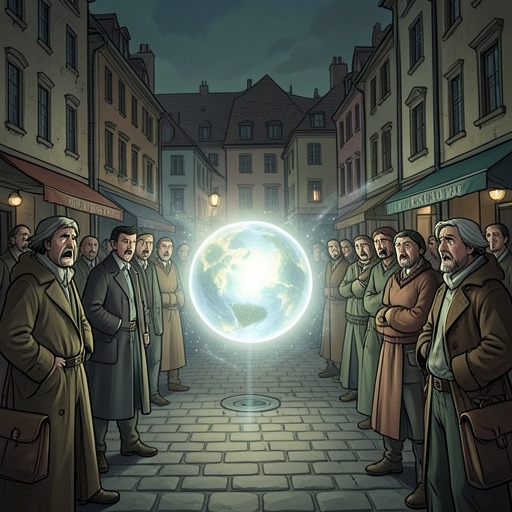
The TommyknockersThe Shed People are the name Jim Gardener gives to the inhabitants of Haven whose minds have become linked through the town’s transformation. Their defining power is not simply that they can hear or transmit thoughts: when danger threatens the ship, their separate voices combine into an authoritative command that mobilizes the whole community. The name captures both the network’s collective character and its coercive force. Ordinary residents become agents of a shared will, while the distinction between neighborhood, surveillance system, and pursuing mob grows perilously thin.
Identity and Formation
The Shed People are not presented as a formal organization with a membership roll or a single visible leader. They are a network of Haven residents, connected by the same alien influence that has altered the town. Gardener’s name for them emphasizes the machinery of collective action: many minds can contribute to one voice, and that voice can reach people who are not physically together. The network’s unity is real, but it does not make its members’ actions ethically neutral; it enables coordinated decisions and violence on a town-wide scale.
The evidence also shows the network working through practical systems rather than through mental contact alone. In one episode, local residents gather information from the minds of Benton Rhodes and Jingles Gabbons and relay it to Buck Peters, who impersonates dispatcher Tug Ellender over a radio. The real transmissions are redirected through a garage, and Andy Baker adds static to blur the substituted voice. The deception succeeds partly because the officers hear the expected answers in what they believe is Tug’s voice. Mental access, human mimicry, radio equipment, and the listeners’ expectations work together: the Shed People’s influence reaches beyond private thought into the town’s communications and its ability to mislead outsiders.
Information and Control of Haven
The network’s power is also visible in what residents know and what they do with that knowledge. When Ruth McCausland goes to the post office after three days without personal mail, Nancy Voss stands behind the counter without expression. Ruth hears an unexplained humming and spiderlike scritching from a device in the office; it sorts the mail, while the absence of letters leaves her cut off from ordinary contact. The scene makes control feel mundane. It does not arrive as a public decree: it is embedded in an everyday service and in the town’s newly blank social encounters.
Ruth’s attempt to leave reveals how uncertain the boundary around Haven has become. As she drives onto Derry Road, the rustling voices recede, but she expects a pursuit and keeps checking the rearview mirror. At the town line, she tries to reason against the idea that the inhabitants have enclosed the place inside a barrier. The evidence initially seems to support her skepticism: traffic passes, a chicken truck heads toward Derry, and Nancy Voss drives by in a Chevy Vega. Yet visible openness does not restore freedom. Ruth’s fear of being brought back, and the town’s continued pressure on her even after she has crossed the line, show that control can operate through shared attention and expectation as well as through a literal obstruction.
The same tension between apparent access and covert restriction shapes the decision made when John Leandro approaches Haven. Dick Allison and Newt Berringer want the town closed, but they do not want outsiders to encounter an inexplicable barrier, turn around, and report it to the wider world. In the confusion of the morning, they leave a route open; Leandro therefore crosses the town line without difficulty, unaware that roads elsewhere could have been blocked by force fields. The Shed People’s defensive system is not omnipotent or perfectly consistent. Its decisions can create openings as well as barriers, and a deliberate effort to hide the boundary allows an outsider to enter.
Coordinated Action and the Final Command
The network’s most decisive demonstration comes when its members respond to Gardener’s danger to the ship. After a sequence of other mental voices falls silent, Dick Allison’s thought rises, shaken but clear: everyone should go to Bobbi Anderson’s farm and stop Gardener before he can do anything else. Hazel’s voice joins it, then Kyle’s; the call expands through the addition of Adley and Newt Berringer. What begins as one person’s urgent thought becomes a growing chorus, each voice reinforcing the others until the command has the force of a single voice that cannot be denied.
The command’s meaning is explicit and repeated: Gardener must be stopped before he can act against the ship. The network’s apparent unity is therefore organized around defending the alien craft, not around protecting each resident’s independent judgment. The urgency passes directly from thought into movement. Rosalie Skehan leaves the cod she is rinsing in the sink and joins her husband; they get into their car and head for the farm. Elt Barker leaves his gas station on his Harley, while Freeman Moss sets out in his pulp truck. Andy Bozeman drives with his wife, who carries a molecule-exciter capable of raising the temperature of a small target by roughly one thousand degrees in fifteen seconds. She hopes to get within five feet of Gardener, the distance at which she believes the device will work reliably. A stream of cars and trucks converges on the same destination.
These details make the network’s violence concrete. Its members do not merely hear an alarming message: they interpret the command as a summons to take part in an attack, bringing vehicles and weapons toward Bobbi Anderson’s farm. The impulse to defend the ship is distributed across ordinary routines and familiar local identities. A kitchen chore is abandoned, a gas station is left behind, and private resentments travel alongside the collective order. The network can unite its members without erasing the individual attitudes that shape what each person hopes to do once they arrive.
Gardener and the Collective Voice
For Gardener, the Shed People’s voice is both a warning and proof that the pursuit has begun. Injured and in extreme physical distress, he hears many voices blend into one and recognizes the source. The command that reaches the town is heard from the other side as a promise of capture: they are coming, as he had suspected they eventually would. The mental chorus closes distance before the pursuers necessarily reach him; it lets him know that the town has aligned itself against him and that remaining where he is will leave him vulnerable.
The network’s message drives him to move despite his condition. He has fallen, is struggling to get up, and fears that if he remains on the floor the approaching residents may shoot or disintegrate him. He uses the counter to rise, while the collective demand to stop him continues in his mind. This episode establishes the practical asymmetry between the many and the one: the Shed People can distribute a command across Haven, while Gardener has to respond alone, hurt and physically weakened.
Meaning and Limits
The Shed People embody the transformation of a community into a connected system of knowledge and enforcement. The same collective mental access that can gather intelligence and coordinate deception can also suppress personal communication, constrain escape, and direct a crowd toward violence. No single scene makes every resident interchangeable: Ruth confronts Bobbi Anderson’s altered behavior directly, and the later pursuit carries the particular motives and equipment of its participants. But the network can make individual decisions converge, converting many local actions into one campaign.
Its power depends on circumstances and judgment rather than on an all-seeing, flawless enclosure. Ruth can drive out of town; Leandro can enter because the expected barrier is not set across his route. Yet neither apparent opening undoes the larger control exerted by the town’s shared minds, concealed communications, and rapid response to perceived threats. The Shed People’s final command crystallizes the danger at the center of that system: a collective bond can produce coordination so complete that dissent disappears, while the people obeying it still arrive as recognizable individuals, each carrying an ordinary vehicle, a personal grievance, or a weapon of their own.