Tommyknockers
The TommyknockersThe Tommyknockers are the dead beings associated with the buried spacecraft in Haven and, more importantly, the invasive force that returns through it to alter human bodies and minds. Their nursery-rhyme name makes them sound like local folklore, but their influence turns an excavation into a town-wide transformation: people gain extraordinary powers even as their shared thoughts, machines, and loyalties become instruments of an alien presence. The novel eventually complicates the idea of a discrete alien race, presenting the Tommyknockers as interstellar wanderers and a recurring process of regeneration that can use a population as its host.
Name, Legend, and First Signs
The name reaches the story through a rhyme about knocking at the door, a deceptively simple verse with an older folkloric history. The word has been associated with tunneling ogres and with ghosts said to haunt abandoned mines or caves. A dictionary account also links “tommy” to army rations and speculates that the figures might be starving dead miners still knocking for food and rescue. That tradition gives the name an apt double edge: the Tommyknockers seem to come from underground, and their arrival carries the suggestion of something dead that has not stopped calling.
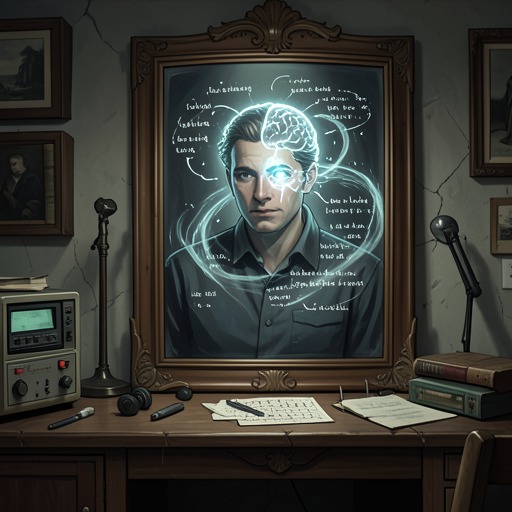
At first, the word is less a settled explanation than a name forming around an encounter. As Jim Gardener looks at Bobbi Anderson’s modified typewriter, its green light prompts him to wonder who “they” are. The answer that rises in his mind is the Tommyknockers: a name that feels adequate precisely because no better one is available. Bobbi later identifies their origin more directly, telling Gardener that the Tommyknockers came from space. She believes the physical beings themselves died long before humanity existed, but distinguishes them from what persists, comparing that persistence to a dead singer whose performances continue on records. The distinction between dead bodies and an active legacy becomes central to understanding the threat.
The rhyme recurs as a mental refrain, linking the beings to different stages of the town’s change. Hilly Brown associates his disappearing trick with the Tommyknocker Man; later, he states clearly that David is on Altair-4 and joins the old rhyme to that revelation. The words are not simply a children’s verse attached to a monster. They become a portable signal, carrying knowledge of the alien presence between people and across episodes of the town’s transformation.
The Ship and the Return of the Force
Bobbi’s discovery of a metal object buried for millennia begins a chain of events that reaches beyond her excavation. The object gives Haven’s residents powers beyond ordinary human capacities, while the town becomes dangerous to outsiders. The change is described not as a bargain freely made by the townspeople but as a takeover of body, soul, and mind. Although the Tommyknockers are called real in the novel’s framing, their reality does not depend on the original crew being alive: the buried craft holds a force capable of returning through contact with human beings.
The excavation makes that return visible and material. During an eight-day heat spell, the sound of Bobbi’s rebuilt truck carries into the village, and townspeople understand that something important is happening at the old Frank Garrick place without discussing it openly. Nearby, Justin Hurd’s “becoming” drives him to build dangerous devices, including one that produces harmonic waves in the earth’s crust and could trigger a catastrophic earthquake. In Haven, a communal pool of knowledge also emerges, so that thoughts become something residents share rather than private possessions. Ruth McCausland recognizes the contradiction at the heart of the process: the force from the excavation galvanizes the town while making it a prisoner, and its influence is growing stronger.
The transformation is not a smooth conversion. Each person’s human mind struggles against the alien group mind that is welding the residents together; the contest can break down into madness. The town’s shared understanding describes this unstable interval as a necessary stage of acceptance, the “dance of untruth.” That phrase captures a community trying to accommodate an invasion while the boundary between its own thoughts and the outsiders’ influence becomes increasingly difficult to hold.
The force announces itself through the shed’s green light and the machines gathered around the excavation. When the shed is opened, the brilliant light seems to dim the sunlight, while a churning sound suggests machinery without quite resembling it. Kyle and the others understand the scene as evidence that the two-hearted nature of the Tommyknockers is drawing together. Elsewhere, Bobbi’s excavation has become a vast industrial operation: a ragged cut stretches more than three hundred yards and reaches sixty feet across at its widest, surrounded by a modified truck, a payloader, a chainfall, a chipper, and fuel stores. This is not ordinary logging, but the physical work of uncovering a power source that has already begun to change the people around it.
Human Hosts and the Shared Mind
The Tommyknockers’ power does not stop at the excavation. Their influence takes hold in the minds of Haven’s residents, turning private thoughts into a town-wide network. Ruth’s sleep is crowded with ordinary worries and fantasies alongside ideas for machines and power; underneath them she recognizes a stream of thoughts that does not belong to the people she has known. She identifies those voices as outsiders’—the Tommyknockers’—and understands that the invasion is present even where no alien body can be seen.
The process also changes the town’s understanding of its own citizens. During “becoming,” the human mind and alien mind coexist, with the shared intelligence gradually welding individuals together and threatening to eclipse them. Affected residents may accept this new state as their own, even as the human mind resists it. Ruth’s dolls tell her that her brain, like those of other Haven residents, is changing. The reassurance that this is merely the familiar invasion from science-fiction films offers no comfort: the invaders are visible in the eyes of people around her, including her own.
The altered residents can mistake the consequences of their transformation for a conventional alien emergence. When water rises, one man cries that the Tommyknockers were not dead and are coming out; Gardener corrects him that it is water. The exchange shows how completely the name has become an all-purpose explanation for what the town fears, even when the immediate event has another cause. The uncertainty is not that the influence exists, but how to distinguish its many effects from the beings or mechanisms supposedly behind them.
Ruth manages to send a signal, and Gardener receives at least part of it. He remains committed to Bobbi’s project but grows uneasy enough to drink increasingly. His lie becomes evidence that Ruth’s warning has reached him, though not enough to free him from the work or its influence. The signal therefore marks a limited breach in the collective pressure: information can pass between resistant individuals, but recognition does not immediately become escape.
The Dead Crew and the Limits of the Name
When Gardener enters the ship, the Tommyknockers become more than a name for the effects spreading through Haven. He finds the crew’s bodies thrown into a far corner, apparently after the craft struck the ground while its occupants were gathered around what may have been a telepathic steering mechanism. He counts four bodies, one in two pieces. Their long-snouted faces, cataract-white eyes, transparent scaly skin, and six-fingered hand still gripping a circular-bladed implement establish that the beings were physical, though radically unlike humans. Their wounds suggest a violent crash, but Gardener does not believe a simple mechanical failure explains it.
Seeing the dead crew lets Gardener connect the original beings to the people undergoing “becoming” without treating the transformed humans as identical copies. Bobbi and the others may not come to look exactly like the ship’s occupants; environment or differences in the host population may alter the result. Yet he sees a close resemblance. The ship’s crew is therefore not a living population emerging intact from the wreck. It is a material record of the beings whose force has persisted and whose pattern is being reproduced through new hosts.
Bobbi’s later explanation unsettles even that account. She says there is not really an Altair-4 in the ordinary sense, just as there are not really Tommyknockers as a stable people. These are names applied in different places to things that simply exist; Altair-4 is a place where things are stored, usually not living things, and the image of a cold, dark attic gives the name a functional rather than planetary meaning. She rejects the idea that the force represents a conventional race or species arriving from a familiar science-fiction civilization.
In her account, the Tommyknockers have no written or oral history. Bobbi accepts that the ship may have crashed because its occupants were effectively fighting over its steering, but she also entertains the possibility that the crash was guided by larger currents in the universe. Telepaths may be partly precognitive, she suggests, and therefore more likely to be carried along by those currents. When she uncovered the ship, the force returned. Her explanation does not make the event harmless or fully comprehensible; it replaces a straightforward alien genealogy with an unsettling idea of recurrence, storage, and return.
Town-Wide Consequences and Narrative Significance
As the transformation advances, the Tommyknockers’ influence reorganizes Haven as a collective body. Residents share a mental “party-line,” and during a vulnerable period of regeneration they accept messages from the Shed People, the clearest distillation of the town’s altered consciousness. The community turns toward closing its borders. Its force-barriers are built from devices that can be activated mentally with simple electronic instruments called Callers, and the residents treat the perimeter as part of the natural cycle of their transformation. The borders have to be sealed; this time, that moment has come early, but not too early.
The process also exposes the danger of tools whose makers do not understand what they have built. The transformed beings can construct elaborate machinery, but their technical ability is not matched by comprehension. The ship reaches out to the town’s mental network and uses it to obey the Controller’s command, “WARP SPEED,” a concept clear to the ship’s organic-cybernetic circuits even though those words are not in its vocabulary. The residents’ shared mind, formed under the Tommyknockers’ influence, becomes a channel through which a larger power can act.
The final consequences are severe. The Tommyknockers take heavy losses: fifteen are flash-fried in Bobbi’s yard, while Bobbi is dead, Kyle is dead, and Adley is expected to die soon. The transformer is destroyed just as the closing of the borders makes it critically needed, yet Gardener remains alive. The outcome ties the alien force to both extraordinary construction and sudden vulnerability: a network capable of transforming an entire town can still be disrupted at a decisive point.
The name itself remains deliberately inadequate. Gardener calls the Tommyknockers cavemen from space, builders whose long claws operate machinery they do not understand; Bobbi denies that they are a people or species at all. Both views illuminate part of the danger. The beings are associated with an ancient craft and a dead crew, but the greater threat is the force that survives them: a power that can awaken through excavation, remake human minds, collect them into a network, and use their new capacities for purposes beyond their understanding. The nursery rhyme’s knocking is thus less a description of a visitor at the door than a warning that the boundary between the visitor and the people inside can disappear.