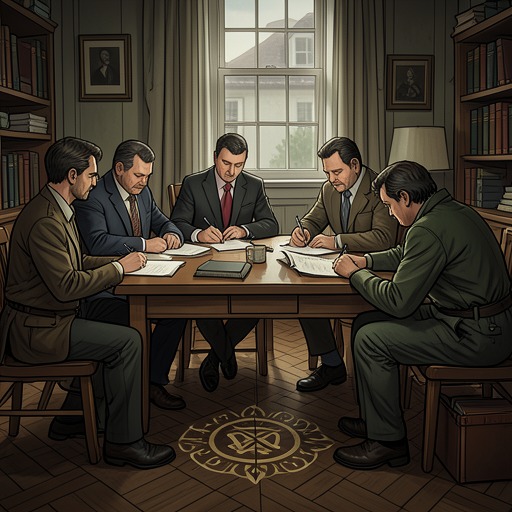
Tommyknockers nursery rhyme
The TommyknockersThe Tommyknockers nursery rhyme is a children’s couplet that becomes one of the novel’s most persistent warnings: as Jim Gardener and the people of Haven encounter the force associated with the buried spacecraft, its knocking rhythm recurs in speech, thought, and machinery. The rhyme gives an old, childlike form to an approaching danger, while its variations connect Gardener’s resistance, Bobbi Anderson’s transformation, and the town’s collective change.
Form and First Recurrence
The central couplet begins, “Late last night and the night before,” and answers its own repetition with “Tommyknockers, Tommyknockers, knocking at the door.” Its simple meter and repeated name make it sound like a nursery chant, but in Gardener’s circumstances the knocking is not merely playful or quaint. At Arcadia Beach, he wakes after nights of drinking and recites the familiar lines. A boy there surprises him by adding a second couplet he has never heard: “Wanna go out, dunno if I can, cause I’m so afraid of the Tommyknocker man.” The boy says he learned it from his mother when he was a baby, giving the rhyme a life beyond Gardener’s immediate experience. The exchange makes the warning seem older and more widely transmitted than a phrase invented in the moment, even as the story leaves the couplet’s history unexplained.
The nursery rhyme’s childlike voice contrasts with the adult circumstances around it. Gardener is injured, disoriented, and trying to understand what is happening to him; the boy responds with a verse that turns fear into a singsong refusal to go out. The rhyme’s simplicity does not explain the threat. Instead, it makes the threat portable: a child can repeat it without understanding its full implications, while Gardener hears in it a pattern that his own experience has made ominous.
Gardener’s Warning and Bobbi’s Danger
As Gardener walks, the pain in his head seems to beat time to a longer, altered version of the rhyme. It begins with the original opening and refrain, then turns into a personal account: “I was crazy and Bobbi was sane / But that was before the Tommyknockers came.” In this variation, the nursery verse becomes a measure of reversal. Gardener’s former belief that he was the one whose mind could not be trusted is set against Bobbi’s changed condition, and the rhyme marks the arrival of the Tommyknockers as the dividing line between before and after.
The verses do not provide a calm explanation. Gardener asks himself what the Tommyknocker business means, but the answer comes instead as the urgent message “Bobbi’s in trouble!” The rhyme and the warning arrive together, making its repeated sounds part of the way danger reaches him. He moves faster, despite his condition, and the walk ends with his nose bleeding again. The couplet therefore works both as an omen and as an alarm: it accompanies Gardener’s bodily distress while pushing him toward action on Bobbi’s behalf.
The association recurs when Gardener stands beside the Tomcat with its engine compartment open. He shudders, pale and sweating, as the nursery words return in a tumbling sequence of taps and knocks. The passage folds the rhyme’s door-knocking refrain into the machine he is inspecting, while an accompanying thought links the Tommyknockers with fixing the water heater and the Tomcat. The child’s couplet has become entangled with the practical, mechanical changes surrounding the buried presence. Its sound is no longer confined to a remembered song; it accompanies the altered devices and the work that binds Gardener and Bobbi to the discovery.
The Rhyme in Machinery and Domestic Life
The rhyme’s most startling recurrence comes through Gardener’s telepathic typewriter. Its keys rattle, letters form words, and those words assemble the opening couplet. Gardener screams. A nursery rhyme that had already entered his speech and thoughts now appears through a machine, without his choosing to compose it. The progression from remembered verse to involuntary mental rhythm to typed words gives the refrain an increasingly external presence: it seems to speak through whatever channel is available, including technology altered by the events around the excavation.
Elsewhere, the rhyme touches ordinary domestic life in a different register. The 3-D portrait of Jesus kept on the Paulsons’ television has occupied roughly the same place for years, first on one television and then another. When the image speaks to ’Becka, it exposes Joe’s affair with a postal employee and says that there is much else happening in Haven that she does not know. This is not a direct occurrence of the nursery verse, but it places the rhyme’s strange familiarity alongside another example of the uncanny entering household objects and everyday speech. The contrast helps clarify the refrain’s function: in this story, an old, ordinary form can carry news of a danger that the listener has not yet grasped.
The distinction between an inherited folk expression and a supernatural message remains deliberately uneasy. The boy’s report that he heard the couplet from his mother suggests it existed before Gardener’s beach encounter, but the novel does not establish who first made it or how it became connected to the events in Haven. Its familiarity may precede the immediate crisis; its repeated appearances nevertheless make it feel newly charged. The rhyme’s power comes from that overlap, not from a definitive account of its origin.
From Private Refrain to Shared Warning
The rhyme’s repeated image of something knocking at a door resonates with Haven’s larger pattern of knowledge arriving without invitation. Ruth McCausland realizes that she and others have been knowing things they had no right to know, and that this apparently natural ability is changing the town for the worse. During the search for David Brown, the townspeople’s minds link instinctively, but their shared mental reach cannot find him: he is not lost so much as “not-there.” Against these developments, the rhyme’s knock becomes an apt image for the boundary between familiar life and an intrusion that people cannot simply dismiss. This is a thematic correspondence, rather than evidence that the verse itself causes the town’s transformation.
As Haven changes, the community’s collective mental life is not a simple source of harmony. During the search for David, the heat, darkness, and difficult terrain accompany mounting conflict, including fistfights among the searchers; mental communication has not made them peaceful or cooperative. After the explosion, residents can act as a network of silent voices while continuing their separate tasks. Much later, Bobbi’s screams stop the town and bring the changed residents into the streets, where shared awareness gives way to dismay, pain, horror, and anger. The rhyme’s movement from one man’s pained thoughts to words emitted by machinery anticipates this widening scale of involuntary communication, without becoming a literal account of every event in the town.
Its folk name also fits a story in which names are acknowledged to be unstable labels. When Gardener confronts the being that looks like Bobbi, it explains that the Tommyknockers are not a people, race, or species, and that “Tommyknockers” is simply the name they acquired because Gardener came back from New Hampshire thinking and talking about them. It likewise describes Altair-4 not as a homeland but as a place where things are stored. That explanation gives the rhyme’s familiar name a new context: the verse supplies a human label for something that does not fit ordinary categories, but the label cannot make the thing fully understood.
Meaning and Narrative Function
The rhyme does not serve as a neat code that can be translated once and for all. Its words recur in different forms and at different points: the familiar couplet is spoken on the beach, expanded by a child’s verse about fear, revised into Gardener’s comparison of his and Bobbi’s states of mind, and reproduced by the telepathic typewriter. Each recurrence changes its emphasis. The child’s version gives fear a voice; Gardener’s version names the reversal in his relationship to sanity; the typewriter makes the words seem to have escaped private memory and entered the material world.
Its most consequential message is therefore not a secret answer but a pressure to recognize change. The refrain connects a remembered children’s song to Gardener’s pain, Bobbi’s danger, the transformation of machinery, and the strange knowledge circulating through Haven. Repetition makes the warning memorable, yet never makes it safe: the song can be known before its meaning is understood. By letting a nursery rhyme carry both the comfort of familiar rhythm and the threat of something knocking to be let in, the novel turns folk expression into an instrument of foreboding rather than explanation.