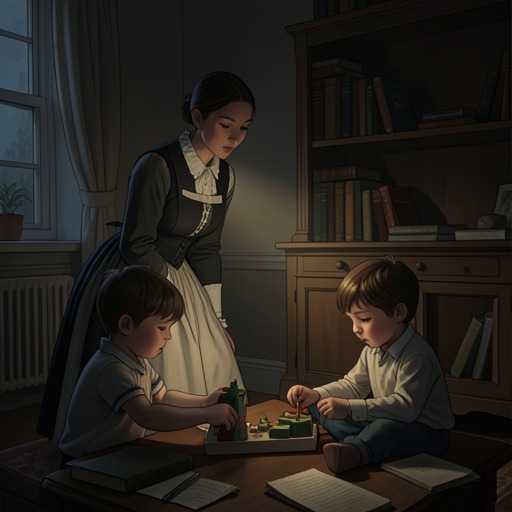
Corruption of childhood innocence
The Turn of the ScrewCorruption of childhood innocence is the moral crisis the governess believes she must confront in Miles: she casts his soul as something Peter Quint has possessed and herself as its defender. At the climax, the boy’s confession appears to confirm her account, but his death turns her triumph into an unbearable ambiguity. The scene offers no independent proof of what Miles said or remembered; instead, it binds the language of rescue to the consequences of the governess’s certainty.
The Governess’s Rescue Narrative
The governess experiences her confrontation with Quint as a struggle for a human soul. When Quint appears outside the window, she draws Miles close and deliberately keeps his back to the glass. She understands her task not simply as making the boy see the apparition, but as facing it herself while preserving his unawareness. In her mind, shielding Miles from the sight is an act of protection, and the struggle becomes one between Quint’s claim and her own devotion.
Miles then says, “Yes—I took it.” The governess receives the admission with joy and enfolds him against her, feeling the fever in his body and the beat of his heart. She keeps watch on Quint, whose movement at the window shifts from the posture of a sentinel to the prowl of a baffled beast. To the governess, the scene seems to establish that she has won the boy away from him; the embrace makes that supposed victory physically intimate and immediate.
A Confession That Does Not Resolve the Past
The details Miles can provide about his school scandal are partial. Asked whom he repeated his words to, he cannot remember names. He says they were only a few, and that they were boys he liked. The governess, who has been pressing him for an explanation, is startled by the possibility that he may be innocent. His answer does not disclose what he said, establish its meaning, or show that Quint caused it.
That uncertainty briefly interrupts the governess’s confidence. She lets Miles move away, and he turns toward the clear window. The exchange therefore leaves two questions entangled: what Miles did at school, and whether the governess’s account of supernatural corruption explains it. His lost recollection and the limited scale of the incident resist the complete confession she seems to seek, even as she continues questioning him.
The Name and the Reversal
The governess finally calls out Quint’s name. Miles asks where Quint is, but when the governess declares that Quint has lost him forever, Miles turns and sees only the quiet day. The governess treats this as the demonstration of her work: she believes that the boy has recognized the threat and that she has prevailed. Yet the apparition is visible to her alone in this final instant, leaving the supposed victory dependent on her interpretation of Miles’s reaction.
Miles cries out as though falling into an abyss, and the governess catches him. The movement that seemed to complete a rescue becomes the scene of his death: after holding him, she realizes that his heart has stopped. Her language of possession and dispossession thus changes its force. What she understands as the recovery of a child from Quint ends with Miles’s life extinguished in her arms.
The Theme’s Unresolved Ending
The climax does not settle whether Miles was corrupted by Quint, whether his school misconduct had a supernatural cause, or whether the governess has mistaken her own certainty for knowledge. The boy’s brief confession appears to support her belief, but its content remains indistinct; his inability to remember names and the governess’s sudden fear that he may be innocent keep another reading open. The narration presents her conviction and its consequences without supplying an independent account that would confirm it.
In this ending, innocence cannot be cleanly distinguished from corruption, nor rescue from harm. The governess believes she has won Miles’s soul at the very moment he dies, and the final image of his stopped heart makes the cost of that belief irreversible. The theme’s force lies in that contradiction: the child is represented both as the object of an attempted salvation and as a life the would-be rescuer cannot save.